Beat the Korean Crowd Calendar -- Best Times to Visit Popular Destinations
The Double-Overlap Problem
Korean workers have predictable vacation patterns: Seollal, May Golden Week, summer break, Chuseok, Christmas. Flight prices from Incheon surge like clockwork during these windows.
But there's a less obvious problem: destination-local holidays often overlap with Korean holidays, creating a double crowd effect. May Golden Week in Korea coincides with Japan's Golden Week -- hotel prices in Osaka and Kyoto jump 80–100%. February Seollal overlaps with Chinese New Year, making all of East and Southeast Asia more expensive.
The sweet spots are months where:
- Weather is good at the destination
- No major Korean holidays drive outbound travel surges
- No local holidays or peak seasons at the destination
The Heatmap
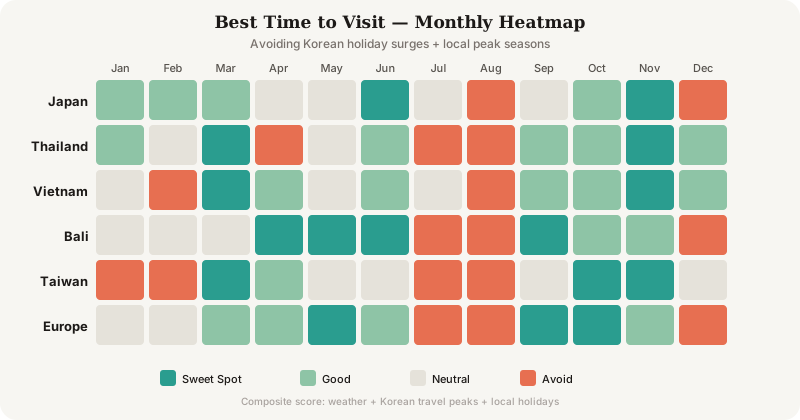
Each cell is scored on three layers: weather quality (35%), Korean crowd avoidance (35%), and local crowd avoidance (30%). Teal = sweet spot. Coral = avoid.
Japan -- June and November
Japan is the #1 outbound destination for Korean travelers. Every Korean holiday sends a wave of tourists to Tokyo, Osaka, and Kyoto. Combined with Japan's own holiday calendar (Golden Week, Obon, Shogatsu), the overlap windows are brutal.
Sweet Spots
| Month | Why | Avg Temp | Daily Budget |
|---|---|---|---|
| Jun | Zero holidays on both sides. Rainy season, but rain is intermittent in Tokyo/Osaka. Hotels 20–40% cheaper | 26°C | ~$100 |
| Nov | Post-Chuseok, pre-Christmas. Peak autumn foliage in Kyoto. Quiet gap between Obon and Shogatsu | 17°C | ~$100 |
Avoid
- Late Apr–Early May: Japan Golden Week + Korean Golden Week = double peak. Shinkansen sold out, hotels 2x.
- August: Obon (Aug 10–18) + Korean summer break = coastal towns and onsen at capacity.
- Late December: Shogatsu (Dec 28–Jan 3). Most shops close. Ski resorts peak.
Thailand -- March and November
Thailand's cool-dry season (Nov–Mar) is ideal, but within that window, you need to dodge Songkran and the Seollal surge.
Sweet Spots
| Month | Why | Avg Temp | Daily Budget |
|---|---|---|---|
| Mar | End of dry season. Post-Seollal/CNY, pre-Songkran. No holidays on either side | 35°C | ~$50 |
| Nov | Cool season begins. Post-Chuseok, pre-Christmas. Bangkok and Chiang Mai at their most pleasant | 31°C | ~$50 |
Avoid
- April: Songkran (Apr 13–15) -- Thailand's biggest holiday. Traffic chaos, prices spike.
- February: Seollal sends a massive Korean wave to Bangkok and beach towns.
- Jul–Aug: Korean summer + Thai rainy season = wet and expensive.
Vietnam (Da Nang) -- March and November
Da Nang is one of the most popular Southeast Asian destinations for Korean travelers -- direct flights, cheap, visa-free. Every Korean holiday fills the Incheon–Da Nang route.
Sweet Spots
| Month | Why | Avg Temp | Daily Budget |
|---|---|---|---|
| Mar | Dry season, perfect beach weather. Post-Tet/Seollal, pre-Liberation Day (Apr 30) | 30°C | ~$40 |
| Nov | Dry season starts. Post-Chuseok, pre-Christmas. Hoi An lantern season | 27°C | ~$40 |
Avoid
- February: Tet (Vietnamese New Year) + Seollal = shops closed + flights full.
- Apr 30–May 1: Vietnam Liberation Day -- domestic tourism surge, Da Nang and Phu Quoc packed.
- August: Korean summer break + approaching typhoon season.
Bali -- April–June and September (Most Sweet Spots)
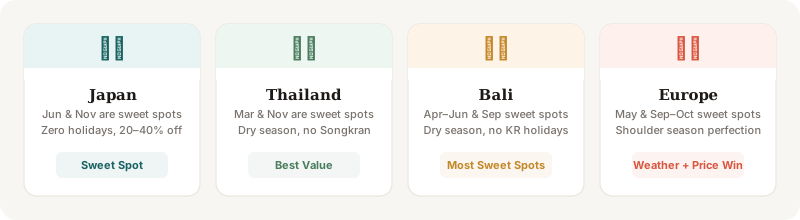
Bali's long dry season (Apr–Oct) creates the most sweet-spot months of any destination. Dodge Nyepi, the Korean summer peak, and the December global rush, and you'll find a quiet, affordable Bali.
Sweet Spots
| Month | Why | Avg Temp | Daily Budget |
|---|---|---|---|
| Apr–May | Dry season starts, post-Nyepi. Korean Golden Week doesn't reach Bali in force | 29–30°C | ~$50 |
| Jun | Perfect dry season. Zero holidays on both sides. True off-peak prices | 28°C | ~$50 |
| Sep | End of dry season. Post-Korean summer, pre-Chuseok. Great surf conditions | 28°C | ~$50 |
Avoid
- March: Nyepi (Balinese Day of Silence) -- 24-hour shutdown, no flights or transport.
- Jul–Aug: Global peak + Korean summer = Ubud/Seminyak fully booked, prices 60–100% up.
- December: Christmas/New Year global peak. Australian, European, and Korean tourists converge.
Taiwan -- March and October–November
Taiwan is just 2.5 hours from Incheon -- perfect for a 3–4 day trip. But it shares the Chinese cultural calendar (CNY, Qingming, Dragon Boat, Moon Festival), so there are more local holidays to navigate.
Sweet Spots
| Month | Why | Avg Temp | Daily Budget |
|---|---|---|---|
| Mar | Post-CNY, pre-Qingming (Apr 4). Spring weather, cherry blossoms start | 22°C | ~$60 |
| Oct | Post-Moon Festival and China Golden Week. Pleasant autumn weather | 27°C | ~$60 |
| Nov | Zero holidays. Comfortable weather, uncrowded night markets | 24°C | ~$60 |
Avoid
- Jan–Feb: CNY + Seollal = Taiwan is packed. Taipei hotel prices double.
- Early April: Qingming (Tomb Sweeping Day) -- domestic travel spike.
- June: Dragon Boat Festival -- 3-day weekend, high humidity.
- Jul–Aug: Korean summer + Taiwan peak = double crowd.
Europe (Mediterranean) -- May and September–October
Long-haul flights make timing critical -- a poorly timed European trip can cost $1,000+ more in airfare alone.
Sweet Spots
| Month | Why | Avg Temp | Daily Budget |
|---|---|---|---|
| May | Post-Korean Golden Week (2nd week onward). Pre-European summer. Barcelona 25°C, Lisbon perfect | 20–25°C | ~$140 |
| Sep | European summer ends. Pre-Chuseok. Rome and Dubrovnik still warm, 30% fewer tourists | 23–27°C | ~$140 |
| Oct | Southern Europe still warm (21°C). Post-Chuseok departure works perfectly. Portugal and Croatia at off-peak prices | 17–21°C | ~$140 |
Avoid
- Jul–Aug: European summer peak + Korean summer break = worst combination. Flights $1,500–2,500, hotels 2x.
- December: Christmas markets are charming but globally peaked. Accommodation books out 3 months ahead.
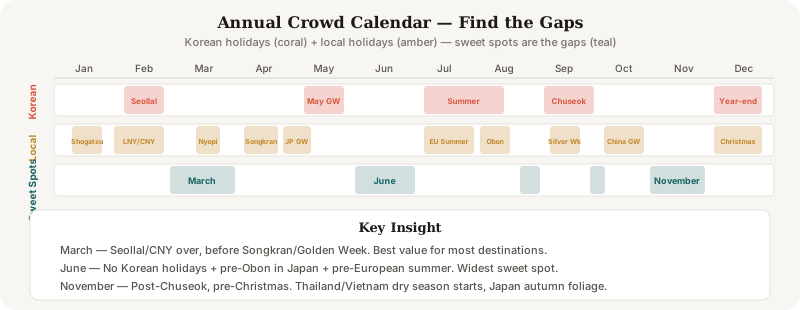
Annual Crowd Calendar
Cheat Sheet
| Destination | Sweet Spots | Hard Avoid | Why |
|---|---|---|---|
| Japan | Jun, Nov | Early May, Aug, late Dec | Golden Week + Obon + Shogatsu overlap with Korean holidays |
| Thailand | Mar, Nov | Apr, Feb, Jul–Aug | Songkran + Seollal + summer |
| Vietnam | Mar, Nov | Feb, Apr 30, Aug | Tet/Seollal overlap + Liberation Day |
| Bali | Apr–Jun, Sep | Mar, Jul–Aug, Dec | Nyepi + global peak seasons |
| Taiwan | Mar, Oct–Nov | Jan–Feb, Jul–Aug | CNY/Qingming + Korean holidays |
| Europe | May, Sep–Oct | Jul–Aug, Dec | European summer + Korean summer |
March, June, and November are the three golden months for Korean travelers. Prioritize your PTO around these windows for 20–40% savings and dramatically fewer crowds.
If You Must Travel During Peak -- Tips to Cut Costs
Sometimes you can't avoid the crowds -- school breaks, work schedules, family commitments. Here's how to soften the blow.
1. Flights: Book 90 Days Out + Fly Midweek
Peak-period flights are cheapest 90 days before departure. Switching from a Friday/Saturday departure to Tuesday or Wednesday saves 15–25% on the same route. Also check departures from Cheongju, Daegu, or Muan instead of Incheon -- budget carriers (Air Busan, T'way) often have the same destination for ₩100,000+ less.
2. Accommodation: One Stop Past the Tourist Center
Tokyo Shibuya → Nakano or Ikebukuro. Bangkok Sukhumvit → On Nut or Phra Khanong. Bali Seminyak → North Canggu or Sanur. Moving just one train stop or 10 minutes away from the tourist core drops hotel prices 30–50%. Use the map view on Booking.com to check nearby transit stops before booking.
3. Alternative Cities: Same Country, Different Crowd
When everyone flies to Osaka and Tokyo, Fukuoka, Kanazawa, and Hiroshima are comparatively empty. Bangkok → Chiang Rai. Da Nang → Ninh Binh or Da Lat. Taipei → Tainan or Hualien. Even during peak Korean travel windows, these alternatives have dramatically lower Korean tourist density and more authentic local atmosphere.
4. Local Transport: Buy Passes in Advance
Japan's JR Pass is cheaper when purchased online before arrival. Europe's Eurail Pass has early-bird discounts 2 months ahead. Thailand's Grab app prevents taxi scams. During peak seasons, local transport costs add up -- pre-purchased passes save ₩10,000–20,000 per day.
5. Food: Eat Outside the Tourist Radius
Search Google Maps for restaurants 500m+ from major attractions. Osaka Dotonbori ramen ¥1,200 vs a full set meal one block back for less. Bangkok Khao San Road pad thai 200 baht vs 50 baht in the next alley. Where locals eat is both cheaper and better.
6. Timing: Shift 2–3 Days Off the Exact Holiday
Moving your trip just 2–3 days before or after the exact holiday dates causes airfare to drop sharply. If Seollal is Feb 14–22, departing Feb 23 instead of Feb 12 can be 30–40% cheaper on the same route. Even using a half-day of PTO to shift your schedule pays for itself many times over.
Destination-Specific Money Traps -- And How to Avoid Them
Comparing airfare alone is misleading. Arrival time, airport location, and local transport quirks can add ₩100,000–300,000 in hidden costs. Here's what actually matters at each destination.
Japan: Arrival Time Is Money
Kansai Airport (Osaka): Korean Air and Asiana Osaka flights often land after 10 PM. The last Nankai Rapi:t to Namba departs around 23:30, the last JR Haruka around 22:50. Miss them and your options are:
- Airport taxi to central Osaka: ¥15,000–20,000 (~₩150,000–200,000)
- Airport hotel for the night: ¥5,000–8,000 (~₩50,000–80,000) plus a wasted first day
Jeju Air and Jin Air run afternoon departures on the same route, landing around 7–8 PM. Take the Rapi:t (¥1,490, 34 minutes) to Namba and you're eating dinner in Dotonbori by 9 PM.
| Item | Korean Air (22:30 arrival) | Jeju Air (19:00 arrival) |
|---|---|---|
| Airfare | ₩350,000 | ₩180,000 |
| Airport → city | Taxi ₩150,000 or hotel ₩70,000 | Rapi:t ₩12,000 |
| Total | ₩420,000–500,000 | ₩192,000 |
Fukuoka is the exception: The airport is 5 minutes by subway to Hakata Station (¥260, ~₩2,600). It's the only airport in Japan with a direct subway connection to the city center. Even arriving at 11 PM, you're in your hotel by 11:30. Just book the cheapest flight regardless of arrival time.
Narita vs Haneda (Tokyo): Korean LCCs (Jeju Air) mostly use Narita -- which is 60–90 minutes from central Tokyo. Narita Express costs ¥3,250, but the limousine bus (¥1,300~) is cheaper and often more convenient. Haneda is just 20–30 minutes from the city center -- if a Haneda flight exists at a similar price, take it.
JR Pass -- usually a bad deal now: After the 70% price increase in October 2023, the 7-day pass costs ¥50,000. A Tokyo↔Kyoto round trip on the Shinkansen is ~¥27,000. Unless you're riding the Shinkansen to 3+ cities, buying individual tickets is cheaper. For Osaka-only or Fukuoka-only trips, skip the JR Pass entirely.
Thailand: Two Airports, Very Different Logistics
Bangkok has two airports -- choosing wrong adds an hour and ₩30,000+:
- Suvarnabhumi (BKK): Korean Air, Asiana, Thai Airways. Airport Rail Link to city center: 45 min, 45 baht (~₩1,800). Last train: ~midnight.
- Don Mueang (DMK): Thai LCCs (AirAsia, Nok Air). Taxi to city: 200–300 baht (~₩8,000–12,000). No rail link.
Some Korean LCCs (T'way, Air Busan) use Suvarnabhumi, others use Don Mueang -- check which airport before booking. If your hotel is near Khao San Road, Don Mueang is closer. If it's in Sukhumvit/Siam, Suvarnabhumi + Rail Link is faster and cheaper.
Late arrival risk at Suvarnabhumi: The Rail Link stops around midnight. Korean Air's 11 PM arrivals cut it very close. Grab (ride-hailing app) is 10–20% cheaper than metered taxis and eliminates haggling.
Vietnam: Arrival Time Doesn't Matter -- Save Money Elsewhere
Da Nang airport is 3 km from the city center -- a 10-minute taxi ride costing 80,000–150,000 VND ($3–6). Even arriving at midnight, the taxi is $5. No airport hotel needed, ever. Just book the cheapest flight regardless of arrival time.
Where money actually leaks:
- Taxi scams: Skip the airport hawkers. Use Grab -- it's 10–20% cheaper than metered taxis with fixed pricing. Cash only (most taxis don't accept cards).
- SIM cards: Airport booth SIM cards cost 100,000–150,000 VND. Pre-purchased eSIMs or city convenience store SIMs are 30–50% cheaper.
- Currency exchange: Incheon airport rates are terrible. In Da Nang, gold/jewelry shops offer the best exchange rates -- significantly better than airport or hotel counters.
Bali: Defeating the Airport Taxi Mafia
Bali's Ngurah Rai airport has a notorious taxi cartel -- the official airport taxi counter charges 2–3x the normal fare to anywhere on the island.
How to pay normal prices:
- Grab: Now officially allowed at the airport with a dedicated lounge (air-con, WiFi, charging). However, Grab prices at the airport are set to match the taxi mafia -- so it's convenient but not cheap.
- The real savings move: Walk 10–15 minutes to the main road outside the airport and flag a Bluebird taxi (metered, honest company) -- half the price of airport taxis.
- Day hire a driver: If you're visiting Ubud, Uluwatu, and temples, hiring a private driver for a full day costs $30–40 (~₩40,000–55,000). Taking individual Grab rides to 3–4 spots costs $50+.
Hidden fees -- visa + tourism levy: Korean passport holders pay Visa on Arrival $35 (~₩50,000) + Bali tourism levy IDR 150,000 (~$10). Total: ~₩65,000 in fees at the airport. Apply for e-VOA online beforehand to skip the arrival queue.
Taiwan: Airport Choice Alone Saves an Hour
- Taoyuan (TPE): Most international flights and LCCs. Airport MRT Express to Taipei Main Station: 35 minutes, NT$160 (~₩7,000).
- Songshan (TSA): Inside Taipei city. Direct MRT connection. Some airlines use it. If you can find a Songshan flight at a similar price, take it -- you save 40+ minutes and the airport-to-hotel trip is under 20 minutes.
EasyCard (悠遊卡): Buy at any convenience store (NT$100 deposit). Works on MRT, buses, and convenience store purchases. Slight MRT fare discount over cash. HSR Tourist Pass is worth checking if you're heading to Taichung or Tainan.
Europe: The Hidden Costs Are Local, Not Airfare
No LCCs fly direct from Korea to Europe -- it's all 10+ hour full-service. The savings opportunities are after you land.
Tourist tax -- the cost nobody budgets for:
- Barcelona: €10–15 per person per night (doubled in 2025–2026)
- Rome: €3–10 per person per night (varies by hotel star rating)
- Lisbon: €2–4 per person per night
A 5-night stay in Barcelona adds €50–75 (~₩70,000–100,000) in tourist tax. This isn't shown on booking sites -- it's charged at check-in.
Intra-Europe flights -- use local LCCs: Barcelona→Lisbon, Rome→Dubrovnik -- Ryanair, EasyJet, and Vueling fly these for €20–50. But beware: only 7 kg carry-on is free. Checked bags cost €20–40 each way. Traveling with just a backpack saves €40–80 per flight.
Free museum days: Major European museums are free on the first Sunday of each month (Louvre, Musée d'Orsay, Prado, and more). Aligning your itinerary saves €15–25 per museum.
Universal: LCC Booking Tips
| Tip | Detail |
|---|---|
| Cheapest window | 6–8 weeks before departure (vs 8–12 weeks for full-service) |
| Flash sales | Jeju Air and Jin Air run monthly sales -- enable app notifications |
| Cheapest day | Tuesday/Wednesday departures are 15–30% cheaper than weekends |
| Cheapest time | 06:00 departures save ₩20,000–40,000 vs afternoon flights |
| Luggage hack | 3–4 day trips: carry-on only (7–10kg). Compression bags + local laundry + add return-only checked bag if you shopped |
Optimize Your PTO
Align your annual leave with these sweet spots automatically. All 2026 Korean holidays and substitute holidays are built in.
Next Step
Match this trip idea to your PTO
See which holiday windows make this trip easiest to book, then set reminders before prices move.
Plan this trip windowGet booking-timing and PTO planning emails
Related topics
Useful tools
Related Articles
Flight Delay Compensation, US vs EU: Who Actually Owes You Cash — EU261, UK261, DOT Refunds, and Canada's APPR
The same three-hour delay can be worth 600 EUR in Europe and zero dollars in the US. A research breakdown of EU261's fixed compensation tiers, the UK's post-Brexit clone, the US DOT automatic-refund rule, and Canada's APPR — plus how to file and the claim deadlines by country.
Annual vs. Per-Trip Travel Insurance: The Break-Even Math Nobody Shows You
How many trips per year does it take before an annual multi-trip travel insurance policy beats buying per-trip? The break-even formula, worked examples at realistic premium ranges, the per-trip length and cancellation caps annual plans hide in the fine print, and when your credit card already fills the gap.
The Best Time to Book International Flights: What the Booking-Window Data Actually Shows
Google Flights, Expedia/ARC, and Hopper publish real booking-window data — and they don't fully agree. A data-driven look at how far ahead to book by region, why the 'book on Tuesday' myth fails while the day you fly genuinely matters, and a price-alert workflow that beats any magic date.