ETIAS for US Travelers: What to Know Before Europe
Fact-checked July 2, 2026 · 5 sourcesHow we verify
If you have a Europe trip on the horizon, there is one new piece of paperwork that did not exist on your last visit: ETIAS, the European Travel Information and Authorisation System. For decades, US passport holders could fly to Paris, Rome, or Barcelona with nothing more than a valid passport. That is changing. Once ETIAS is live, visa-exempt travelers — Americans included — will need to register online and get an approved authorization before they board. This guide explains what ETIAS is, who needs it, what it costs, how long it lasts, and the one thing that trips people up most: it is not a visa.
This is a research post written with sources. The structural facts (what ETIAS is, the 90/180 rule, how it differs from a visa) are stable. The launch date, fee, and country list are still moving — the program has already been delayed more than once — so every date and price below is marked "approx." Confirm the current details on the official EU site in Sources before you book or travel.
What ETIAS Is — and What It Is Not
ETIAS is a travel authorization, not a visa. The closest US analogy is ESTA, the system foreign visitors use to enter the United States visa-free. You fill out a short online form, pay a small fee, and the EU runs a quick pre-screening against security and migration databases. If you clear, your authorization is linked electronically to your passport — there is no sticker, stamp, or embassy visit.
The distinction matters because the requirements, cost, and effort are worlds apart from a traditional Schengen visa.
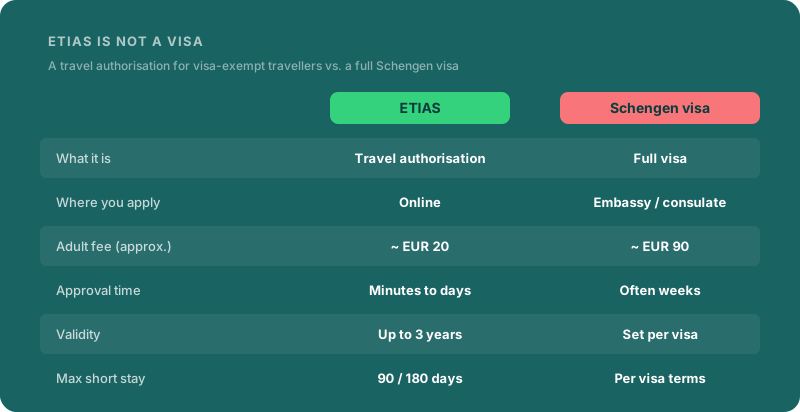
A few things ETIAS is not:
- It is not a visa. Visa-required nationals still need a full Schengen visa; ETIAS does not replace that.
- It does not guarantee entry. A border officer still checks your passport on arrival and can ask for proof of onward travel, accommodation, or funds. ETIAS is permission to travel to the border, not an automatic green light through it.
- It does not extend your stay. ETIAS travelers are still capped at the standard short-stay limit (more on that below).
When Does ETIAS Actually Start?
This is the question with the softest answer. As of mid-2026, the European Commission's stated target is for ETIAS to become operational in the last quarter of 2026 (approx.) — and the EU has said it will announce the precise start date several months ahead of time. The program has slipped repeatedly, so treat any date as provisional.
ETIAS is tied to a separate system called the EES (Entry/Exit System), the EU's new biometric border database (digital photo and fingerprints, replacing passport stamps). EES is the prerequisite, and it has been rolling out first: a phased introduction that began around October 2025 and reached full coverage at the borders by approximately April 2026. ETIAS follows once EES is fully bedded in.
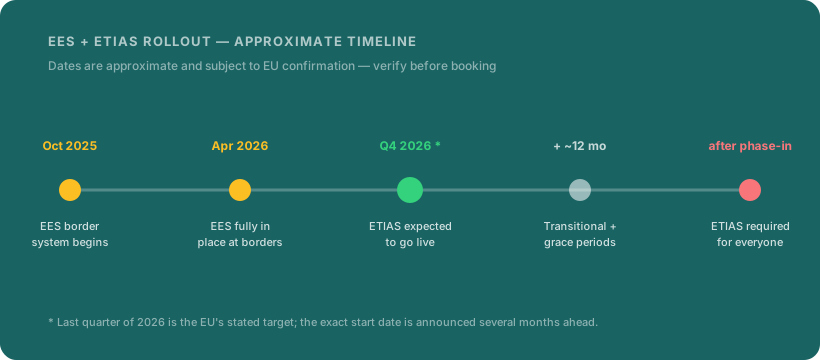
Crucially, ETIAS does not switch on overnight as a hard requirement. Expect a phase-in:
- Transitional period (approx. 6 months): ETIAS is live but not enforced — you can still enter without one if you meet all other entry conditions.
- Grace period (approx. 6 months): only first-time travelers to Europe are exempt; anyone who has visited since ETIAS launched needs an approved authorization.
- After the phase-in: ETIAS is mandatory for all visa-exempt travelers.
The practical takeaway: do not assume you can skip it just because a friend flew over without one shortly after launch. Once the grace period ends, the requirement is firm.
Who Needs ETIAS (and Who Is Exempt)
If you currently travel to the Schengen area visa-free, you will need ETIAS. That covers US citizens plus travelers from roughly 60 other visa-exempt countries (Canada, the UK, Australia, Japan, and many more). It applies to travel to 30 European countries (approx.) — essentially the Schengen-area members plus a few others such as Cyprus. Always check the official country list before relying on it; the roster has shifted as the Schengen area expands.
You will need ETIAS regardless of your reason for a short visit — tourism, business, visiting family, or transiting. A few notes on who is not charged or covered the same way:
- Children under 18 and travelers over 70 are exempt from the fee — but they still must submit an application and hold a valid ETIAS.
- Family members of EU nationals who qualify for that status may be exempt from the fee as well.
- Holders of certain residence permits or long-stay visas for a Schengen country generally do not need ETIAS for that country — but confirm your specific situation.
Don't forget the rest of Europe. ETIAS covers Schengen-area travel. The United Kingdom runs its own separate scheme, the ETA (Electronic Travel Authorisation), and Ireland is not in Schengen. A London-then-Paris trip can mean two different authorizations — plan for both.
Cost, Validity, and the 90/180 Rule
Here is the part most travelers actually want pinned down. The headline numbers, with the usual caveat that prices and rules can change:
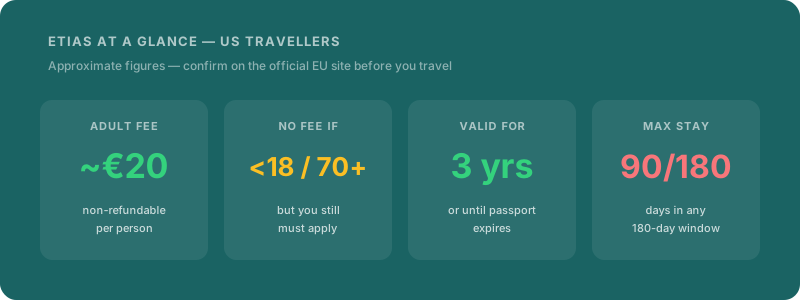
| Item | What to expect (approx.) | Notes |
|---|---|---|
| Application fee (adults 18–70) | ~ EUR 20 (about US$22–23) | Raised from EUR 7 in July 2025; non-refundable |
| Fee for under-18 / over-70 | EUR 0 | Still must apply and be approved |
| Validity | Up to 3 years, or until your passport expires | Whichever comes first |
| Entries | Multiple | Travel in and out during the validity period |
| Max stay | 90 days in any 180-day period | Across the whole Schengen area combined |
| Approval time | Often minutes; up to ~30 days if flagged | Apply ahead, not at the airport |
Two of these deserve a closer look.
The fee jumped — and it's per person
The EU originally floated a EUR 7 fee. On 17 July 2025, the European Commission confirmed the fee would be EUR 20 (approx.), citing operational costs, inflation, and alignment with comparable programs in other countries. For a family of four where two adults pay, that is roughly EUR 40 — modest, but budget for it, and budget for it per adult. The fee is non-refundable even if your application is denied.
The 90/180 rule is not "90 days per country"
ETIAS does not change Europe's core short-stay limit, and people misread it constantly. You may stay up to 90 days within any rolling 180-day window, counted across all Schengen countries together. Thirty days in France plus sixty in Italy uses your full allowance — there is no per-country reset. If your itinerary is long or you bounce in and out of Europe across a season, count carefully; overstaying carries real consequences at the next border.
How to Apply (and How to Avoid the Scam Sites)
The process is designed to be quick. You will need a valid passport, an email address, a payment card, and your travel details. Steps, in brief:
- Apply online on the official EU site (or the official mobile app) — not a third-party lookalike.
- Fill the form with passport data, contact and trip details, and background questions (security, prior immigration issues).
- Pay the fee (waived for under-18 / over-70).
- Wait for approval. Many applications clear within minutes; some take longer if a manual review or extra documents are needed — occasionally up to about 30 days.
- Travel. Approval is linked to the passport you applied with. If you renew that passport, you need a new ETIAS.
Apply early, and use the official site only. Travel authorities recommend applying at least a few weeks — ideally a month — before departure in case your case is flagged for review. And be alert to copycat websites: many third-party "ETIAS" sites charge a large markup on top of the real fee, and some are outright scams. The legitimate system is run by the European Commission at travel-europe.europa.eu/etias. If a site quotes a fee far above ~EUR 20 or pressures you to pay extra "service" charges, leave.
Plan the Trip Around It
ETIAS is a small administrative step, but it pairs naturally with the bigger planning questions: when to go and how many days off it actually takes. Once you know your authorization is sorted, the leverage is in the calendar.
- Use the leave optimizer to see how a handful of PTO days bridge into public holidays for a longer European trip on fewer vacation days.
- For when to fly, Europe's shoulder seasons line up cheaper flights and thinner crowds with the same authorization.
- Don't let a passport snag derail the plan — check your passport renewal lead time early, since ETIAS is tied to the passport you apply with and your authorization dies when that passport expires.
FAQ
Is ETIAS a visa?
No. ETIAS is a travel authorization for visa-exempt travelers, broadly similar to the US ESTA. It is faster, cheaper, and applied for entirely online, with no embassy appointment. Visa-required nationals still need a full Schengen visa — ETIAS does not replace it.
Do US citizens need ETIAS, and how much does it cost?
Yes. Once the system is live, US passport holders will need an approved ETIAS for short stays in the Schengen area. The fee is approximately EUR 20 (about US$22–23) for adults, and free for travelers under 18 or over 70 (who still must apply). Always confirm the current fee on the official EU site before applying.
How long is ETIAS valid, and how long can I stay?
An approved ETIAS is valid for up to 3 years, or until your passport expires — whichever comes first. It allows multiple entries, but your stay is still limited to 90 days within any 180-day period across the Schengen area combined.
When do I have to start using ETIAS?
The EU's stated target is the last quarter of 2026 (approx.), with a transitional period and grace period phasing in the requirement over roughly the following year. Because the date has been pushed before, check the official launch announcement before assuming you do — or do not — need one for your specific trip.
Sources
- What is ETIAS — Travel to Europe (European Commission, official) — definition, validity, 90/180 rule, fee, who applies
- Revised timeline for the EES and ETIAS — Travel to Europe (official) — official launch timeline and transitional/grace periods
- The European travel authorisation ETIAS will cost EUR 20 — European Commission, Migration and Home Affairs (17 Jul 2025) — the fee increase from EUR 7 to EUR 20
- Europe's Digital Border Entry and ETIAS Launching in 2026 — AFAR — launch context, EES relationship, traveler impact
- ETIAS / EES launch status — Fragomen (immigration law firm) — EES phasing dates and ETIAS transitional/grace periods
- What Are ETA and ETIAS, Europe's New Visa-Waiver Programs? — Rick Steves — practical traveler guidance and how ETIAS differs from a visa
The launch date, fee, participating-country list, and entry rules are volatile and have changed before. Verify every date and price on the official EU site (travel-europe.europa.eu/etias) before booking or traveling.
Next Step
Match this trip idea to your PTO
See which holiday windows make this trip easiest to book, then set reminders before prices move.
Plan this trip windowGet booking-timing and PTO planning emails
Related topics
Useful tools
Related Articles
New Mexico Travel Guide: Chile, Dunes, and Big Skies
New Mexico rewards drivers with white gypsum dunes, mile-high adobe cities, and green-chile everything, but the distances, altitude, and afternoon storms catch most first-timers off guard.
New York Travel Guide: Beyond the City, Into the State
New York is two trips in one: a dense five-borough metropolis and a huge upstate wilderness of gorges, six-million-acre forests, and lake-effect snow belts that most visitors never reach.
Iceland in November: The Off-Peak Window Before the Christmas-Market Surge
November is the last quiet window before Iceland's Christmas-market prices kick in. Here is exactly how it pencils out -- flights, hotels, Blue Lagoon, Ring Road access -- and how US holidays bridge into it.