Jet Lag: Why Flying East Is Harder Than West (and How to Beat Both)
Fact-checked July 2, 2026 · 6 sourcesHow we verify
You take the same flight, the same number of hours, just in opposite directions — and one trip flattens you for a week while the other barely registers. That is not in your head. For most people, flying east produces worse, longer-lasting jet lag than flying west, and the reason comes down to a quirk of how your internal clock keeps time.
This guide explains the circadian science in plain language, then turns it into a direction-by-direction playbook: when to chase daylight, when to hide from it, and how to use the one biological landmark that makes all the timing make sense.
This is a research post written with citations. The mechanisms (how your body clock works, why direction matters) are well established. The specific numbers — adaptation rates, recovery days, melatonin doses — are population averages with large individual variation, so we hedge them and flag them as "approx." Treat melatonin and any sleep medication as something to confirm with a clinician, not as medical advice. Primary sources are linked under Sources.
The one-sentence answer: your clock runs a little long
Left alone in a cave with no daylight and no clocks, the human body does not settle into a tidy 24-hour day. It drifts to roughly 24.2 hours — slightly longer than a real day (PNAS). To stay synced to the planet, your clock has to nudge itself earlier by a small amount every single day. Morning light does that nudging.
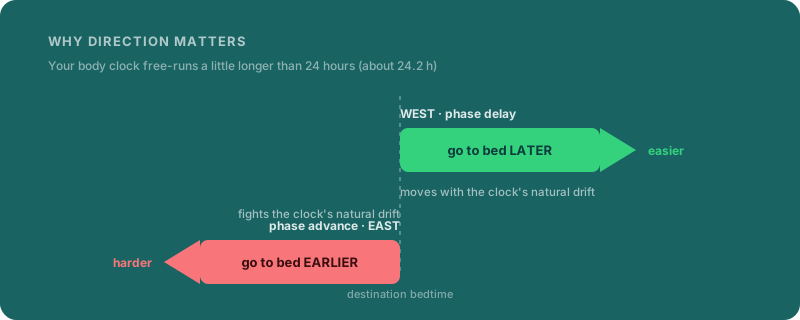
Here is why that one fact decides everything:
- Flying west (e.g. New York to Los Angeles, London to New York) asks you to stay up later and wake later. Your clock already wants to drift later, so you are pushing in the direction it leans. This is a phase delay — the easy one.
- Flying east (e.g. Los Angeles to New York, New York to London) asks you to fall asleep earlier and wake earlier. That fights your clock's natural drift. This is a phase advance — the hard one.
As the CDC Yellow Book puts it, "it is easier to delay than advance the circadian rhythm since the average period of the intrinsic circadian rhythm is slightly longer than 24 hours." The Sleep Foundation notes that roughly 75% of people find eastward travel harder (approx. — a minority genuinely find west worse).
Phase advance vs. phase delay, side by side
| Flying WEST | Flying EAST | |
|---|---|---|
| Clock shift needed | Delay (later) | Advance (earlier) |
| Works with your natural drift? | Yes — easier | No — harder |
| Day feels... | longer (extra hours) | shorter (lost hours) |
| Typical first nights | stay awake longer than you want | can't fall asleep, then can't wake |
| Light strategy | seek evening light | seek morning light |
| Example routes | US→Asia/Pacific, Europe→Americas | Americas→Europe, Asia→US west coast |
The cost is not just grogginess. A study of NBA teams found that eastward travel — not westward, and not raw distance — was associated with measurably worse on-court performance, which is what you would predict if the eastbound phase advance is the harder adjustment (NBA jet lag study, PMC).
How long it actually takes to recover
The old rule of thumb is about one day of recovery per time zone crossed — but that average hides the directional gap. Your clock can only shift so fast, and it shifts faster going west.
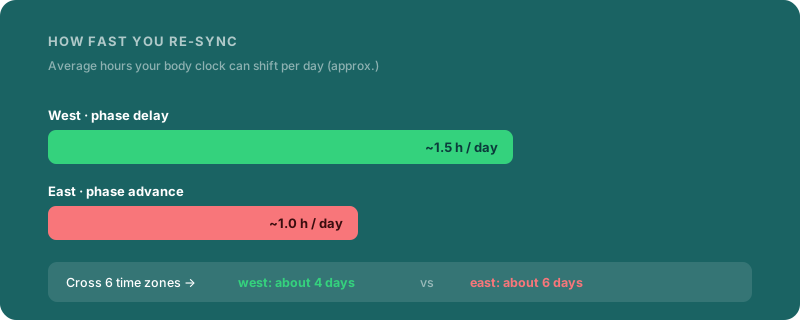
The CDC cites an average adaptation rate of approx. 1.5 hours per day going west versus approx. 1 hour per day going east (CDC). Run the math on a 6-time-zone trip and the asymmetry is stark:
| Time zones crossed | Going WEST (~1.5 h/day) | Going EAST (~1 h/day) |
|---|---|---|
| 3 zones | ~2 days | ~3 days |
| 6 zones | ~4 days | ~6 days |
| 9 zones | ~6 days | ~9 days* |
*Past roughly 9+ zones eastward, the shift is so large that some people's clocks re-sync the "long way around" (delaying ~15 hours instead of advancing ~9), which can make recovery even more erratic. These are population averages — your mileage will vary, sometimes a lot.
This is the single biggest reason to build a buffer day into your itinerary rather than land and go straight to a meeting or a wedding. If you are choosing dates, our annual-leave optimizer makes it easy to add a quiet recovery day on the back end of a long-haul trip without burning extra holiday — see also our long-haul flight timing guide.
Light is the master switch — aim it at your temperature minimum
Light is by far the strongest lever you have. But "get morning sun" is too crude, because the same light can shift your clock earlier or later depending on when you get it. The hinge point is your temperature minimum (CBTmin) — the moment your core body temperature bottoms out, roughly 2 hours before your usual wake time (Huberman Lab).
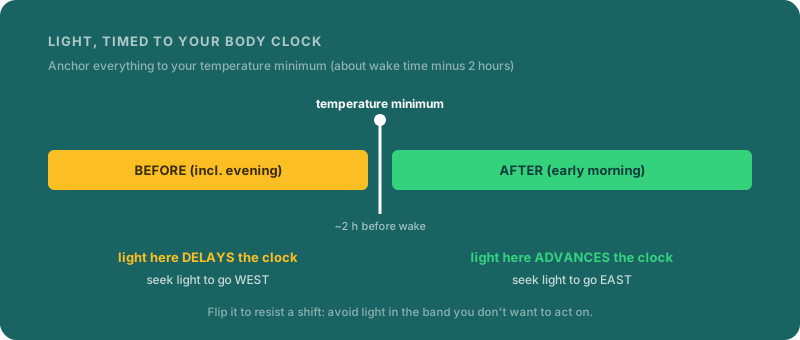
The rule is simple once you anchor to that point:
- Light in the hours after your temperature minimum → advances your clock (good for going EAST). The CDC describes this as bright light "following the circadian nadir (approximately 2–4 hours prior to habitual wake time)" promoting phase advances.
- Light in the hours before your temperature minimum, including evening light → delays your clock (good for going WEST).
If you want to resist a shift instead, do the opposite: avoid light in the band that would push you the wrong way (sunglasses on a bright morning if you are trying to stay on west-coast time, for example). The Wu Tsai Human Performance Alliance summarizes it as: going east, get morning light and avoid evening light; going west, avoid morning light and get evening light.
Your direction-by-direction playbook
You can start shifting before you fly. Moving your sleep by about an hour a day for 2–3 days pre-trip (earlier for east, later for west) shrinks the gap you have to close on arrival.
Flying EAST (the hard one): advance everything
- Pre-trip (2–3 nights before): go to bed ~1 hour earlier each night and get bright light right after you wake.
- On the plane: if it is nighttime at your destination, sleep. Block light (eye mask) — light at the wrong time will hold you back.
- Arrival morning: get outside for bright morning light, ideally 20–30 minutes, soon after a local wake time. This is the advance you need.
- Arrival evening: dim the lights early and avoid bright screens. Evening light delays your clock — the opposite of what you want.
- Melatonin (optional, with clinician guidance): a low dose taken in the evening can reinforce an advance. The CDC notes 0.5–1 mg is often enough and advises against high doses (>5 mg); the Sleep Foundation cites 1–3 mg taken a few hours before target bedtime. Confirm dosing and interactions with a clinician before your trip.
Flying WEST (the easy one): delay everything
- Pre-trip: go to bed ~1 hour later each night for a couple of nights; sleep in if you can.
- On the plane: try to stay awake if you are flying into daytime/evening at the destination; save sleep for destination night.
- Arrival evening: seek light in the late afternoon and evening to push your clock later. This is the one time "stay up and go out" is the science-backed move.
- Arrival morning: avoid early bright light at first (sleep in, sunglasses if you're up). Early light would advance you — the wrong direction for west.
- Melatonin: usually less necessary going west, since you are working with your clock, not against it.
What helps, what doesn't, and what to skip
| Tactic | West | East | Notes |
|---|---|---|---|
| Timed bright light | evening | morning | The single strongest lever |
| Low-dose melatonin | rarely needed | evening, low dose | Confirm with a clinician (approx. 0.5–3 mg) |
| Caffeine | morning only | morning only | Helps alertness; avoid within ~8 h of target sleep |
| Strategic napping | short, early | short, early | Cap at ~20–30 min so it doesn't wreck night sleep |
| Alcohol on the plane | skip | skip | Fragments sleep, worsens dehydration |
| "Just power through" | sometimes ok | risky | Eastbound deficits linger; protect the first nights |
For trips under ~2 days, the CDC's advice is often to not bother adjusting at all — stay anchored to home time and you may dodge the worst of it. For workcations and longer stays where you actually need to function, plan the recovery in. Our strategic leave guide for remote workers has more on protecting the first day or two after a long haul.
Frequently asked questions
Is jet lag really worse going east than west?
For most people, yes. Eastward flights require a phase advance (falling asleep earlier), which fights your body clock's natural drift toward a slightly-longer-than-24-hour day, so it takes longer to adjust — roughly 1 hour/day east vs. 1.5 hours/day west on average (approx.). A minority of people genuinely find westward travel harder, so treat this as a strong tendency, not an iron law.
How many days does jet lag last?
A common estimate is about one day per time zone crossed, but direction matters: westward recovery tends to be faster than eastward for the same number of zones. A 6-zone trip might mean ~4 days west and ~6 days east (approx.). Individual variation is large, and good light timing can shorten it.
When should I take melatonin for jet lag?
General guidance is a low dose in the evening at your destination to reinforce an earlier bedtime (most useful when flying east). The CDC notes 0.5–1 mg is often sufficient and warns against high doses; other sources cite 1–3 mg a few hours before target bedtime. Timing matters more than amount, and taking it when your own melatonin is already high (overnight) is not effective. Confirm dose, timing, and any drug interactions with a clinician before you travel — this article is not medical advice.
What's the fastest way to beat jet lag without pills?
Time your light. Anchor to your temperature minimum (~2 hours before your normal wake time): seek light after it to shift earlier (east), and before/evening it to shift later (west). Start shifting your sleep by an hour a day for 2–3 days before you fly, skip alcohol in transit, and get outside on arrival at the right time of day.
Sources
- CDC Yellow Book (2026 ed.) — Jet Lag Disorder — adaptation rates (~1.5 h/day west, ~1 h/day east), phase-delay-is-easier mechanism, light timing, melatonin dosing.
- Sleep Foundation — How to Get Over Jet Lag — eastward generally harder (~75%), melatonin dose/timing, light advice.
- Wu Tsai Human Performance Alliance — Beating Jet Lag: Strategic Light Exposure — directional light rules and the longer-than-24-h clock.
- Huberman Lab — Defeat Jet Lag — temperature minimum (CBTmin) as the anchor for light timing.
- PNAS — Entrainment of the human circadian pacemaker to longer-than-24-h days — intrinsic human circadian period (~24.2 h).
- Eastward Jet Lag and NBA performance (PMC) — eastward (not westward) travel linked to impaired performance.
Adaptation rates, recovery-day estimates, and melatonin doses are population averages and general guidance, not medical advice. Individual response varies widely. Confirm any sleep medication with a clinician before travel.
Next Step
Match this trip idea to your PTO
See which holiday windows make this trip easiest to book, then set reminders before prices move.
Plan this trip windowGet booking-timing and PTO planning emails
Useful tools
Related Articles
New Mexico Travel Guide: Chile, Dunes, and Big Skies
New Mexico rewards drivers with white gypsum dunes, mile-high adobe cities, and green-chile everything, but the distances, altitude, and afternoon storms catch most first-timers off guard.
New York Travel Guide: Beyond the City, Into the State
New York is two trips in one: a dense five-borough metropolis and a huge upstate wilderness of gorges, six-million-acre forests, and lake-effect snow belts that most visitors never reach.
Iceland in November: The Off-Peak Window Before the Christmas-Market Surge
November is the last quiet window before Iceland's Christmas-market prices kick in. Here is exactly how it pencils out -- flights, hotels, Blue Lagoon, Ring Road access -- and how US holidays bridge into it.