PTO Strategy for Remote Workers: Why You Need It More, Not Less
The Remote Work Vacation Paradox
You'd think working from home would make it easier to take time off. The opposite is true.
A 2025 Pew Research survey found that remote workers used an average of 10.2 vacation days per year, compared to 12.8 days for in-office workers. Remote workers report feeling like they "should be available" and struggle to draw a line between work and rest.
The irony: the people with the most scheduling flexibility take the least time off.
Why Remote Workers Skip PTO
Three patterns come up repeatedly:
1. "I can just work from the beach." This sounds great until you're on a video call in your hotel bathroom while your partner explores the old town alone. Working remotely from a vacation destination is not a vacation -- it's a different desk with a view.
2. "Nothing changes when I'm out." In an office, your empty desk signals to everyone that you're gone. When you're remote, your absence is invisible. Slack messages still come. Nobody covers your standup. The work just piles up.
3. "I'll take time off later." The flexibility trap. When you can take PTO any time, you never feel urgency to take it now. Then December arrives and you have 8 unused days.
The Fix: Plan PTO Like You Plan Sprints
Remote workers are often good at structured planning for work. Apply the same discipline to rest:
Block PTO at the start of the year. Open your calendar in January and block out your major breaks. Don't wait for "the right time" -- it never comes.
Use holiday bridges. This is where remote workers have an actual advantage. You don't need to worry about office closure schedules or team coverage as rigidly. You can take the optimal bridge days around every holiday without competing for slots.
Set real boundaries. When you take PTO, turn off Slack notifications. Set an auto-responder. Close your laptop. The work will be there Monday.
Remote-Specific PTO Strategies
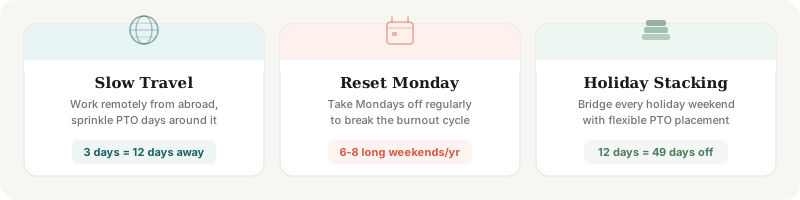
The "Slow Travel" Play
Remote workers can do something office workers can't: take PTO days non-consecutively around work days. Example:
- Fly to Lisbon on a Saturday
- Work Mon–Wed from your Airbnb (it's still remote work, just a different city)
- Take Thu–Fri as PTO → 4-day weekend in Portugal
- Work the following Mon–Tue
- Take Wed as PTO → explore a day trip
- Fly home next weekend
Net PTO used: 3 days. Net time in Lisbon: 12 days. You can't do this from a cubicle.
The "Extended Weekend" Strategy
Instead of one big 2-week vacation, take 6–8 extended weekends throughout the year. Each one uses just 1–2 PTO days:
- Take a Friday off → 3-day weekend, enough for a road trip
- Take a Monday off → different 3-day weekend
- Bridge a Thursday holiday → 4-day weekend for a domestic flight
With 15 PTO days spent this way, you get 15+ mini-vacations instead of 2 big ones. For remote workers who suffer from low-grade burnout rather than acute exhaustion, frequent short breaks are more restorative than rare long ones.
The "Shoulder Season" Arbitrage
Remote workers aren't tied to school schedules or office holiday closures. You can travel during the cheapest weeks of the year:
- Mid-January to mid-February: Post-holiday lull. Cheapest international flights of the year.
- Late April to mid-May: Spring in Europe, pre-summer pricing.
- Mid-September to mid-October: Best weather-to-price ratio globally.
- Early November: The forgotten month. Almost everything is cheap.
The 2026 Remote Worker Calendar
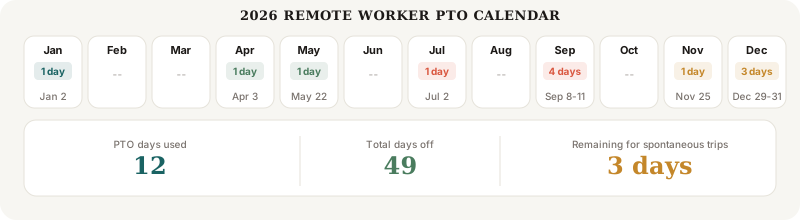
Here are the highest-value PTO days for remote workers in 2026 -- optimized for flexibility:
| PTO Day(s) | What You Get | Best For |
|---|---|---|
| Fri Jan 2 | 4-day New Year's weekend | Ski trip, winter city break |
| Fri Apr 3 | 4-day Easter weekend (Good Friday) | Europe spring trip |
| Fri May 22 | 4-day Memorial Day weekend | Beach opener |
| Thu Jul 2 | 4-day July 4th weekend | National parks |
| Tue–Fri Sep 8–11 | 9-day post-Labor Day | Major international trip |
| Wed Nov 25 | 5-day Thanksgiving break | Family + travel |
| Mon–Wed Dec 29–31 | 10-day holiday break | Year-end reset |
Total: 12 PTO days → 49 days off. That leaves 3 PTO days for spontaneous long weekends.
Stop Saving PTO for "Someday"
The data is clear: unused PTO correlates with higher burnout, lower job satisfaction, and ironically, lower productivity. Taking time off isn't a luxury -- it's maintenance.
If you haven't planned your 2026 PTO yet, do it now. It takes 30 seconds.
Next Step
See your own best PTO windows
The article gives you the strategy. The optimizer gives you the exact dates for your year and your PTO balance.
Find my windowsGet the calendar and return when you are ready
Related topics
Useful tools
Related Articles
Gen Z First Job: How to Actually Take Your PTO Without the Guilt
You earned the PTO. The handbook says you can take it. Your manager hasn't taken a vacation since 2019. Here is how Gen Z workers actually use their leave without guilt.
The Global PTO Gap: Why Workers Take Far Less Leave Than They're Entitled To
In most countries, workers leave a significant chunk of their paid leave unused. Here's the data on the gap between statutory entitlement and actual usage across 18 countries -- and what drives it.
How Long Is Lunar New Year? Public-Holiday Length by Country (and How to Leverage It)
A data comparison of how many statutory public-holiday days each country gives for Lunar New Year — China, Vietnam, South Korea, Singapore, Malaysia and Hong Kong — plus the make-up-weekend and substitute-holiday mechanics that stretch a 2–3 day holiday into a 7–9 day break, and how to leverage it with your own paid leave.