Weekend Holidays: How Many Days Off Your Country Quietly Loses Each Year
Fact-checked July 10, 2026 · 6 sourcesHow we verify
Here is a number almost nobody budgets for: in a normal year, a handful of your public holidays quietly fall on a Saturday or Sunday. What happens next depends entirely on which country you live in. In some places the government hands you a replacement weekday — the holiday is preserved. In others, the day simply evaporates. You "had" the holiday on paper, but it collided with a weekend you already had off, and nobody gives it back.
Over a career, this rounding error adds up to weeks. This piece puts real numbers on it: which countries protect weekend holidays, which let them vanish, and how many days off each system loses in an average year.
This is a research post. The rules below are stable law and change rarely. The counts — how many holidays collide with a weekend in a given year — shift every single year with the calendar, so they are modeled estimates, clearly flagged. For the exact collisions in your target year, run your calendar through the leave optimizer rather than trusting a fixed table.
The One Rule That Changes Everything: Substitute Holidays
Every country's public-holiday system answers one question differently: when a holiday lands on a weekend, do you get it back?
There are three broad answers.
- Full substitute (nothing is lost). The holiday is moved to the nearest working day — almost always the following Monday. The United Kingdom does this for every bank holiday.
- Partial substitute (some days are lost). Only certain holidays, or only certain weekend days, trigger a replacement. Korea, the US federal system, and Japan all sit here, but with very different fine print.
- No substitute (weekend holidays vanish). If it lands on a Saturday or Sunday, it is simply gone. Germany is the clearest example among major economies.
Here is how the five systems compare on the mechanics.
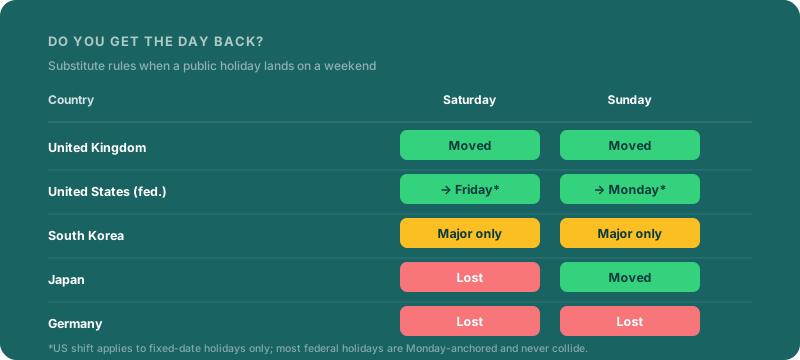
| Country | Weekend holiday moved? | Saturday rule | Sunday rule | Result |
|---|---|---|---|---|
| United Kingdom | Yes, always | → next weekday | → next weekday | No days lost |
| South Korea | Major holidays only | → next weekday (eligible list) | → next weekday (eligible list) | Some days lost |
| United States (federal) | Fixed-date only | → preceding Friday | → following Monday | Few days lost |
| Japan | Sunday only | Lost | → next weekday | Some days lost |
| Germany | No | Lost | Lost | Most days lost |
Two design choices drive the whole outcome: which weekend days count, and which holidays are eligible. The UK maximizes both (all days, all holidays). Germany minimizes both. Everyone else is somewhere in between — and the "in between" is where the lost days pile up.
United Kingdom: the gold standard
Under the GOV.UK bank-holiday rules, if a bank holiday falls on a weekend, a "substitute" weekday — normally the following Monday — becomes the bank holiday instead. This applies to both Saturday and Sunday, and to every bank holiday. The practical effect: a UK worker essentially never loses a public holiday to the calendar. When Christmas Day and Boxing Day fall on a weekend, you get the following Monday and Tuesday.
South Korea: substitutes, but with an eligibility list
Korea's substitute-holiday system (대체공휴일, daechegonghyuil) moves an eligible holiday to the next non-holiday weekday when it collides with a Saturday, Sunday, or another holiday. But not every holiday qualifies. Per summaries of the 대체공휴일 rules (overview of the substitute-holiday system), the eligible holidays include Seollal (Lunar New Year), Chuseok, Children's Day, Independence Movement Day, Liberation Day, National Foundation Day, Hangul Day, Buddha's Birthday, and Christmas (the last two added in the 2023 expansion). The two notable exclusions are New Year's Day (Jan 1) and Memorial Day (Jun 6) — when those fall on a weekend, they are lost with no replacement.
The list has grown over the years through amendments (Children's Day, Liberation Day, and Hangul Day were folded in during recent expansions), so it is worth re-checking. Separately, Korea's statutory annual leave under the Labor Standards Act (Article 60) is 15 paid days after one year of service at 80%+ attendance, which is the pool you draw on for bridge days.
United States: quiet, but effective for federal workers
US federal law (5 U.S.C. 6103, administered by OPM) shifts a Saturday holiday to the preceding Friday and a Sunday holiday to the following Monday — but only for holidays fixed to a specific date (like July 4 or December 25). Crucially, many US federal holidays are already anchored to a Monday (Martin Luther King Jr. Day, Presidents' Day, Memorial Day, Labor Day, Columbus Day) or a Thursday (Thanksgiving), so they can never collide with a weekend in the first place. That design quietly protects most of the calendar. The catch: this is a rule for federal employees. Private-sector observance varies, and there is no federal law requiring private employers to give paid holidays at all.
Japan: half a safety net
Japan recognizes 16 national holidays. Per Public Holidays in Japan, the substitute-holiday rule (furikae kyūjitsu) grants a replacement only when a holiday falls on a Sunday — the following Monday becomes a compensatory holiday. When a holiday lands on a Saturday, it is simply lost. So Japan protects roughly half of its weekend collisions, on average.
Germany: use it or lose it
Germany offers no substitute day when a public holiday falls on a Saturday or Sunday. As German labor-law summaries and practitioner guidance confirm, a weekend Feiertag is lost unless a specific collective agreement (Tarifvertrag) says otherwise. Combined with Germany's relatively modest 20-day statutory leave minimum, a bad calendar year can meaningfully cut into total days off.
How Many Days Actually Get Lost?
Here is where the calendar math matters. A public holiday has a 2-in-7 (about 29%) chance of landing on a weekend in any given year, if the holiday is fixed to a date. So a country with, say, 11 fixed-date public holidays would expect roughly 3 of them to collide with a weekend annually. Whether those 3 are lost depends entirely on the substitute rule.
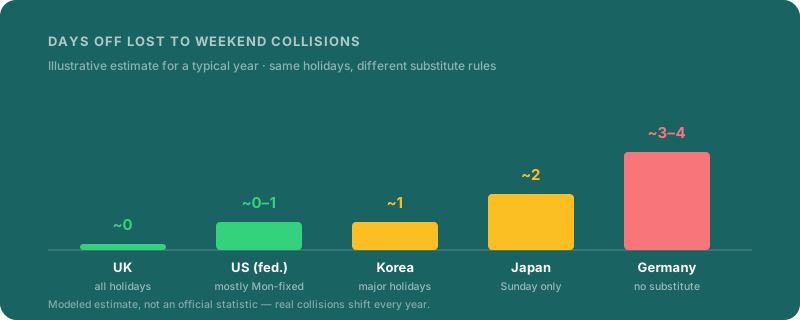
The table below is an illustrative model for a typical year, not an official statistic. It assumes a country's fixed-date holidays collide with weekends at the expected ~29% rate, then applies each country's substitute rule to estimate net days lost.
| Country | Approx. national holidays | Expected weekend collisions/yr | Substitute coverage | Est. days lost/yr |
|---|---|---|---|---|
| United Kingdom | ~8 | ~2–3 | All holidays, both days | ~0 |
| United States (federal) | ~11 | ~1–2* | Fixed-date only | ~0–1 |
| South Korea | ~15 | ~4 | Major holidays only | ~1 |
| Japan | ~16 | ~4–5 | Sunday only | ~2 |
| Germany | ~10–13 | ~3–4 | None | ~3–4 |
*Most US federal holidays are Monday-anchored and cannot collide, so real collisions are far below the naive 29%.
The spread is stark. A German worker can lose three or four days off to the calendar in a bad year while a UK worker loses none — a gap of nearly a full working week, from the same underlying number of holidays. This is exactly why the raw "public holiday count" is a misleading way to rank countries; what matters is holidays that survive contact with the calendar plus statutory leave. (We rank the headline counts in 10 Countries With the Most Public Holidays, and the day-of-week skew that drives collisions in Which Day of the Week Do Holidays Fall On Most?.)
Worked Example: Two Workers, Same Holiday, Different Countries
Take a concrete case. Imagine a fixed-date holiday — say, a National Day pinned to the same calendar date every year — that happens to fall on a Saturday this year.
Worker A (Germany). The holiday lands on Saturday. Germany grants no substitute. Worker A already had Saturday off, so the holiday delivers zero additional days off. Net gain: 0 days.
Worker B (United Kingdom). The same holiday lands on Saturday. Under the UK substitute rule it moves to Monday. Worker B now has a genuine three-day weekend (Sat–Sun–Mon). Net gain: 1 extra day off.
Now stretch it across a career. Suppose two of a country's holidays hit a weekend in a typical year, and this happens — conservatively — in 2 out of every 3 years. That is roughly 1.3 lost days per year in a no-substitute system. Over a 40-year career:
1.3 days/year × 40 years ≈ 52 days
≈ 10+ working weeks lost to the calendar
Ten weeks of days-off, gone — not because the law gave you fewer holidays, but because the substitute rule let weekend collisions slide. For the UK worker on the same holiday calendar, that number is close to zero. Same holidays on paper; a two-month difference in reality.
This is also why bridge-day strategy matters more in weak-substitute countries: if the calendar is going to cost you days, you claw them back by placing your own annual leave next to the holidays that do survive. Plug your country and year into the optimizer to see which of this year's holidays actually land midweek and are worth bridging.
What You Can Actually Do About It
You cannot rewrite your country's substitute-holiday law. But you can plan around it.
- Know your country's rule before you plan. If you are in a no-substitute or Sunday-only system (Germany, Japan), a holiday landing on a weekend is money left on the table — plan your annual leave around the survivors.
- Front-load leave onto midweek holidays. A holiday that lands on a Tuesday or Thursday is worth far more to you than one that lands on a weekend. Spend your annual leave building bridges there. See how holiday bridges work.
- Watch for the excluded holidays. In Korea, remember New Year's Day and Memorial Day get no substitute. In Japan, remember Saturday holidays are simply lost. Do not count on them.
- Let the optimizer do the collision math. The exact holidays that collide with weekends change every year. Rather than guessing, feed your year and country into the optimizer — it flags which holidays are wasted and which are prime bridge targets.
Frequently Asked Questions
Why do some countries not give a substitute day when a holiday falls on a weekend?
Largely history and legal design. Countries like the UK and Korea explicitly wrote substitute rules into law to guarantee a minimum number of actual days off. Germany's system treats public holidays as a "the day itself is a holiday" concept — if you already weren't working that day, there is nothing to compensate. It is a philosophical difference about whether a holiday is a day or a day off.
Does the US really lose almost no holidays to weekends?
For federal employees, yes — largely by design. Most US federal holidays are anchored to a specific Monday or Thursday, so they can never collide with a weekend, and the few fixed-date ones (New Year's, Juneteenth, Independence Day, Veterans Day, Christmas) shift to the adjacent Friday or Monday. The big caveat is that this is a rule for federal workers; private employers set their own policies and are not required by federal law to provide paid holidays at all.
How is Korea's substitute-holiday list decided, and can it change?
It is set by regulation and has been expanded several times by amendment — Children's Day, Liberation Day, and Hangul Day were added in recent rounds. New Year's Day and Memorial Day remain excluded as of this writing. Because the list is amendable, confirm the current eligible holidays for your target year rather than relying on an old list.
Is it better to have more holidays or a better substitute rule?
Both matter, but the substitute rule is the more reliable multiplier. A country with 16 holidays and a weak substitute rule (Japan) can deliver fewer real days off in a bad calendar year than a country with 8 holidays and a full substitute rule (UK). When comparing countries, always look at holidays plus statutory leave minus weekend collisions — not the headline holiday count alone.
Sources
- UK bank holidays — GOV.UK — official rule that weekend bank holidays move to a substitute weekday.
- US Federal Holidays — U.S. Office of Personnel Management (OPM) — federal "in lieu of" observation rules under 5 U.S.C. 6103.
- Public holidays in Japan — Wikipedia — 16 national holidays and the Sunday-only furikae kyūjitsu substitute rule.
- Substitute holiday system in Korea (대체공휴일) — Hanok Korean Class — the 대체공휴일 eligible-holiday list, exclusions, and the 2023 expansion.
- Public holidays in Germany — Wikipedia — nationwide holidays and the absence of a weekend substitute.
- List of minimum annual leave by country — Wikipedia — statutory annual-leave minimums used in the comparison.
Next Step
See your own best PTO windows
The article gives you the strategy. The optimizer gives you the exact dates for your year and your PTO balance.
Find my windowsGet the calendar and return when you are ready
Related topics
Useful tools
Related Articles
How to Request Time Off: 5 Email Templates That Actually Get Approved
Stop guessing what to write in your leave request. These 5 proven email templates cover standard PTO, bridge days, extended leave, last-minute requests, and denied leave follow-ups -- with timing advice by company size.
Part-Time Worker Leave Rights: How Pro-Rata Annual Leave Actually Works
A comprehensive guide to pro-rata annual leave for part-time workers. Covers calculation methods, country-by-country entitlements, public holiday rules, worked examples, and strategies to make the most of a reduced leave budget.
The Sandwich Day Strategy, Explained: Turn 1 Leave Day Into 4 Off
A sandwich day is the lone workday wedged between a public holiday and the weekend. Spend one leave day on it and a 4-day break appears. Here is the leverage math, a weekday-by-weekday ratio table, a worked example, and the one payroll trap that can quietly cost you extra days.