2030 Public Holidays: An Early Preview of the Bridge-Day Map (US + Korea)
Fact-checked July 10, 2026 · 6 sourcesHow we verify
The 2030 calendar is already fixed. Every date, every weekday -- locked in by the Gregorian and lunar calendars years in advance. The only thing that isn't settled yet is how you'll use it. This is an early, data-first preview of where 2030's leave value will sit, for both US federal holidays and Korean public holidays, so you can map the high-value bridge weeks long before your colleagues start competing for the same dates.
This is a research post written with sources. Fixed-date holidays (Jan 1, Jul 4, Mar 1, Aug 15) are reliable years out. Lunar-calendar holidays (Seollal, Chuseok, Buddha's Birthday) and any substitute/temporary holiday designations are set by government notice and can shift by a day -- treat those as approximate and confirm the exact dates in the leave optimizer once the official 2030 calendar is published. See Sources.
Why look at 2030 this early
The best leave planners book six to twelve months out. But the structure of a year -- which holidays land on which weekday -- is knowable much further ahead, and it's the structure that decides whether a holiday is worth a bridge day at all.
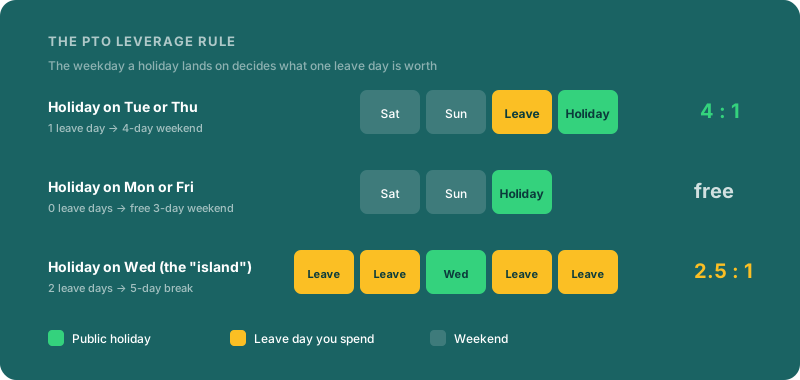
A public holiday's leave value depends almost entirely on the weekday it lands on:
- Tuesday or Thursday holiday -> one bridge day buys a 4-day weekend (a 4:1 return on one leave day).
- Monday or Friday holiday -> already a 3-day weekend, zero leave needed. Great for you, but nothing to optimize.
- Wednesday holiday -> the "island." Two bridge days buys a 5-day break, but the return is weaker (5 days off for 2 leave days = 2.5:1), and you can't bridge only one side cleanly.
- Saturday or Sunday holiday -> pure loss in countries without a substitute rule; recovered in countries that have one (Korea, UK Christmas/Boxing Day).
That single rule -- weekday determines value -- is what makes an early preview useful. You can already see which 2030 holidays are the winners.
The 2030 US federal calendar
Here's the headline for the United States: in 2030, not a single one of the 11 federal holidays falls on a weekend. That's genuinely rare and genuinely good -- no holidays are "wasted" against a Saturday or Sunday.
| Holiday | Date | Weekday | Bridge value |
|---|---|---|---|
| New Year's Day | Jan 1 | Tuesday | High -- bridge Mon for 4 days |
| MLK Jr. Day | Jan 21 | Monday | Free 3-day weekend |
| Presidents' Day | Feb 18 | Monday | Free 3-day weekend |
| Memorial Day | May 27 | Monday | Free 3-day weekend |
| Juneteenth | Jun 19 | Wednesday | Island -- 2 days for 5 |
| Independence Day | Jul 4 | Thursday | High -- bridge Fri for 4 days |
| Labor Day | Sep 2 | Monday | Free 3-day weekend |
| Columbus Day | Oct 14 | Monday | Free 3-day weekend |
| Veterans Day | Nov 11 | Monday | Free 3-day weekend |
| Thanksgiving | Nov 28 | Thursday | Elite -- bridge Fri for 4 days |
| Christmas Day | Dec 25 | Wednesday | Island -- anchors a year-end run |
The two standout single-day plays are New Year's Day (Tue) and Independence Day (Thu): one leave day each turns them into four-day weekends. Thanksgiving is the classic -- the Friday after is a near-universal soft holiday, so most people already get a 4-day break there.
The December window is the interesting one: Christmas (Wed) and New Year's Day 2031 (Wed) both sit mid-week, so a well-placed block of leave around the last two weeks of December buys an outsized run. We'll do the math on that below.
The 2030 Korean calendar
Korea's fixed holidays are joined by the two lunar giants -- Seollal (Lunar New Year) and Chuseok (harvest festival) -- each a three-day block, each eligible for a substitute holiday (대체공휴일) when it collides with a weekend.
| Holiday | Date (approx.) | Weekday | Notes |
|---|---|---|---|
| New Year's Day | Jan 1 | Tuesday | Fixed |
| Seollal (3 days) | Feb 2–4 | Sat–Mon | Feb 2 is Saturday -> substitute weekday expected |
| Independence Movement Day | Mar 1 | Friday | Free 3-day weekend |
| Children's Day | May 5 | Sunday | Substitute Monday expected |
| Buddha's Birthday | May 9 | Thursday | Lunar; bridge Fri for 4 days |
| Memorial Day | Jun 6 | Thursday | Bridge Fri for 4 days |
| Liberation Day | Aug 15 | Thursday | Bridge Fri for 4 days |
| Chuseok (3 days) | Sep 11–13 | Wed–Fri | Main day Sep 12 (Thu); rolls into weekend |
| National Foundation Day | Oct 3 | Thursday | Bridge Fri for 4 days |
| Hangeul Day | Oct 9 | Wednesday | Island |
| Christmas Day | Dec 25 | Wednesday | Fixed |
The season to watch for Korea in 2030 is autumn. Chuseok runs Wed–Fri (Sep 11–13) and flows straight into the weekend, and only three weeks later there's a dense cluster: Foundation Day (Thu, Oct 3) and Hangeul Day (Wed, Oct 9). That's a lot of Thursday/Wednesday holidays in a short window -- fertile ground for bridge days.
A note on the "super-break" years. 2030 is a solid year, but not a legendary one. Korea's rare ten-day mega-breaks depend on holidays stacking against weekends in exactly the right way -- the next realistic candidates are 2028 and then 2044, per reporting on the calendar mechanics. 2030 is a strong, ordinary year: good bridges, no once-in-a-generation stack. Plan it as a normal high-value year, not a jackpot.
Cross-country context: what one leave day is worth
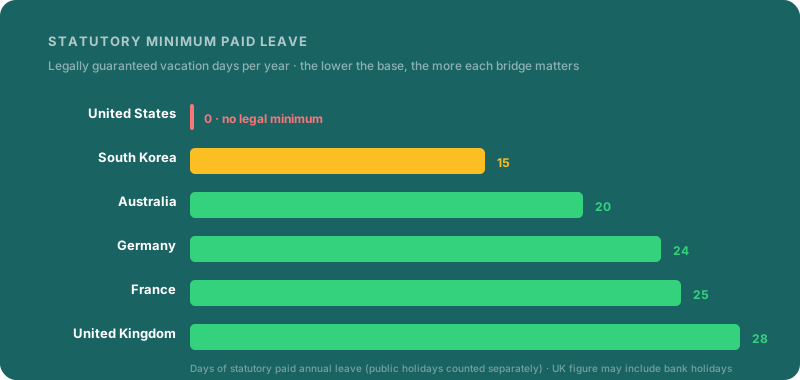
The reason a bridge day feels so valuable in some countries and merely nice in others comes down to how much statutory leave you start with. The fewer paid days you're guaranteed, the more each one has to work.
| Country | Statutory minimum paid leave | Paid public holidays | How bridges feel |
|---|---|---|---|
| United States | None (no federal minimum) | ~11 federal (private avg ~6–8 paid) | Every leave day is precious; bridges are essential |
| South Korea | 15 days after 1 yr (+1 / 2 yrs, cap 25) | ~15 public | Bridges multiply an already-modest base |
| United Kingdom | 28 days (5.6 weeks, may include bank holidays) | 8 bank holidays | Comfortable base; bridges are optimization, not survival |
| Germany | 24 days (federal min 20) | 9–13 (varies by state) | Generous base + strong bridge culture |
| France | 25 days | 11 | Very generous; "faire le pont" is a national habit |
| Australia | 20 days | ~10 (varies by state) | Solid base; bridges add polish |
The contrast at the top of the table is the real story. The US is the only OECD country with no statutory minimum paid leave -- which is exactly why efficient bridge planning matters more for American workers than almost anyone else. Korea's 15-day base (rising with tenure to a cap of 25) is modest by European standards, so squeezing four days off out of one leave day is worth real effort. In the UK, with a 28-day floor, bridge days are a nice-to-have rather than a necessity.
Worked example: the December 2030 year-end run (US)
Let's put concrete numbers on the strongest US play of the year. In December 2030, Christmas is Wednesday the 25th and New Year's Day 2031 is Wednesday the 1st -- two mid-week holidays exactly a week apart.
Take leave on the four working days that sit between the two holidays:
- Christmas Day, Wed Dec 25 — federal holiday (0 leave)
- Thu Dec 26, Fri Dec 27 — leave (2 days)
- Sat Dec 28 / Sun Dec 29 — weekend (0)
- Mon Dec 30, Tue Dec 31 — leave (2 days)
- New Year's Day, Wed Jan 1 — federal holiday (0 leave)
That gives a continuous run from Wed Dec 25 through Wed Jan 1 — 8 days off for just 4 leave days, a clean 2:1 leverage ratio anchored on the year's two mid-week December holidays.
Want to fold in the weekend before Christmas too? Dec 21 and 22 are Saturday and Sunday, but Dec 23 (Mon) and Dec 24 (Tue) are working days, so you'd need to spend two more leave days to bridge them. Do that and you stretch the break to Sat Dec 21 through Wed Jan 1 — 12 consecutive days off for 6 leave days (still 2:1). If your employer treats Dec 24 or Dec 31 as a soft/half day, the effective ratio climbs higher. For a US worker with no guaranteed leave floor, turning a handful of PTO days into an 8-to-12-day break is close to the best single move on the 2030 board.
The equivalent Korean play sits in autumn: chain the Chuseok block (Sep 11–13) into the surrounding weekend, then bridge the Foundation Day / Hangeul Day cluster in early October. The exact optimal chain depends on the substitute-holiday designations, which is precisely the kind of shifting detail the optimizer resolves for you.
How to plan 2030 without over-committing
- Lock the fixed winners first. For the US: New Year's Day (Tue), Independence Day (Thu), and the December run. For Korea: Liberation Day (Thu, Aug 15), Foundation Day (Thu, Oct 3), and Buddha's Birthday (Thu). Tuesday/Thursday holidays are your 4:1 bridges.
- Pencil in, don't ink, the lunar holidays. Seollal and Chuseok dates and their substitute days can move by a day. Reserve the window; confirm the date later.
- Watch for temporary-holiday announcements (Korea). Governments occasionally add a one-off bridge day around big clusters. If one appears near Chuseok 2030, the whole autumn plan improves.
- Feed it to the optimizer. Rather than hand-mapping every bridge, drop your leave balance and the 2030 calendar into the leave optimizer and let it rank the highest-ROI chains for your country.
For the year-by-year setup, 2027's early-planning guide and the every-country 2027 holiday calendar walk through the same method on a nearer horizon.
FAQ
Are the 2030 holiday dates really confirmed already?
The fixed-date ones are -- Jan 1, Jul 4, Dec 25, Korea's Mar 1 and Aug 15, and so on -- because they don't move. The weekday each lands on is pure calendar math and is certain years out. What is not final is (a) the exact date of lunar holidays like Seollal and Chuseok, which can shift by a day when the official calendar is published, and (b) any substitute or temporary holidays the government may designate. Treat the lunar and substitute pieces as approximate until confirmed.
Which 2030 holidays give the best return on a single leave day?
Any holiday on a Tuesday or Thursday, because one bridge day connects it to the weekend for a 4-day break (a 4:1 return). In 2030 that includes US New Year's Day (Tue), Independence Day (Thu), and Thanksgiving (Thu); and Korean Liberation Day (Thu), National Foundation Day (Thu), Memorial Day (Thu), and Buddha's Birthday (Thu). Wednesday holidays (US Juneteenth and Christmas; Korea Hangeul Day) need two leave days for a five-day break -- a weaker 2.5:1.
Is 2030 a good year for a long holiday in Korea?
It's a good, normal year -- not a rare "super-break" year. The autumn cluster (Chuseok Sep 11–13, then Foundation and Hangeul days in early October) offers strong bridge opportunities. But Korea's legendary ten-day mega-breaks require a specific weekend alignment that lands in 2028 and then not again until 2044. Plan 2030 for solid four- and five-day bridges rather than a single epic block.
Why does a US worker benefit more from bridge planning than a UK worker?
Because of the starting floor. The US has no statutory minimum paid leave -- the only OECD country in that position -- so every leave day is scarce, and getting a 4:1 bridge or an 8-days-for-4 December run genuinely changes how much rest you get in a year. UK workers start from a 28-day statutory minimum, so bridges are optimization on top of an already-comfortable base rather than a necessity.
Sources
- US federal holidays 2030 (federalholidays.net) — 2030 US federal holiday dates and weekdays.
- South Korea public holidays (worlddata.info) — Korean public holidays including 2030 Seollal and Chuseok dates.
- Labor Standards Act, Article 60 (Korea Legislation Research Institute) — statutory annual paid leave (15 days after first year, +1 per 2 years, cap 25).
- UK bank holidays (GOV.UK) — official UK bank holiday dates.
- List of minimum annual leave by country (Wikipedia) — cross-country statutory leave and public-holiday counts.
- 2028 and 2044 'super-break' analysis (The Korea Herald) — how the calendar produces rare 10-day breaks and why most years don't.
Next Step
See your own best PTO windows
The article gives you the strategy. The optimizer gives you the exact dates for your year and your PTO balance.
Find my windowsGet the calendar and return when you are ready
Related topics
Useful tools
Related Articles
How to Request Time Off: 5 Email Templates That Actually Get Approved
Stop guessing what to write in your leave request. These 5 proven email templates cover standard PTO, bridge days, extended leave, last-minute requests, and denied leave follow-ups -- with timing advice by company size.
Weekend Holidays: How Many Days Off Your Country Quietly Loses Each Year
When a public holiday lands on a Saturday or Sunday, some countries hand you a substitute day off — and some just let it vanish. This data piece compares the weekend-holiday rules of Korea, the US, the UK, Japan, and Germany, and estimates how many days off each system loses in an average year.
Part-Time Worker Leave Rights: How Pro-Rata Annual Leave Actually Works
A comprehensive guide to pro-rata annual leave for part-time workers. Covers calculation methods, country-by-country entitlements, public holiday rules, worked examples, and strategies to make the most of a reduced leave budget.