China's Visa-Free Transit for US Passport Holders: 10-Day Transit, Eligible Ports & the Rules That Trip People Up
Fact-checked July 2, 2026 · 5 sourcesHow we verify
For a US passport, China is one of the few big destinations where you can have a genuine, multi-day trip without applying for a visa at all — but only if you read the fine print. The headline is the 240-hour (10-day) transit visa-free policy, and the single rule that trips most people up is that you have to be passing through China to a different country, not flying round-trip. This guide sorts the routes that actually apply to a US passport, the conditions, and the airports where you can land.
This is a sourced research piece. The structural facts (which routes exist, the transit logic, which regions are covered) change less often, but port counts, eligible-country lists, durations, and entry rules change frequently — China expanded the port list as recently as November 2025. Everything below is marked "approx." where it is volatile. Confirm on the official sites in Sources before you book or fly.
The big picture: what a US passport actually gets you
There is a lot of confusing coverage out there, largely because China runs several separate visa-free schemes and they each have different rules. Here is the part most US travelers miss: as of early 2026, the 30-day unilateral visa-free entry that made headlines applies to roughly 50 countries — and the United States is not on that list. (China Briefing)
So for a US passport, the practical visa-free options are the ones below.
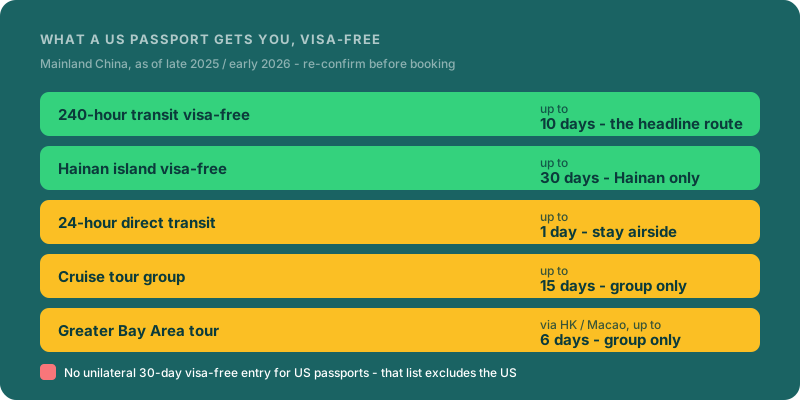
- 240-hour transit visa-free (up to ~10 days) — the headline. US passports are eligible. Requires a confirmed onward ticket to a third country. This is the route most independent travelers will use.
- Hainan island visa-free (up to ~30 days) — US passports are eligible, but only for stays inside Hainan province (Sanya, Haikou).
- 24-hour direct transit (up to ~1 day) — open to all nationalities, but you generally stay airside.
- Cruise tour group (up to ~15 days) — for organized cruise groups arriving by ship.
- Greater Bay Area tour group (up to ~6 days) — for organized groups entering from Hong Kong or Macao.
If you just want a normal independent trip (land, explore, leave), the 240-hour transit is almost certainly your route. The rest of this guide focuses there, then covers the alternatives.
The 240-hour (10-day) transit policy
China's National Immigration Administration confirms the transit visa-free policy covers nationals of 55 countries, including the United States, and allows a stay of up to 240 hours (10 days), entering and exiting through 65 designated ports across 24 provinces, autonomous regions and municipalities. (NIA)
The eligible-country count grew to 55 when Indonesia was added in December 2024 (Chinese Embassy in the US), and the port list grew from 60 to 65 on November 5, 2025, when several Guangdong crossings were added (gov.cn). Both numbers have moved more than once — treat them as a snapshot, not a constant.
The rule that disqualifies people: you must be in transit
This is the make-or-break condition. The 240-hour policy is a transit benefit, not a tourist visa. You must be travelling from country A, through China, onward to a different country or region C — and A and C cannot be the same place.
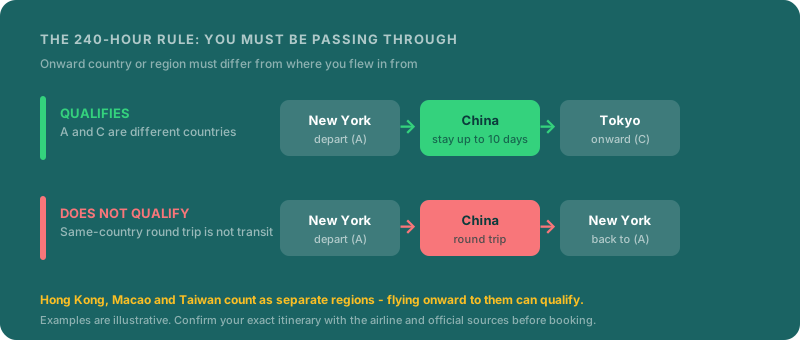
- Qualifies: New York → China (stay up to ~10 days) → Tokyo. You arrived from the US and depart onward to Japan — two different countries.
- Does not qualify: New York → China → New York. A round trip to the same country is not a transit, so the 240-hour rule does not apply. (TravelChinaGuide)
One useful wrinkle: Hong Kong, Macao and Taiwan are treated as separate regions for this purpose. An onward flight to Hong Kong can count as your third-region departure, which is why a US → mainland China → Hong Kong itinerary is a common way to use the policy. Still, confirm your specific routing with the airline at check-in and against the official source — airline staff sometimes interpret these rules conservatively.
The conditions checklist
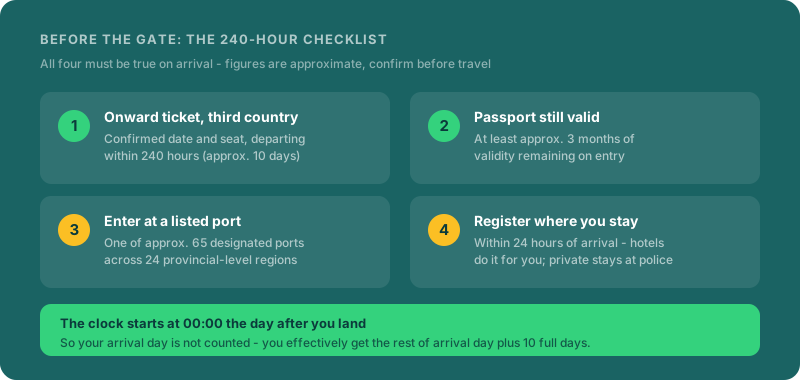
To use the 240-hour transit, the following generally must be true on arrival (all figures approx., confirm before travel):
| Condition | What it means | Notes |
|---|---|---|
| Onward ticket | Confirmed ticket to a third country/region, with date and seat | Must depart within 240 hours of entry |
| Passport validity | Valid for at least approx. 3 months | Carry the physical passport |
| Entry port | Arrive at one of approx. 65 designated ports | Across 24 provincial-level regions |
| Purpose | Tourism, business, visits, family | Not work, study, or journalism |
| Registration | Register your stay within 24 hours | Hotels do this; private stays register at the local police station |
The clock. The 240 hours generally start at 00:00 on the day after you arrive, so your arrival day is not counted against the limit. In practice you get the rest of your landing day plus ten full days — but do not push the boundary; overstaying a visa-free entry is treated seriously.
How you "apply." You do not apply in advance. You tell the airline at check-in that you intend to use transit visa-free, and you request the temporary-entry permit at the border on arrival. Build in extra time at immigration; the dedicated counter can be slow.
Where you can land: eligible ports and regions
The 240-hour policy runs through 65 ports in 24 provincial-level regions, and — importantly — once admitted you can cross provincial boundaries freely among the eligible regions rather than being stuck in one city (NIA). That is what makes a real itinerary possible: fly into Shanghai, take the high-speed rail to a neighboring province, fly out of another city.
Major international airports commonly used for this policy include:
| Region | Common entry airport(s) |
|---|---|
| Beijing | Capital International (PEK), Daxing International (PKX) |
| Shanghai | Pudong (PVG), Hongqiao (SHA) |
| Guangdong | Guangzhou Baiyun (CAN), Shenzhen Bao'an (SZX) |
| Sichuan | Chengdu Tianfu (TFU) |
| Shaanxi | Xi'an Xianyang (XIY) |
| Other | Kunming, Wuhan, Hangzhou, Qingdao, Xiamen and more |
The November 2025 expansion added Guangdong land and rail crossings too — Guangzhou, Zhuhai's Hengqin, Zhongshan, the Hong Kong–Zhuhai–Macao Bridge, and the West Kowloon Station of the Guangzhou–Shenzhen–Hong Kong Express Rail Link (gov.cn). Because the official list is published port-by-port and keeps growing, verify your exact arrival point against the NIA list before booking flights — do not assume a smaller airport is covered.
Other visa-free options for US passports
If a transit itinerary does not fit, a US passport still has a few other doors in — most are narrower or require a group.
| Route | Max stay (approx.) | Who it fits | Key condition |
|---|---|---|---|
| 24-hour direct transit | ~1 day | Quick layovers | Onward ticket; usually stay within the port/airside area (NIA) |
| Hainan visa-free | ~30 days | Beach trip to Sanya/Haikou | Ordinary passport, 59-country list incl. US; stay within Hainan only (NIA regional) |
| Cruise tour group | ~15 days | Cruise passengers | Organized group arriving by cruise ship |
| Greater Bay Area group tour | ~6 days | Day-trippers from HK/Macao | Enter Hong Kong or Macao first, then join a registered tour group into Guangdong's GBA cities + Shantou (NIA regional) |
A few notes:
- Hainan is the most useful "non-transit" option for an independent US traveler who just wants a single-destination beach holiday — but historically it has involved registering through a local travel agency before arrival, and you cannot leave Hainan on it. Confirm the current registration mechanics.
- The cruise and Greater Bay Area routes are group-only — they will not work for independent travel.
- If none of these fit (you want to roam mainland China for three weeks, or you are flying round-trip from the US), you will need a regular tourist (L) visa.
Plan the leave around the policy
Ten days of visa-free China is a real trip, and the way to make it cost a sane number of vacation days is to anchor it on a holiday weekend and stack a few days of PTO. A US → China → onward-country routing also pairs naturally with a wider Asia loop (China + Japan, or China + a Southeast Asia leg), which spreads one long-haul flight across two destinations.
Run your dates through the annual leave optimizer to see which holiday bridges turn a handful of PTO days into a 10-day window. If you are weighing this against other passport perks, our guide to visa-on-arrival timing for US passport holders covers how entry rules shape when you should go, and the travel eSIM and device guide is worth a look before China specifically — connectivity and app access there are not like other destinations.
Before you book: the reality checks
Two things every US traveler should weigh, separate from the visa mechanics:
- Volatile rules. Port counts, country lists, durations, and the 30-day unilateral list have all changed within the past 18 months. The US could be added to the 30-day list, or rules could tighten, between now and your trip. Re-confirm everything close to departure.
- The advisory. The US Department of State has maintained a Level 2 ("Exercise Increased Caution") advisory for China, citing risks including exit bans and wrongful detention that can affect US citizens — particularly dual nationals and those of Chinese descent (Travel.State.gov). This is not a reason most tourists cancel, but it is a reason to read the official advisory yourself before you commit.
FAQ
Can a US citizen visit China without a visa?
Yes, in specific cases. The most useful is the 240-hour (10-day) transit visa-free policy, which US passports are eligible for, provided you are transiting onward to a third country and meet the conditions. US passports also qualify for Hainan visa-free entry (within Hainan only) and certain group-tour routes. There is no general 30-day unilateral visa-free entry for US passports as of early 2026, so a round-trip leisure visit usually still needs a tourist visa. Confirm on the official sources before booking.
Does a round-trip ticket from the US qualify for the 240-hour transit?
No. The policy is a transit benefit: your onward destination must be a different country or region from where you flew in. New York → China → New York does not qualify, but New York → China → Tokyo (or → Hong Kong) does. Hong Kong, Macao and Taiwan count as separate regions for this rule.
How many cities can I visit on the 240-hour transit?
Once admitted, you can cross provincial boundaries among the 24 eligible provincial-level regions — so a multi-city itinerary (for example Shanghai plus a neighboring province by high-speed rail) is allowed, as long as you exit within the time limit from a designated port. Verify that both your entry and exit points are on the official list.
What happens if the rules change before my trip?
They might — China has adjusted this policy several times recently, including a November 2025 port expansion. Treat this article as a starting map, not a guarantee. Re-check the official National Immigration Administration pages and the US State Department advisory in the days before you book and again before you fly.
Sources
- National Immigration Administration — Visa-Free Transit Policies — official: 24-hour and 240-hour transit, 55 countries incl. US, 65 ports / 24 regions
- National Immigration Administration — Regional Visa-Free Entry Policies — official: Hainan, cruise, Greater Bay Area group tour
- gov.cn — China widens visa-free access (Nov 4, 2025) — official: 60→65 ports, Guangdong additions, effective Nov 5, 2025
- Embassy of China in the US — 240-hour transit expanded to 55 countries — official: Indonesia added, country count
- China Briefing — China Visa-Free Travel: A Complete Guide — reference: schemes overview, 30-day unilateral list (US excluded)
- TravelChinaGuide — 240-hour transit visa-free — reference: transit logic, round-trip exclusion, examples
- US Department of State — China Travel Advisory — official: advisory level, exit-ban and detention risk
Entry rules, port lists, eligible-country lists, durations, and advisory levels change frequently and sometimes with little notice. This piece reflects sources current as of mid-2026; verify every detail on the official sites above before booking or travelling.
Next Step
Match this trip idea to your PTO
See which holiday windows make this trip easiest to book, then set reminders before prices move.
Plan this trip windowGet booking-timing and PTO planning emails
Related topics
Useful tools
Related Articles
New Mexico Travel Guide: Chile, Dunes, and Big Skies
New Mexico rewards drivers with white gypsum dunes, mile-high adobe cities, and green-chile everything, but the distances, altitude, and afternoon storms catch most first-timers off guard.
New York Travel Guide: Beyond the City, Into the State
New York is two trips in one: a dense five-borough metropolis and a huge upstate wilderness of gorges, six-million-acre forests, and lake-effect snow belts that most visitors never reach.
Iceland in November: The Off-Peak Window Before the Christmas-Market Surge
November is the last quiet window before Iceland's Christmas-market prices kick in. Here is exactly how it pencils out -- flights, hotels, Blue Lagoon, Ring Road access -- and how US holidays bridge into it.