No Foreign Transaction Fee Cards: How They Save You Money
Fact-checked July 2, 2026 · 8 sourcesHow we verify
A no-foreign-transaction-fee card is the single highest-return piece of "travel gear" most people never pack. It costs nothing extra to carry, and on a typical trip it quietly outperforms airport exchange kiosks, prepaid currency cards, and that wad of cash you ordered from your bank. This post explains the two fees that tax nearly every overseas swipe — the foreign transaction fee and dynamic currency conversion (DCC) — shows how they stack, and lays out the simple two-part move that beats almost every other "exchange trick": carry a no-FTF card, and always decline home-currency conversion.
This is a research post written with sources. It sticks to the parts that rarely change — how the fees are built and the rules around them — and flags everything volatile (exact percentages, which specific cards waive fees, reimbursement policies) as approx. Confirm your own card's terms and current rates with the issuer before you travel. Sources are listed at the bottom.
Planning the trip these fees apply to? Build the dates first with the annual leave optimizer, then come back and sort out how you'll pay once you land.
The two fees hiding in every overseas swipe
When your card touches a payment terminal abroad, two separate charges can attach themselves to the purchase. They are easy to confuse, but they come from different places and you fight them in different ways.
- Foreign transaction fee (FTF) — a surcharge your card adds for any purchase processed outside your home country, or with a non-domestic merchant. You don't get a screen asking permission; it just appears on your statement.
- Dynamic currency conversion (DCC) — an opt-in trap at the terminal or ATM. The merchant's machine offers to bill you in your home currency "so you know what you're paying," and bakes in an inflated exchange rate to do it.
The first is set by your card. The second is set by the merchant's payment processor — and, crucially, you can refuse it on the spot. A no-FTF card kills the first fee; declining DCC kills the second. Together they get you close to the raw wholesale exchange rate.
How a foreign transaction fee is built
A foreign transaction fee is usually quoted as a single percentage, but it's actually two charges stacked together: a fee from the card network (Visa, Mastercard) and a fee from your issuer (the bank whose name is on the card).
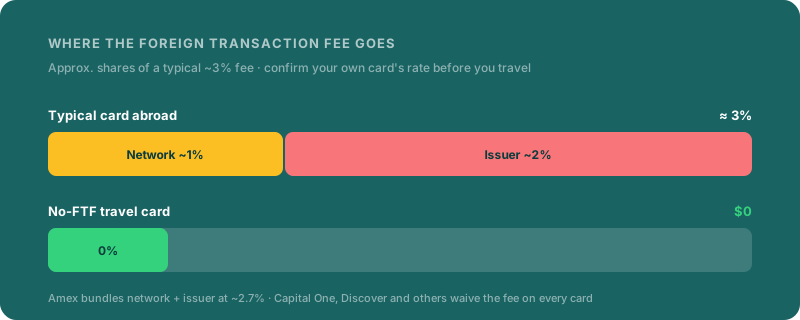
Foreign transaction fees generally run approx. 1%–3% of each transaction. On a typical card that charges the full 3%, the split looks roughly like this:
| Layer | Who charges it | Approx. share |
|---|---|---|
| Network conversion fee | Visa / Mastercard | ~1% |
| Issuer surcharge | Your bank | ~2% |
| Typical total | ~3% | |
| American Express (issuer + network in one) | Amex | ~2.7% |
| No-FTF travel card | Card waives it | 0% |
A few things worth knowing:
- The "average" is lower than the headline. WalletHub's 2026 Credit Card Landscape Report puts the average foreign transaction fee at approx. 1.58% — because so many travel and online cards now waive it entirely. (Verify against the current report; this is an annual figure.)
- Whole issuers waive it. Capital One and Discover, among others, advertise no foreign transaction fees on any of their cards — so the fee isn't really about which network you use, it's about which card you reach for.
- It hits online too. The fee applies whenever a charge is processed by a foreign merchant — including buying from an overseas website from your own couch, even if the price was shown in your home currency.
A no-FTF card converts at your network's wholesale rate (Visa/Mastercard), which is typically far better than a bank-branch or airport-kiosk rate. That's the whole reason it beats ordering cash before you go.
Dynamic currency conversion: the "helpful" screen that costs the most
DCC is the one to watch, because it disguises itself as a courtesy. When you tap or insert your card, the terminal reads your card's country from its first digits (the issuer identification number), notices it's foreign, and offers to charge you in your home currency. The screen shows a tidy dollar figure — and an exchange rate the merchant chose, padded with a markup.
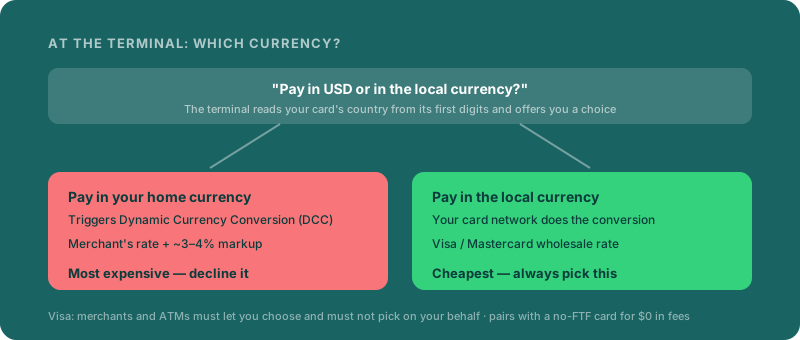
How much does that "convenience" cost? Approx. 3%–4% on top of the normal conversion rate, and sometimes far more — documented DCC markups range from a couple of percent to, in some cases, double digits. And here's the kicker: DCC stacks poorly with everything else. Even if accepting DCC means your issuer skips its own foreign transaction fee (because the charge now arrives already in your home currency), the DCC markup is usually bigger than the FTF you avoided. You rarely come out ahead.
The fix is one sentence: always choose to pay in the local currency. Some rules in your favor:
- You have the right to choose. Visa states that merchants and ATMs "should give you a choice to accept or decline currency conversion and must not choose on your behalf," and that declining "will not impact your ability to make purchases or withdraw cash."
- You can dispute a sneaky one. If you were never given the choice, or a DCC charge shows up with an inflated rate you didn't agree to, you can dispute it with your issuer. (Visa's chargeback rules specifically cover not being told DCC would occur.)
- ATMs do it too. The same "Would you like to be charged in USD?" prompt appears at cash machines abroad. Decline it there as well.
The math: what each path actually costs
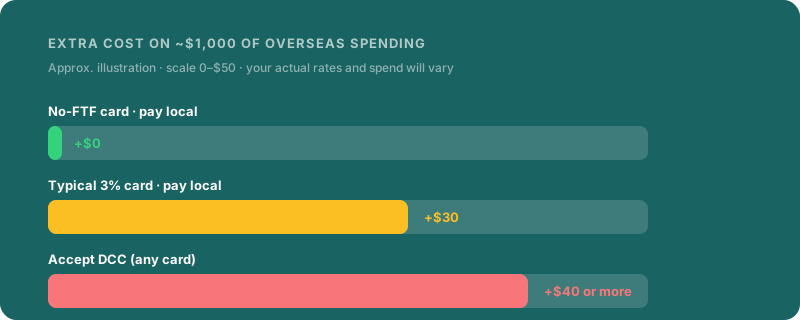
Put it together on roughly $1,000 of overseas spending and the three realistic outcomes spread out fast. These are approximate illustrations to show the shape of the difference, not a quote for your specific card.
| How you pay | Approx. extra on ~$1,000 | Verdict |
|---|---|---|
| No-FTF card · decline DCC (pay local) | ~$0 | Best — network wholesale rate |
| Typical 3% FTF card · decline DCC | ~$30 | Avoidable with a better card |
| Any card · accept DCC | ~$40 or more | Worst — merchant's padded rate |
| Airport / hotel cash exchange | often 5%–15% in spread | Usually worse than all of the above |
The pattern holds at any trip size: the no-FTF-card-plus-local-currency combo is the floor, and everything else is a premium you're choosing to pay. Order $300 of cash from an airport kiosk and the spread alone can dwarf a year's worth of card fees on a short trip.
The playbook: how to actually keep the money
You don't need to optimize every transaction. You need two habits and one piece of prep.
- Carry a no-FTF card and make it your default abroad. Confirm the "0% foreign transaction fee" line in your card's terms (issuers refresh card benefits, so check the current agreement, not a blog list). If your everyday card charges a fee, this is the one reason to apply for a travel card before a big trip.
- Always tap "pay in local currency." At every terminal and every ATM, if you're offered your home currency, decline. It feels counterintuitive — the local-currency number looks "uncertain" — but your card converts it at a better rate than the screen is offering.
- Bring a small cash buffer, not a cash strategy. Keep enough local cash for taxis, tips, and the rare cash-only stall, but don't fund the trip from an exchange counter. Withdraw from a bank ATM if you need more, decline its DCC, and check whether your bank reimburses ATM fees (some do; confirm yours).
A couple of edge cases to keep in mind:
- Debit and ATM fees are separate. Cash withdrawals abroad can stack an international transaction fee and an out-of-network ATM fee. Some banks reimburse the ATM fee — confirm your bank's policy before you rely on it.
- "Priced in USD" online isn't always safe. A foreign merchant showing dollars can still route the charge abroad and trigger your FTF, or run its own DCC. The no-FTF card protects you here too.
For the rest of your money-side trip prep, pair this with how travel card points fit a bridge-day plan, and if you're heading somewhere you'll need data on arrival, sort your travel eSIM before you fly.
FAQ
Is paying in local currency or my home currency cheaper abroad?
Local currency, almost always. Choosing your home currency triggers dynamic currency conversion (DCC), which adds approx. 3%–4% or more on top of the rate. Paying in the local currency lets your card network (Visa/Mastercard) convert at its wholesale rate, which is typically much better. Decline the home-currency offer at terminals and ATMs.
Do no-foreign-transaction-fee cards still charge a currency conversion fee?
No hidden one. A no-FTF card waives the issuer surcharge and absorbs the network conversion, so you simply get the network's wholesale exchange rate with no percentage added. That's different from DCC, which is a markup the merchant applies — a no-FTF card doesn't protect you from DCC, so you still have to decline it yourself.
Does a foreign transaction fee apply to online purchases from home?
Yes. The fee is about where the charge is processed, not where you are. Buying from an overseas website — even one that shows prices in your home currency — can be processed abroad and trigger the fee. A no-FTF card avoids it whether you're standing in another country or shopping from your living room.
Is exchanging cash before I travel a good way to avoid fees?
Usually not. Airport kiosks, hotels, and many bank branches build a wide spread into their exchange rate that often runs well above a card's fee. A no-FTF card converting at the network rate typically beats ordered cash. Bring a small local-cash buffer for taxis and tips, but don't fund the whole trip from an exchange counter.
Sources
- Bankrate — A Guide to Foreign Transaction Fees — fee range, the ~1% network + ~2% issuer split, Amex ~2.7%, and ATM/debit details
- Capital One — Foreign Transaction Fees Defined & Explained — 1%–3% range, application to online foreign purchases, no-FTF issuer
- NerdWallet — Foreign Transaction Fees: What to Know and How to Avoid Them — overview and avoidance strategies
- WalletHub — How Much Are Foreign Transaction Fees? — ~1.58% 2026 average; share of cards with no fee
- Visa — Dynamic Currency Conversion (official) — your right to choose; merchants must not pick for you
- Wikipedia — Dynamic Currency Conversion — how DCC detects card origin, markup ranges, and network rules
Fees, exchange rates, and which specific cards waive foreign transaction fees change often. Confirm your card's current terms with the issuer and decline home-currency conversion at the point of sale before you rely on any figure above.
Next Step
Match this trip idea to your PTO
See which holiday windows make this trip easiest to book, then set reminders before prices move.
Plan this trip windowGet booking-timing and PTO planning emails
Useful tools
Related Articles
New Mexico Travel Guide: Chile, Dunes, and Big Skies
New Mexico rewards drivers with white gypsum dunes, mile-high adobe cities, and green-chile everything, but the distances, altitude, and afternoon storms catch most first-timers off guard.
New York Travel Guide: Beyond the City, Into the State
New York is two trips in one: a dense five-borough metropolis and a huge upstate wilderness of gorges, six-million-acre forests, and lake-effect snow belts that most visitors never reach.
Iceland in November: The Off-Peak Window Before the Christmas-Market Surge
November is the last quiet window before Iceland's Christmas-market prices kick in. Here is exactly how it pencils out -- flights, hotels, Blue Lagoon, Ring Road access -- and how US holidays bridge into it.