Rental Car Insurance Abroad: CDW, LDW, and What You Actually Need
Fact-checked July 2, 2026 · 7 sourcesHow we verify
Picking up a rental car overseas is where a lot of well-planned trips quietly spring a leak. You did the hard part — you used the leave optimizer to turn a couple of days off into a real trip — and then a counter agent slides a tablet across and asks if you want "full protection" for "just" another €25 a day. Say yes too quickly and you can pay more for the waiver than for the car. Say no without understanding what you're declining and one scraped bumper can cost you thousands.
This guide demystifies the alphabet soup — CDW, LDW, SCDW, SLI, the excess — and the question underneath all of it: what do you actually need, and what are you already covered for?
This is a research post written with sources. The concepts (what a waiver is, primary vs secondary, what's excluded) are stable. The numbers, country lists, and specific card perks are volatile — every price below is marked "approx." and you should confirm the details with your card's benefits guide and the rental contract before you book or travel.
First: it's a "waiver," not "insurance"
The single most useful thing to understand is that CDW and LDW are not insurance policies. A collision damage waiver is a contractual promise: the rental company agrees to waive its right to bill you for damage to (or theft of) the car, as long as you follow every term of the rental agreement (WalletHub; Rick Steves).
That distinction matters in practice:
- A waiver only protects the rental vehicle itself. It does nothing for other people, your own injuries, or your belongings.
- It can be voided if you break the contract — driving on an unsealed road, crossing a border that isn't permitted, a second unlisted driver, or alcohol involvement are common exclusions.
- Because it's a contract term and not a regulated insurance product, what it covers varies by company and country, so reading your specific agreement beats assuming.
CDW vs LDW vs SCDW — the glossary
In day-to-day use the terms blur together. Most large US agencies now sell a single LDW that bundles collision and theft, so the old CDW/LDW split is mostly academic (WalletHub). Here's the working vocabulary:
| Term | What it means | The catch |
|---|---|---|
| CDW (Collision Damage Waiver) | Waives your bill for damage to the rental car | An excess/deductible usually remains |
| LDW (Loss Damage Waiver) | CDW plus theft of the car bundled together | Still vehicle-only; excess can still apply |
| SCDW / "Super" CDW | An add-on that reduces or zeroes the excess | Approx. +$10–30/day; sold hard at the counter |
| Excess / Deductible | The amount you still pay before the waiver kicks in | Approx. $500–$3,000+ depending on the car |
| SLI (Supplemental Liability) | Covers harm you cause to other people | Separate product; CDW/LDW never includes it |
| PAI / PEC | Personal accident / personal effects | Covers you and your bags, not the car |
What a damage waiver actually covers (and the four things it doesn't)
Here is the mental model to carry to the counter. A CDW/LDW draws a tight circle around the car's sheet metal — and everything important to you as a human is outside that circle.
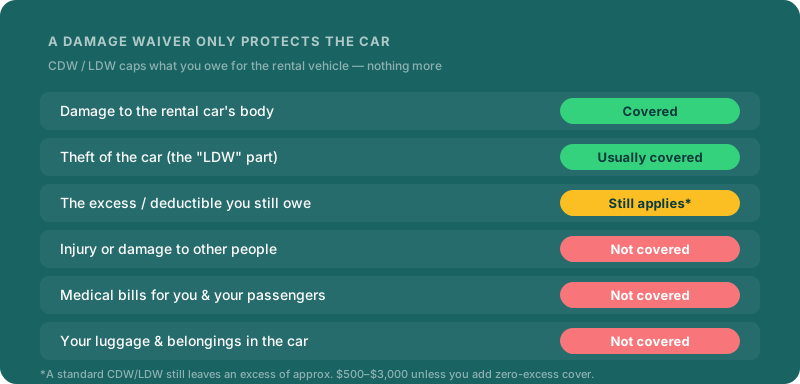
So even with the priciest waiver on the lot, you are typically not covered for:
- Liability — injury or property damage you cause to other people. This is the big financial risk, and it lives in a separate product called SLI (Supplemental Liability Insurance), which raises your third-party limit to as much as approx. $500,000–$1,000,000 depending on jurisdiction. Credit-card rental benefits almost universally exclude liability (State Farm).
- Your own medical bills — that's PAI (Personal Accident Insurance), or, better, your own travel medical plan.
- Your belongings — PEC (Personal Effects Coverage); often your home contents or travel insurance already does this.
- The excess itself — a standard CDW caps the damage but still leaves you owing an excess unless you buy it down to zero.
That last point is where most travelers get surprised, so it deserves its own section.
The excess (deductible) — the gap nobody mentions
"CDW included" on a booking site rarely means "you pay nothing." It almost always means CDW with an excess — often a high one. Inclusive-rate waivers in Europe frequently carry deductibles of approx. $1,000–$3,000 (Rick Steves). If the car is damaged, the company can charge that excess to your card first and sort out the claim later.
There are two ways to close that gap, and they cost wildly different amounts:
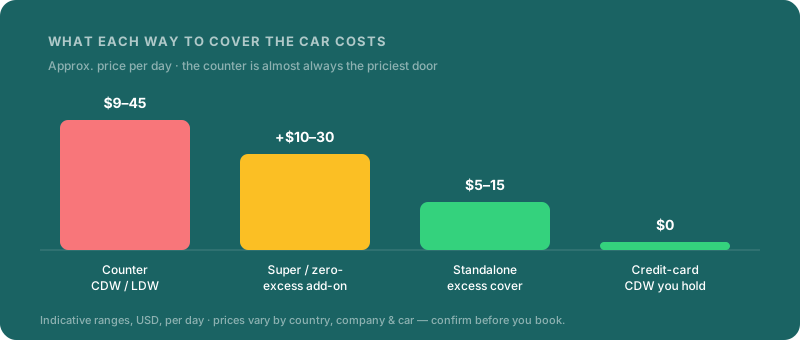
- At the counter — the "super"/zero-excess upgrade. Convenient, immediate, and the most expensive door: counter waivers run approx. $9–$45/day, and the excess buy-down adds roughly $10–30/day on top (KAYAK; Rick Steves).
- Standalone excess insurance — bought in advance from a third party for approx. $5–$15/day (or a flat ~$30–$80 for a week, ~$99–$200 for an annual policy). It works by reimbursement: you still pay the rental company if there's damage, then claim it back. The upside is it often covers areas the counter waiver excludes — tyres, windscreen, undercarriage, and roof (KAYAK).
The trade-off is cash flow and hassle: standalone cover is far cheaper but you front the money and file a claim; the counter upgrade is dearer but you walk away owing nothing on the spot.
Where your coverage can come from
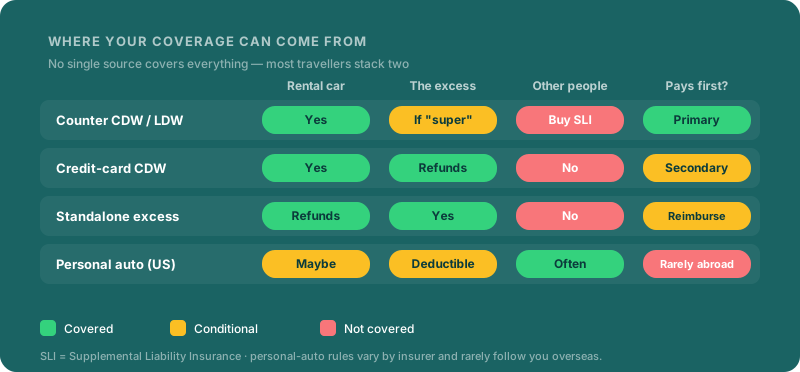
You rarely need to buy everything. Most travelers already hold one or two pieces of this puzzle and only need to fill the gaps. Four sources matter:
Your credit card — but read the fine print
Many travel and mid-tier cards include auto-rental CDW as a benefit. It typically covers damage and theft to the car and can reimburse your excess — but two details decide whether it works:
- Primary vs secondary. Most US cards offer secondary coverage, meaning your own auto policy pays first and the card only tops up what's left (often just your deductible). Primary coverage pays before — and instead of — your own insurer, so you avoid a claim on your personal policy. Primary is much better and much rarer; analysts have found only a minority of cards offer it (NerdWallet; Capital One). Some premium travel cards (for example, the Chase Sapphire line) provide primary coverage for rentals up to approx. 31 days — confirm your own card's current terms, as these change.
- The activation rules are strict. To keep the benefit you generally must (1) decline the rental company's CDW/LDW entirely, (2) pay for the whole rental with that same card, and (3) be the primary renter named on the agreement (State Farm). Accept any counter waiver and you typically forfeit the card benefit.
Credit-card CDW also comes with exclusions worth checking before you fly: it frequently does not apply in certain countries (commonly cited: Italy, Ireland, Israel, Australia, New Zealand, Jamaica), and excludes exotic/luxury cars, large vans and trucks, and very long rentals (NerdWallet; Rick Steves). And remember — it never covers liability.
Your personal auto policy
If you have a US auto policy, its collision and liability coverage may extend to rentals within the US/Canada — but it usually does not follow you overseas, and using it means a claim and your own deductible. Don't assume it travels; call your insurer.
The counter
The counter's CDW/LDW and SLI are the simplest path — they're primary, on the spot, and need no claim with a third party. You pay a premium for that convenience. They make the most sense when your card and home policy leave a real gap, or in a country where credit-card coverage doesn't apply.
Forced-insurance traps to watch for
This is where renting abroad differs most from renting at home. A few patterns to recognize:
- "CDW is mandatory here." Sometimes true, sometimes a sales line. In parts of Europe some basic CDW is effectively bundled into the rate, and a handful of countries (e.g. Italy, Ireland) make it non-optional (Rick Steves). But "you must buy our top-tier zero-excess package" is almost never a legal requirement — that's the upsell.
- The deposit hold. Decline the counter waiver and the company may place a hold on your card for a chunk of the car's value (or the full excess). If your credit limit is low, this can fail — and a failed hold can force you into buying their coverage on the spot. Travel with enough available credit.
- "Your credit card won't be accepted here." Agents outside the US are sometimes genuinely unfamiliar with card CDW, because the perk is rare on locally issued cards. Bring a printout of your card's benefits guide to cut down the pushback (Rick Steves).
- The pre-ticked tablet. Excess buy-downs and SLI are often pre-selected on the signature screen. Read every line before you sign.
- Tyres, glass, and undercarriage exclusions. Even after you've paid for a waiver, these are commonly not included — which is exactly the gap a standalone excess policy fills.
The cleanest defence: decide your coverage before you arrive, not under pressure at the desk. Print your card benefits, know your excess number, and know whether you're buying SLI for liability.
So, what do you actually need?
A quick decision shortcut — adjust to your own card and country:
| Situation | A sensible baseline |
|---|---|
| Renting in a country your card CDW covers, and you accept secondary coverage | Decline counter CDW, pay with that card, add SLI for liability |
| Renting where card CDW is excluded (e.g. Italy, Ireland) | Take the counter CDW/LDW; consider a standalone excess policy to cut cost |
| You want zero claims hassle and predictable cost | Buy counter LDW + SLI, or a primary-coverage card + SLI |
| Budget-focused, comfortable fronting a claim | Standalone excess insurance booked in advance + your card's CDW |
| Renting in the US/Canada with a personal auto policy | Your own policy may extend — confirm, then add only the gaps |
The one piece almost nobody should skip abroad is liability (SLI or equivalent) — it's the coverage with the largest possible bill and the one your card won't provide.
Planning the rest of the trip? Sort your travel insurance and the trade-offs against a PTO buyout before you leave, and line up your data with a travel eSIM so your maps and translation work the moment you drive off the lot.
Frequently asked questions
Is CDW the same as insurance?
No. CDW (and LDW) is a waiver — a contractual promise by the rental company not to charge you for damage to or theft of the car, provided you follow the rental agreement. It is not a regulated insurance policy, it only protects the vehicle, and it can be voided if you breach the contract (WalletHub).
Does my credit card cover rental cars abroad?
Often, but with conditions. Many cards include auto-rental CDW that you activate by declining the counter waiver and paying with that card. It's usually secondary in the US, almost always excludes liability, and is frequently not valid in certain countries (commonly Italy, Ireland, Israel, Australia, New Zealand). Read your specific benefits guide before you travel (NerdWallet; State Farm).
What is the excess, and why do I still owe money with CDW?
The excess (deductible) is the amount you pay before the waiver applies — commonly approx. $500–$3,000+. A standard CDW caps your liability but doesn't erase the excess. To remove it you either buy a "super"/zero-excess upgrade at the counter (approx. +$10–30/day) or a cheaper standalone excess policy (approx. $5–15/day) that reimburses you after you've paid (Rick Steves; KAYAK).
Do I really need the rental company's liability insurance (SLI)?
It's the coverage most worth taking seriously abroad. CDW/LDW and credit-card benefits cover the car, not harm you cause to other people — and that's the claim that can run into hundreds of thousands. If your own auto or travel policy doesn't extend liability to your rental overseas, the counter's SLI is usually the practical way to fill that gap.
Sources
- Rick Steves — Car Rental and the Collision Damage Waiver (CDW) in Europe — waiver definition, European deductibles, counter upsell, credit-card exclusions (Italy/Ireland).
- WalletHub — What Is the Difference Between CDW and LDW? — CDW vs LDW, "waiver not insurance," excess ranges.
- NerdWallet — Rental Car Insurance: How Your Credit Card Has You Covered — primary vs secondary, activation rules, country and vehicle exclusions.
- State Farm — Credit Card Rental Car Insurance Benefits Explained — what card CDW does and doesn't cover (liability excluded).
- Capital One — Credit Card Rental Car Insurance: How It Works — primary vs secondary coverage and how reimbursement works.
- KAYAK — The essential guide to car rental excess insurance — excess explained, standalone third-party cover, reimbursement, cost comparison.
Prices, excess amounts, country exclusions, and specific credit-card perks change frequently. Confirm the details with the rental company and your card's current benefits guide before you book or travel.
Next Step
Match this trip idea to your PTO
See which holiday windows make this trip easiest to book, then set reminders before prices move.
Plan this trip windowGet booking-timing and PTO planning emails
Useful tools
Related Articles
New Mexico Travel Guide: Chile, Dunes, and Big Skies
New Mexico rewards drivers with white gypsum dunes, mile-high adobe cities, and green-chile everything, but the distances, altitude, and afternoon storms catch most first-timers off guard.
New York Travel Guide: Beyond the City, Into the State
New York is two trips in one: a dense five-borough metropolis and a huge upstate wilderness of gorges, six-million-acre forests, and lake-effect snow belts that most visitors never reach.
Iceland in November: The Off-Peak Window Before the Christmas-Market Surge
November is the last quiet window before Iceland's Christmas-market prices kick in. Here is exactly how it pencils out -- flights, hotels, Blue Lagoon, Ring Road access -- and how US holidays bridge into it.