How to Claim Your VAT Refund in Europe: A Step-by-Step Guide for Visitors
Fact-checked July 2, 2026 · 8 sourcesHow we verify
If you live outside the European Union and you shop while visiting, a chunk of what you pay at the till is Value-Added Tax (VAT) — and you may be able to get it back when you fly home. The catch is that the refund is not automatic. You have to ask for the right paperwork in the shop, get it validated by customs before you leave, and then choose how you want the money paid. Miss any one of those and the refund quietly disappears.
This guide walks the whole journey end to end: who qualifies, the per-country minimum spend, the Global Blue / Planet forms, the customs stamp, and the cash-versus-card decision that quietly eats into your refund. If you're still deciding when to take the trip, our calculator at /optimize helps you turn a few days off into a longer break, and Europe's shoulder season — where and when covers the cheapest windows to go.
This is a research post written with sources. The mechanics of the refund (who qualifies, the customs stamp, cash vs card) change slowly, but prices, fees, minimum-spend thresholds and refund timelines change often and differ by country and operator. Everything time-sensitive below is marked "approx." Confirm the current rules with the official sources in Sources before you shop or travel.
What a VAT refund actually is — and who qualifies
VAT is a consumption tax baked into the shelf price across the EU and much of Europe. Standard rates are high — very roughly 8% to 27% depending on the country — so on a meaningful purchase the refund is real money, not loose change.
The core eligibility rule is set at EU level and is refreshingly simple: if you are resident outside the EU, you are entitled to a VAT refund on goods you bought during your stay, provided the goods are shown to customs on departure within 3 months of purchase, together with the refund documents, and the goods leave the EU with you. (Source: the EU's official Your Europe portal.)
A few things follow from that:
- It's for goods you take home, not services you consume there. Hotel nights, restaurant meals, car hire and museum tickets don't qualify — you used them in the EU.
- The goods should stay unused and available to show until you've cleared customs. Some shops literally seal the bag.
- The actual procedure is not harmonised across the EU — each country (and each refund operator) runs it slightly differently, which is why the steps below have "it depends" moments.
Non-EU resident is the test, not nationality. An EU passport holder living abroad can qualify; a non-EU citizen living in the EU usually cannot. Border officers may ask for proof of residence.
The refund in four steps
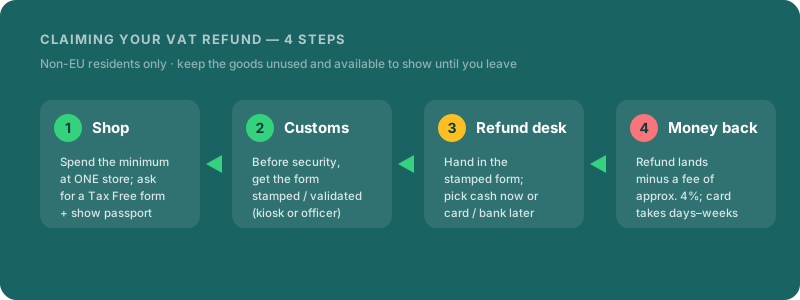
1. In the shop: hit the minimum, ask for the form
Tell the assistant before you pay that you want to shop tax free. They'll prepare a Tax Free form (often branded Global Blue or Planet, the two big refund operators, though some shops use others or their own scheme) and will need your passport — sometimes a photo of it — to fill in your details. Keep the form stapled to the original receipt.
Two rules trip people up:
- You have to clear the country's minimum spend at a single retailer. You generally cannot add up small purchases from several shops to reach the threshold.
- The minimum is per country, and it varies a lot (see the next section).
2. At customs: the stamp is the whole ballgame
This is the step that makes or breaks the refund. Before you check a bag or pass security on your way out of the EU, you must get the form validated by customs — either a physical stamp from an officer or a digital validation at a self-service kiosk (France uses the PABLO kiosks; Italy, Spain and Portugal are largely digital too).
To validate, you present your passport, the receipt/invoice, the Tax Free form, and the goods themselves if asked. Customs confirms the items are leaving the EU and authorises the refund. No validation, no refund — "no matter how perfect the paperwork," as Global Blue puts it.
Practical realities:
- Allow extra time. You may have to visit a customs office before check-in (because the goods could be in your checked bag), then a separate refund desk afterwards. Queues are real — budget an extra hour or so on a busy day.
- If you're connecting through another EU country, you usually validate at your final EU departure point, not the first.
- Leaving by train, car or ferry? Customs locations vary by route — confirm where the validation point is before you travel.
Skipping the stamp doesn't just forfeit the refund. If the operator never receives a validated form, many will charge the VAT back to the card you used — and several set a tight return deadline (Planet, for example, has cited around 21 days to get the validated form back). Treat the stamp as mandatory.
3. At the refund desk: choose cash or card
With a validated form, you collect the money:
- Cash at an airport refund counter — paid in the local currency, in your hand on the spot.
- Card or bank transfer — credited to the card you used, arriving later.
- App / online portal for some operators and countries.
That choice has a cost attached, which is the next big decision.
4. Money back — minus the fees
Refund operators keep a cut for handling everything. Expect to receive noticeably less than the headline VAT — a service fee of approx. 4% of the purchase is a common rule of thumb, and cash and currency conversion can shave off more. We break the math down below.
Minimum spend: per country, per shop
There is no single EU-wide minimum — each country sets its own, and they move. The chart and table below are approximate and meant for orientation only; confirm the current figure for your country before you shop.
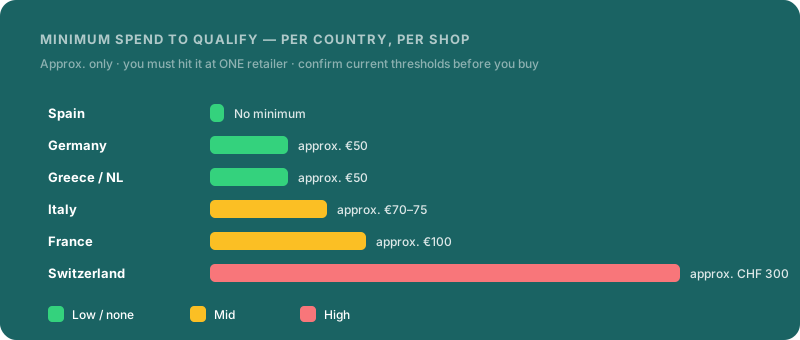
| Country | Approx. minimum spend (one shop) | Notes |
|---|---|---|
| Spain | No minimum | Even small buys can qualify |
| Germany | approx. €50 | One of the lower EU thresholds |
| Netherlands / Greece | approx. €50 | Common ~€50 band |
| Italy | approx. €70–75 | Confirm current figure |
| France | approx. €100 | Among the higher EU minimums |
| Switzerland | approx. CHF 300 | Not in the EU — own scheme |
These are per country and per single retailer, including VAT. The amounts change with policy, so treat the table as a starting point and verify before buying. (Country figures here track CNBC's May 2026 round-up and operator pages; see Sources.)
Cash vs card: which refund to take
Both payout methods lose something to fees — the question is whether you're paying for speed (cash) or holding out for the largest net amount (card). Here's the trade-off.
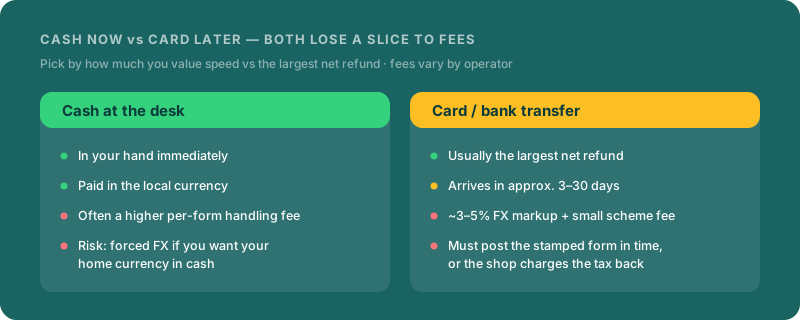
| Cash at the desk | Card / bank transfer | |
|---|---|---|
| Speed | Immediate | approx. 3–30 days (operator-dependent) |
| Currency | Local currency of the refund office | Back to your card |
| Main cost | Higher per-form handling fee | FX markup approx. 3–5% + small per-form scheme fee |
| Watch out for | "Forced" home-currency conversion at a poor rate | Must post the validated form in time, or you're charged the tax back |
A few specifics worth knowing:
- For card refunds, Global Blue has described a currency-conversion charge based on a European retail-bank rate plus roughly 3–5% when your refund currency differs from the form's, plus a scheme fee of up to about €1 per form (more for some countries), and there can be a further 2–4% if the refund currency differs from your card's billing currency.
- Card timing varies widely: Global Blue has cited roughly 3–5 days, while Planet aims to process card refunds within ~30 days of receiving your validated form.
- If you take cash, decline the offer to convert into your home currency at the desk — take the local currency and let your own bank handle the exchange, which is usually cheaper.
Rule of thumb: for a small refund where you just want it done, cash is fine. For a larger refund, the card route — in local currency — typically nets you more, as long as you actually mail/return the validated form on time.
How much will you really get back?
The headline VAT rate is not what hits your account. Subtract the operator's fee, then any currency conversion. Below is an illustrative example on a €1,000 purchase in a country with a 20% VAT rate — figures are rounded and for orientation only.
| Step | Approx. amount |
|---|---|
| Purchase price (VAT included) | €1,000 |
| VAT portion (at ~20%) | ~€167 |
| Less operator service fee (~4% of purchase) | −~€40 |
| Approx. refund received | ~€120–€130 |
So on a €1,000 buy you might pocket something like 12–13% back rather than the full 20% — still worthwhile on higher-value items like fashion, watches and jewellery, less exciting on small purchases once fees bite. Add currency conversion if you take cash in the wrong currency and the net shrinks further.
Numbers above are illustrative. VAT rates, the refundable portion and operator fees all vary by country and operator and change over time — confirm before you count on a figure.
Plan it into your trip
The refund process is mostly about time and paperwork at the airport, so build it into your travel day rather than your shopping day:
- Keep every receipt and form together, goods unused, until after customs.
- Get to the airport early — the customs/refund detour can add an hour on busy days.
- Validate at your final EU departure point, then visit the refund desk.
- Take local currency if paying out in cash; prefer card in local currency for larger sums.
If the trip itself is still on the drawing board, line up the dates first: the leave optimizer at /optimize helps you stretch public holidays into a longer break, and if you're sorting out staying connected abroad, see our travel eSIM guide so maps and translation work the moment you land.
FAQ
Do I get the VAT refund automatically at the till?
No. You must ask the shop for a Tax Free form at the time of purchase (showing your passport), clear the country's minimum spend at that one store, then get the form validated by customs when you leave the EU and claim the refund from the operator. Skip any step and there's no refund.
What happens if I forget the customs stamp?
You lose the refund. Customs validation — a physical stamp or a digital kiosk validation — is mandatory before you leave the EU. Worse, if the operator never receives a validated form, many will charge the VAT back to your card, sometimes within a short deadline (Planet has cited ~21 days). Always validate before security or check-in.
Should I take my refund in cash or on my card?
For a small refund where convenience matters, cash at the airport is simplest. For a larger refund, card in the local currency usually nets more because you avoid stacked conversion fees — just make sure you return the validated form on time. Either way, decline a "convert to my home currency" offer at the desk; it's typically a poor rate.
Can I combine purchases from different shops to reach the minimum?
Generally no. The minimum spend almost always has to be met at a single retailer in a single transaction. Some operators or department stores let you consolidate purchases made the same day in the same store, but you can't pool small buys from different shops to clear the threshold.
Sources
- Your Europe (European Union) — VAT refunds for non-EU residents — official eligibility, the 3-month export rule, and customs validation requirement.
- European Commission — Taxation and Customs Union: VAT refunds — EU-level framework and that the procedure is not harmonised.
- Global Blue — How to shop Tax Free — operator's three-step process (shop, validate, refund) and refund methods.
- Planet — VAT refund / Tax Free shopping — operator process, customs/kiosk validation, and card-refund timing.
- Rick Steves — How to Claim Value-Added Tax (VAT) Refunds — single-retailer minimums, the ~4% service fee, customs-stamp warnings, and airport timing advice.
- CNBC (May 2026) — European VAT refunds: how travelers can get money back — per-country minimum spend round-up and expert guidance.
Minimum-spend thresholds, operator fees, refund timelines and VAT rates change and differ by country and operator. Confirm the current rules with the official sources above before you shop or travel.
Next Step
Match this trip idea to your PTO
See which holiday windows make this trip easiest to book, then set reminders before prices move.
Plan this trip windowGet booking-timing and PTO planning emails
Useful tools
Related Articles
New Mexico Travel Guide: Chile, Dunes, and Big Skies
New Mexico rewards drivers with white gypsum dunes, mile-high adobe cities, and green-chile everything, but the distances, altitude, and afternoon storms catch most first-timers off guard.
New York Travel Guide: Beyond the City, Into the State
New York is two trips in one: a dense five-borough metropolis and a huge upstate wilderness of gorges, six-million-acre forests, and lake-effect snow belts that most visitors never reach.
Iceland in November: The Off-Peak Window Before the Christmas-Market Surge
November is the last quiet window before Iceland's Christmas-market prices kick in. Here is exactly how it pencils out -- flights, hotels, Blue Lagoon, Ring Road access -- and how US holidays bridge into it.