The Best Bridge Years, Ranked: 2027–2030 for Squeezing Days Off (US + Korea)
Fact-checked July 10, 2026 · 6 sourcesHow we verify
Not all years are created equal. Take the same 10 days of paid leave, spend them in one year versus another, and the amount of continuous time off you actually get can differ by a week or more — purely because of which weekday each public holiday happens to land on. This is the quiet math behind "bridge" planning, and it's the reason a savvy colleague seems to be on holiday constantly while you burn the same days for far less.
This post ranks 2027, 2028, 2029, and 2030 on exactly that: how efficiently a fixed pool of leave converts into consecutive days off. We score each year for the US federal calendar and South Korea's holiday system, because the two behave very differently — one has fixed-date holidays that drift across weekdays, the other pins several holidays to the lunar calendar and layers a substitute-holiday rule on top.
This is a research/analysis piece with sources listed at the bottom. Holiday dates shift every year, and Korea's substitute-holiday and any government-declared temporary holidays are set by decree and can change. We deliberately keep the ranking relative and methodology-based and hand off exact per-year dates to the leave optimizer. Confirm specifics against the official calendars in Sources before booking.
The one metric that decides a "good" bridge year
A holiday is only worth planning around if it lands on a weekday. A public holiday that falls on a Saturday or Sunday is, for most workers, a day you already had off — its bridge value collapses to roughly zero (unless your country grants a substitute day, which we'll get to).
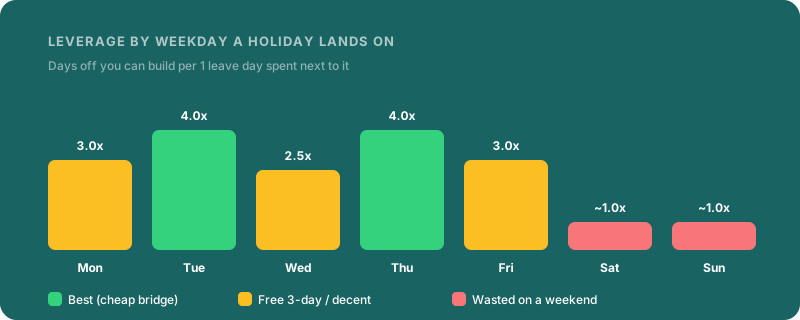
So the single most useful lens is the leverage ratio: days of continuous time off divided by days of paid leave spent.
- Spend 1 leave day next to a Monday holiday to bridge Sat–Sun–Mon–Tue: that's 4 days off for 1 day spent → 4.0× leverage.
- Spend 4 leave days in a week with a Thursday holiday to chain the weekend, the holiday, and the Friday: often 9 days off for 4 spent → 2.25×.
- Spend a leave day next to a holiday that already fell on a Saturday: ~1.0× leverage — you gained almost nothing.
The best bridge years are the ones where the most holidays fall on a Tuesday or Thursday (one cheap bridge day turns a 3-day weekend into a 4-day one, or unlocks a 9-day run) and the fewest are wasted on a Saturday or Sunday.
Why weekday placement, not holiday count, is what matters
Every year has roughly the same number of public holidays — 11 US federal holidays, ~15 Korean public holidays. What changes year to year is where they land. A year with 11 holidays that mostly fall Tuesday/Thursday is dramatically more valuable to a planner than a year with the same 11 holidays clustered on weekends. Counting holidays tells you almost nothing; counting weekday holidays and bridgeable weekday holidays tells you almost everything.
US federal calendar: 2027–2030 scored
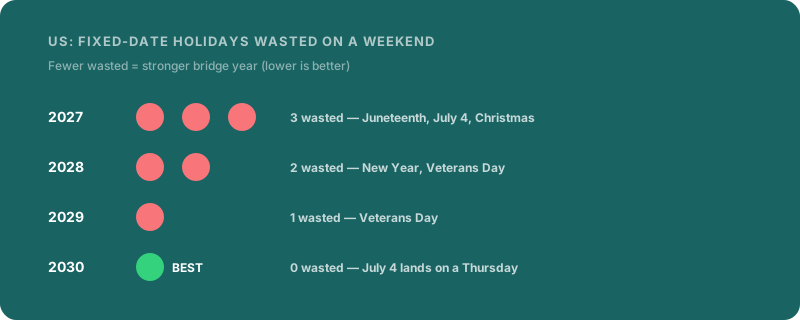
The US has 11 federal holidays. Several are pinned to a Monday by design (MLK Day, Presidents' Day, Memorial Day, Labor Day, Columbus Day) — those give a reliable 3-day weekend every year but don't vary. The fixed-date holidays are where a year wins or loses: New Year's Day, Juneteenth (Jun 19), Independence Day (Jul 4), Veterans Day (Nov 11), and Christmas (Dec 25) drift across the week annually.
Here's how the fixed-date holidays fall, and how many land on a weekend (a weekend fall = wasted, though it's observed on the adjacent Friday/Monday for federal workers):
| Year | Fixed-date holidays on a weekday (good) | On a weekend (wasted) | Standout bridge setups |
|---|---|---|---|
| 2027 | Veterans Day → Thursday | 3 — Juneteenth (Sat), July 4 (Sun), Christmas (Sat) | Thu Veterans Day → cheap 4-day |
| 2028 | July 4 → Tuesday; Juneteenth → Monday | 2 — New Year (Sat), Veterans Day (Sat) | Tue July 4 → 1-day bridge = 4-day |
| 2029 | July 4 → Wednesday; Juneteenth → Tuesday | 1 — Veterans Day (Sun) | Tue Juneteenth → 4-day |
| 2030 | July 4 → Thursday; Juneteenth → Wednesday; Veterans Day → Monday; Christmas → Wednesday | 0 | Thu July 4 → 1-day bridge = 4-day; clean year |
US ranking (best → worst bridge year):
- 2030 — zero fixed-date holidays wasted on a weekend, and Independence Day lands on a Thursday (a classic one-bridge-day → 4-day-weekend setup). The strongest year of the four.
- 2029 — only one weekend loss (Veterans Day on a Sunday), with Independence Day mid-week (Wednesday) and Juneteenth on a Tuesday.
- 2028 — two weekend losses, but Independence Day on a Tuesday and Juneteenth on a Monday salvage it.
- 2027 — the weakest US year: three fixed-date holidays fall on a weekend (Juneteenth, July 4, and Christmas), each observed on an adjacent day but with far less bridge upside than a clean weekday.
South Korea: the lunar calendar and the substitute-holiday rule
Korea plays by different rules, and they mostly work in your favor.
First, entitlement: under the Labor Standards Act (근로기준법) Article 60, a worker with at least one year of service and 80%+ attendance gets 15 days of paid annual leave, rising by 1 day every 2 years of service up to a cap of 25 days. On top of that sit ~15 public holidays.
Second, the substitute holiday (대체공휴일): when major holidays — Lunar New Year (Seollal), Chuseok, Children's Day, National Foundation Day, Hangeul Day, and now Buddha's Birthday and Christmas — fall on a weekend, the next non-holiday weekday becomes an official day off. This rule blunts the "wasted weekend holiday" problem that hurts the US calendar.
Third, and most importantly: Seollal and Chuseok are three-day blocks anchored to the lunar calendar, so their Gregorian dates move every year. When one of these blocks brushes up against a weekend and a nearby fixed holiday, you get rare mega-bridges.
The 2028 super-break
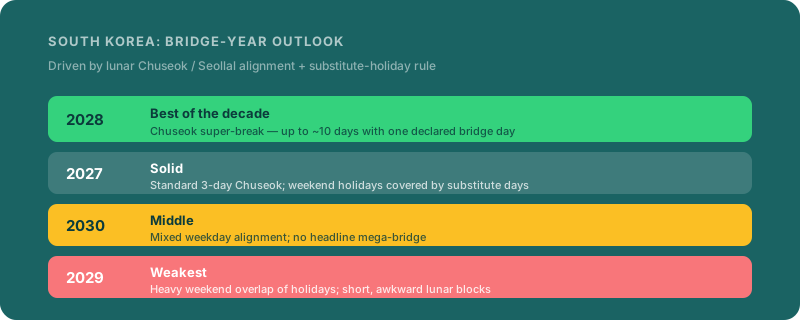
2028 is the standout Korean year of the decade. Chuseok falls on October 3 (coinciding with National Foundation Day), producing a six-day consecutive break from Saturday, September 30 through Thursday, October 5 (with a substitute day around the Chuseok / National Foundation Day overlap). If the government designates one additional bridge day (Friday, Oct 6), it can chain to the following weekend and Hangeul Day (Monday, Oct 9) for a ~10-day break — the kind of alignment that, per reporting, essentially doesn't recur again until 2044.
By contrast, 2029, 2032, and 2035 (alongside 2026) are called out in the same reporting as among the worst for Korean workers — a group of years tied for the shortest Chuseok breaks, because holidays overlap heavily with weekends and the lunar blocks land inconveniently even with substitute days softening the blow.
| Year | Korea outlook | Why |
|---|---|---|
| 2028 | Best of the decade | Chuseok super-break; possible ~10-day run with one declared bridge day |
| 2027 | Solid | Standard 3-day Chuseok; several weekend holidays covered by substitute days |
| 2030 | Middle | Mixed weekday alignment; no headline mega-bridge |
| 2029 | Weakest | Heavy weekend overlap of holidays; short lunar blocks |
Korea ranking (best → worst): 2028 › 2027 ≈ 2030 › 2029.
Worked example: 10 leave days, 2027 vs 2030 (US)
Say you have 10 paid-leave days and want the most continuous time off. Hold the strategy constant — bridge the highest-leverage holidays first — and just change the year.
2027 (weak year). Three of your fixed-date holidays (Juneteenth, July 4, Christmas) fell on a weekend, so their bridge value is muted. You lean on the Monday holidays and Thursday Veterans Day:
- Veterans Day (Thu) + 1 bridge day (Fri) → 4 days off (1 leave spent)
- Memorial Day (Mon) + 1 bridge day (Tue) → 4 days off (1 leave spent)
- Labor Day (Mon) + 1 bridge day → 4 days off (1 leave spent)
- Thanksgiving (Thu) + 1 bridge day (Fri) → 4 days off (1 leave spent)
- Two standalone 2-day extensions with remaining 6 leave days → modest gains
Rough tally: ~10 leave days → ~26–28 days off, i.e. ~2.7× blended leverage, dragged down by the three wasted weekend holidays.
2030 (strong year). Now Independence Day is a Thursday, Juneteenth a Wednesday, Christmas a Wednesday, Veterans Day a Monday — nothing wasted on a weekend:
- July 4 (Thu) + 1 bridge day (Fri) → 4 days off (1 leave)
- Veterans Day (Mon) + 1 bridge day (Tue) → 4 days off (1 leave)
- Memorial / Labor / Presidents' Day Mondays each + 1 bridge → 4 days off each
- Christmas (Wed) → build a longer year-end run by bridging both sides
Rough tally: ~10 leave days → ~30–34 days off, i.e. ~3.2× blended leverage — the same 10 days buying you roughly half a week to a week more of continuous time off than in 2027.
These totals are illustrative and depend on your exact allocation, company observance, and whether Friday/Monday bridges are available. The point is the direction and size of the gap, not the decimal. Plug your real leave balance and country into the optimizer to get exact runs for your year.
How to use this ranking
- Front-load the strong years. If you can shift a big trip, aim it at the higher-ranked year (US: 2030 > 2029 > 2028 > 2027; Korea: 2028 first). You get more days off for the same leave.
- In weak years, protect the good holidays. In a year like US-2027, the few weekday holidays (Thursday Veterans Day, the Monday-anchored ones) carry disproportionate value — book those bridges early before flights and hotels spike.
- In Korea, watch for declared bridge days. The 2028 super-break only reaches ~10 days if the government designates the extra day. Keep leave in reserve so you can pounce if it's announced.
- Don't plan on stale dates. Everything above is relative ranking. Exact dates and substitute-day designations shift — always confirm the specific year in the optimizer and the official calendars before committing money.
For year-specific US bridge maps see 2027 PTO calendar: every bridge day in the US, for the head-to-head see 2026 vs 2027: which year is better for leave, and for the underlying mechanics see how holiday bridges work.
FAQ
Which single year, 2027–2030, is the best for maximizing days off?
It depends on your country. For the US federal calendar, 2030 ranks best of the four — no fixed-date federal holidays fall on a weekend and Independence Day lands on a Thursday. For South Korea, 2028 is the standout because of the Chuseok super-break that can reach roughly 10 days. Your personal best year also depends on your leave balance and how many bridge days your employer allows, so verify with the optimizer.
Why is a Tuesday or Thursday holiday better than a Monday or Friday one?
A Monday or Friday holiday already gives you a 3-day weekend for free — nice, but no leverage. A Tuesday or Thursday holiday lets you spend just one leave day (Monday, or the Friday) to bridge the whole thing into a 4-day weekend, and often longer if you extend the other side. That single cheap bridge day is why Tue/Thu placements score highest on the leverage ratio.
Does Korea's substitute-holiday rule make weekend holidays "safe"?
Largely, yes. When a covered major holiday (Seollal, Chuseok, Children's Day, National Foundation Day, Hangeul Day, Buddha's Birthday, Christmas) falls on a weekend, the next available weekday becomes an official day off. That's a real advantage over the US, where a federal holiday on a Saturday is simply observed on the adjacent Friday for federal workers and often not honored at all by private employers. It doesn't create new bridge upside, but it stops weekend holidays from being pure losses.
Can these rankings change before the year arrives?
Yes — that's why they're relative, not absolute. US fixed-date holiday weekdays are known well in advance and are stable, but Korea's substitute-holiday designations and any government-declared temporary holidays are set by decree and can be added or shifted (the 2028 ~10-day run literally depends on one such declaration). Always re-check the official calendars in Sources and the optimizer before you book anything.
Sources
- U.S. Office of Personnel Management — Federal Holidays — official US federal holiday dates and weekend-observance rules.
- FederalPay.org — List of Federal Holidays — federal holiday dates and days of the week by year (cross-check).
- The Korea Herald — "2028 and 2044 may bring 10-day 'super-break'" — analysis of Korea's long-holiday alignment through the decade.
- 근로기준법 (Labor Standards Act), Article 60 — Korea Law Information Center — statutory annual leave entitlement (15 days rule).
- PublicHolidays.co.kr — South Korea public-holiday calendar and substitute-holiday listings.
- Wikipedia — List of minimum annual leave by country — cross-country leave and public-holiday comparison (US has no federal statutory minimum).
Next Step
See your own best PTO windows
The article gives you the strategy. The optimizer gives you the exact dates for your year and your PTO balance.
Find my windowsGet the calendar and return when you are ready
Related topics
Useful tools
Related Articles
The Bridge-Day ROI Formula, Explained: How to Measure Days-Off-Per-Leave-Day
A data-driven breakdown of bridge-day ROI: the days-off-per-leave-day formula, why Tuesday and Thursday holidays outperform Mondays, and how to rank every leave day you own. Worked examples for the US, Korea, and Europe.
How Many Days Off Per PTO Day? The Leave Leverage Ratio, Explained
Every vacation day you spend buys somewhere between 1 and 4+ days off, depending on the calendar. This data explainer defines the leave leverage ratio, ranks the scenarios, and shows how the US, Korea, and Europe differ — with a worked example and a country comparison table.
The Holiday Leverage Ratio: How Much Time Off Each Weekday Buys You
A data-driven look at the holiday leverage ratio -- how many days off each paid leave day buys you, ranked by the weekday a public holiday lands on. Includes a Korea vs. US comparison, a worked 15-day PTO example, and the exact bridge math.