How Many Days Off Per PTO Day? The Leave Leverage Ratio, Explained
Fact-checked July 10, 2026 · 5 sourcesHow we verify
Two people take the exact same amount of vacation this year — say, five paid leave days each. One of them ends the year with five extra days off. The other ends the year with fifteen. Neither cheated. The second person simply spent their days where the calendar was doing half the work for them.
That multiplier has a name. Call it your leave leverage ratio: how many total consecutive days off you get for every paid leave (PTO) day you actually spend. It is the single most useful number in leave planning, and it is fully knowable before you file a single request.
This post explains what the ratio is, what values are realistic, why the same PTO day is worth so much more in some weeks than others, and how the whole picture shifts depending on whether you work in the US, Korea, or Europe. It is a companion to The Bridge-Day ROI Formula, Explained and How Holiday Bridges Work — this one is the plain-language "why does this even work" version.
This is a research post written with sources. The ratio is deterministic arithmetic. The inputs — exact holiday dates, which weekday each lands on, and substitute-holiday rules — shift every single year. Don't hard-code any specific date below for a future year; drop your real calendar into the leave optimizer instead.
What the leave leverage ratio actually is
The definition is one line of arithmetic:
Leverage ratio = Total consecutive days off ÷ Paid leave days spent
If you take one Friday off and it hands you a Saturday–Sunday, you were off for three days on one day of leave. That is a leverage ratio of 3.0. If you take a random Wednesday off in a week with no holidays and no adjacent weekend, you were off for one day on one day of leave: a ratio of 1.0 — the floor. You can never go below 1.0, because the day you spent is itself one of the days you got off.
The whole game of leave optimization is pushing that number as far above 1.0 as the calendar allows. And the calendar allows a lot: the ceiling in a normal week is around 3–4, and around long multi-day public holidays it can spike far higher.
Two things generate all the leverage:
- Adjacent weekends. A weekend is time off you already have. Any leave day you place next to it inherits those two free days.
- Public holidays. A public holiday is a free non-weekend day off. A leave day placed between a holiday and a weekend "bridges" the gap and absorbs both.
Everything else in this post is just those two forces, counted carefully.
The realistic range: a ratio ladder
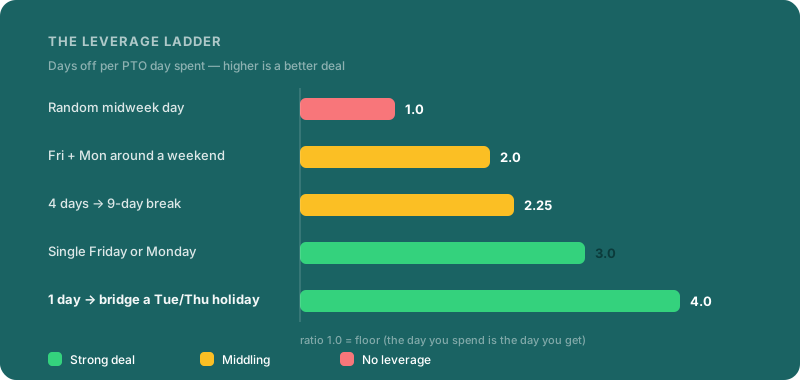
Here is what actually happens per leave day spent, ordered worst to best. The multiplier is what you get per PTO day, not the total break length.
| Scenario | Leave days spent | Total days off | Leverage ratio |
|---|---|---|---|
| Random midweek day, no weekend, no holiday | 1 | 1 | 1.0 |
| A single Friday or Monday (extend a weekend) | 1 | 3 | 3.0 |
| Friday and Monday around one weekend | 2 | 4 | 2.0 |
| One day bridging a Tue/Thu holiday to the weekend | 1 | 4 | 4.0 |
| Two days bridging a midweek holiday to both weekends | 2 | 6 | 3.0 |
| Four days filling a full work-week that contains a holiday | 4 | 9 | 2.25 |
| Leave stacked onto a 3-day national holiday block + weekends | ~2 | ~7–9 | ~3.5–4.5 |
Read the ratio column, not the days-off column. A three-day weekend from one Friday (3.0) is more efficient per day than a nine-day break that cost you four days (2.25) — the nine-day break is longer and more restful, but it is a worse deal per PTO day. Both are legitimate goals; you just want to know which lever you are pulling.
The standout row is the single day bridging a Tuesday or Thursday holiday. That one leave day turns a four-day block into reality at a 4.0 ratio — the best routine deal on the calendar.
Why the weekday of the holiday decides everything
The reason a holiday's weekday matters so much is that it changes how many free days a single leave day can reach.
| Holiday lands on… | Bridge you can build | Leave days needed | Total off | Ratio |
|---|---|---|---|---|
| Tuesday | Take Monday → Sat–Sun–Mon–Tue | 1 | 4 | 4.0 |
| Thursday | Take Friday → Thu–Fri–Sat–Sun | 1 | 4 | 4.0 |
| Monday | Already a long weekend — nothing to bridge | 0 | 3 | ∞ (but no lever) |
| Friday | Already a long weekend — nothing to bridge | 0 | 3 | ∞ (but no lever) |
| Wednesday | Take Mon+Tue or Thu+Fri to reach a weekend | 2 | 6 | 3.0 |
A Monday or Friday holiday is generous — it gives you a three-day weekend for free — but it offers no bridge to buy, so there is no leverage decision to make. The Tuesday and Thursday holidays are the ones where spending a single day is transformative. Wednesday holidays are the "island in the middle": you need two days to reach a weekend on either side, so the best you can squeeze is a 3.0 ratio. This is the core insight in Ranking US Federal Holidays by Bridge Potential.
A worked example: five leave days, two strategies
Say you have five PTO days to spend this year, and your calendar happens to contain (dates deliberately generic — plug your real year into the optimizer):
- One Tuesday public holiday
- One Thursday public holiday
- One Monday public holiday (already a long weekend)
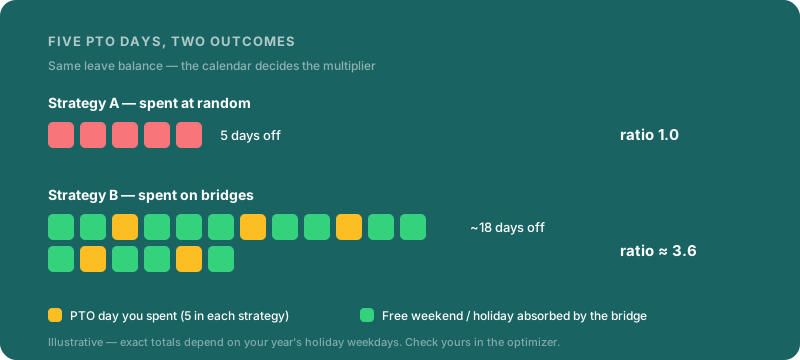
Strategy A — spend them randomly. You take five scattered midweek days for errands and appointments. None touch a weekend or holiday.
5 days spent → 5 days off Leverage ratio = 1.0
Strategy B — spend them on the bridges. You place:
- 1 day before the Tuesday holiday → a 4-day block (ratio 4.0)
- 1 day after the Thursday holiday → a 4-day block (ratio 4.0)
- 2 days bridging a midweek holiday week to both weekends → a 9-day block (ratio 4.5 across those 2 days plus the holiday and weekends)
- 1 day left over, stacked onto the free Monday long weekend → a 4-day block (ratio 4.0 on that day)
5 days spent → roughly 17–20 days off Leverage ratio ≈ 3.4–4.0
Same five days. Strategy A gives you five days off. Strategy B gives you the better part of three extra weeks. The delta — 12 to 15 additional days off — is pure calendar leverage, paid for with zero extra PTO. The half-day PTO strategy can push the ratio even higher on the margins.
The ratio depends heavily on where you work
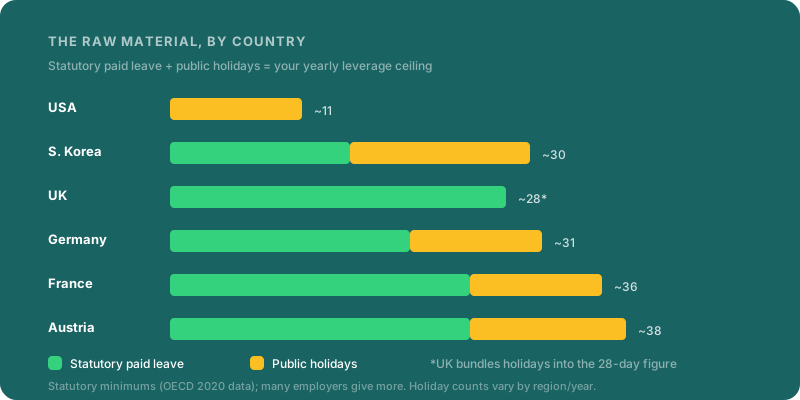
Your maximum achievable leverage over a year is capped by two things you don't control: how many paid leave days the law/your employer gives you, and how many public holidays your country has. More public holidays means more bridge opportunities; more paid leave means more days to spend on those bridges.
Here is the raw material by country. Statutory figures are legal minimums — many employers give more — and public-holiday counts vary by region within a country.
| Country | Statutory paid leave (min) | Public holidays (approx) | Combined floor | Notes |
|---|---|---|---|---|
| United States | 0 (no federal minimum) | ~11 federal | ~11 | Only OECD country with no legal vacation floor |
| South Korea | 15 (after 1 yr) → 25 max | ~15 | ~30 | Substitute-holiday rule recovers weekend clashes |
| United Kingdom | 28 (incl. bank holidays) | ~8 bank | ~28 | The 28 already bundles the holidays |
| Germany | 20 | ~10–13 (varies by state) | ~30–33 | Bridge days ("Brückentage") are a national sport |
| France | 25 | ~11 | ~36 | Among the highest combined totals in the OECD (French law states this as "5 weeks" / 30 jours ouvrables on a 6-day count = 25 on a 5-day week) |
| Austria | 25 | ~13 | ~38 | Highest combined statutory total in the OECD |
Two things jump out. First, the US is the outlier: with no legal paid-leave floor, American workers who do get PTO have every incentive to run the highest-leverage plan possible, because every day is precious. Second, Korea has a quietly powerful feature — the substitute-holiday (대체공휴일) system, which shifts an eligible holiday to the next weekday when it collides with a weekend. That rule protects your leverage: a holiday that would have been "wasted" on a Saturday reappears as a bridgeable weekday. (New Year's Day and Memorial Day are excluded from that rule.) For the full picture see UK vs US: Who Gets More Time Off and Average PTO by Country.
A quick note on why "more holidays" isn't automatically "more leverage"
A country with lots of holidays can still waste them if they cluster on Mondays and Fridays (generous, but nothing to bridge) or fall on weekends without a substitute rule. Leverage is not about how many holidays exist — it's about how many land on a Tuesday, Wednesday, or Thursday in a given year, and whether you have leave days free to bridge them. That mix is different every year, which is exactly why the optimizer recomputes it from scratch for your real calendar rather than trusting a rule of thumb.
How to use the ratio in practice
You don't need to memorize any of this. The workflow is simple:
- Rank your holidays by weekday for the year. Tuesday and Thursday holidays are your 4.0 targets. Wednesday holidays are 3.0 targets (cost two days). Monday/Friday holidays are already free — save your PTO for elsewhere.
- Spend from the top of the ratio ladder down. Fund every 4.0 bridge you can reach before you spend a single day on anything at a 1.0 ratio.
- Keep a reserve. Leave one or two days unbridged for genuinely random needs — sick backup, a wedding, a bad Monday. Not every day has to be optimized.
- Let the tool do the counting. The exact dates and weekdays change annually; the leave optimizer ranks every possible bridge for your specific year and PTO balance so you don't have to.
FAQ
What is a good leave leverage ratio to aim for?
For a routine long weekend, 3.0 (one day → three days off) is the baseline and easy to hit. Around Tuesday/Thursday holidays, aim for 4.0 (one day → four days off). Across a whole year, a well-planned schedule that concentrates leave on bridges can average somewhere around 2.5–3.5 days off per PTO day, versus 1.0 for someone who spends days at random. Anything sustainably above 4.0 usually requires a multi-day national holiday block to build on.
Can the ratio ever be higher than 4?
Yes — around long, multi-day public holidays. When a holiday block already spans several days (for example a multi-day national holiday adjacent to a weekend), a single bridge day can connect it to yet another weekend and produce a week-plus off. Countries with 3-day holiday blocks (such as Korea's Seollal and Chuseok) routinely produce ratios of ~3.5–4.5 or higher on just one or two leave days. The exact number depends entirely on where the block sits in the week that year — check it in the optimizer.
Does a nine-day break have a bad ratio? Should I avoid it?
Not at all — it just has a lower per-day ratio because you're funding the mid-week gaps. A nine-day break might cost four leave days (ratio 2.25), while a three-day weekend costs one (ratio 3.0). The three-day weekend is more efficient, but the nine-day break is longer, more restful, and often better for actual travel. Use the ratio to decide how many breaks to buy, not to shame yourself out of a real vacation. Efficiency and rest are two different goals.
Do public holidays count as part of my paid leave?
Almost never in the way people fear. In most countries, statutory paid annual leave and public holidays are separate buckets — a public holiday is a free day off that does not draw down your PTO balance. The main exception is the UK, where the standard 28-day statutory entitlement can legally include the ~8 bank holidays, so employers may count them against your allowance. Always check your contract; if holidays are bundled into your allowance, your effective leverage is lower than the table above suggests.
Sources
- List of minimum annual leave by country — Wikipedia — statutory paid leave and public-holiday counts by country.
- Statutory minimum paid leave and public holidays — Statista (OECD 2020 data) — combined leave-plus-holiday totals (Austria ~38, France/Spain ~36, Germany ~30, UK ~28); US has no federal minimum.
- US Federal Holidays — U.S. Office of Personnel Management (OPM) — the 11 US federal holidays.
- Labor Standards Act (근로기준법), Article 60 — Korea Legislation Research Institute — Korea's 15-day annual leave entitlement and accrual rules.
- 2026 South Korea Substitute Holidays — Calculkorea — how the 대체공휴일 substitute-holiday rule works and which holidays qualify.
Next Step
See your own best PTO windows
The article gives you the strategy. The optimizer gives you the exact dates for your year and your PTO balance.
Find my windowsGet the calendar and return when you are ready
Related topics
Useful tools
Related Articles
The Bridge-Day ROI Formula, Explained: How to Measure Days-Off-Per-Leave-Day
A data-driven breakdown of bridge-day ROI: the days-off-per-leave-day formula, why Tuesday and Thursday holidays outperform Mondays, and how to rank every leave day you own. Worked examples for the US, Korea, and Europe.
The Holiday Deserts: Which Months Have the Fewest Public Holidays — and How to Spend PTO There
A data look at which calendar months have the fewest public holidays in the US and South Korea, why April, July and August are 'holiday deserts,' and the PTO strategy that turns those empty months into your cheapest long weekends.
The Holiday Leverage Ratio: How Much Time Off Each Weekday Buys You
A data-driven look at the holiday leverage ratio -- how many days off each paid leave day buys you, ranked by the weekday a public holiday lands on. Includes a Korea vs. US comparison, a worked 15-day PTO example, and the exact bridge math.