The Bridge-Day ROI Formula, Explained: How to Measure Days-Off-Per-Leave-Day
Fact-checked July 10, 2026 · 6 sourcesHow we verify
Two coworkers each spend one vacation day. One comes back with a three-day weekend. The other comes back with a nine-day break. Same leave balance, wildly different result. The difference is not luck — it is bridge-day ROI, and it is fully calculable before you ever file the request.
This post defines the formula, shows why the weekday a holiday lands on is the single biggest lever, and walks through worked numbers for the US, Korea, and Europe. It is a companion to How Holiday Bridges Work and Ranking US Federal Holidays by Bridge Potential — read those for the intuition; read this for the math.
This is a research post written with sources. The formula is deterministic arithmetic. The inputs — exact holiday dates, which weekday they fall on, and substitute-holiday rules — shift every year. Don't hard-code any date below for a future year; drop your real calendar into the leave optimizer instead.
The formula: days off per leave day
Bridge-day ROI answers one question: for every vacation day I spend, how many total consecutive days off do I get?
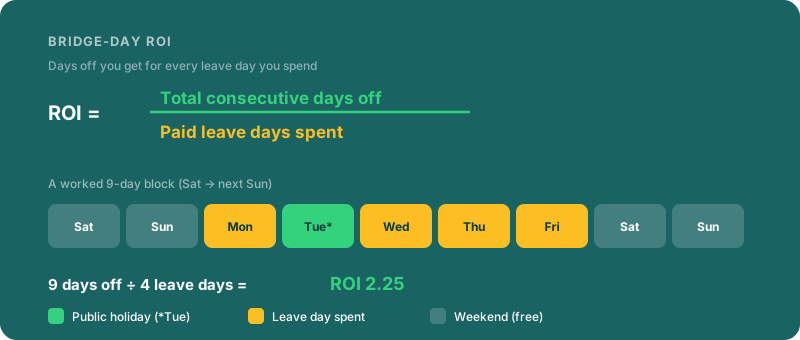
ROI = Total consecutive days off ÷ Paid leave days spent
The numerator counts everything in the unbroken block — weekends, public holidays, and your own leave days. The denominator counts only the leave days you burn from your balance. Weekends and public holidays are "free" days you already own; the art of bridging is stringing paid days across the smallest possible number of purchased ones.
A plain vacation day mid-week, surrounded by normal workdays, scores 1.0 — one day off for one day spent. Anything above 1.0 is leverage. The whole game is finding the days where a single purchase unlocks a chain of free days on either side.
Why the weekday matters more than the holiday
A public holiday is worth different amounts depending on which weekday it lands on. The reason is simple: to turn a holiday into a long break, you have to bridge the gap between it and the nearest weekend, and that gap changes with the weekday.
- Holiday on a Tuesday — bridge Monday (1 leave day) and you connect Sat-Sun-Mon-Tue = 4 days off for 1. ROI 4.0.
- Holiday on a Thursday — bridge Friday (1 leave day) and you connect Thu-Fri-Sat-Sun = 4 days off for 1. ROI 4.0.
- Holiday on a Monday or Friday — it already touches the weekend, so it's a "free" three-day weekend with 0 leave days. Great for you, but the marginal leverage of adding a leave day next to it is lower (bridging the far side costs more).
- Holiday on Wednesday — the worst case. It sits two days from either weekend, so a bridge costs 2 leave days on each side; the cheapest upgrade is 2 days spent for a 5-day block (ROI 2.5).
That is the counter-intuitive headline: a Tuesday or Thursday holiday is the most leverageable because it's exactly one bridge-day away from the weekend. Monday and Friday holidays are lovely but give you nothing extra to optimize. Midweek Wednesday holidays are the hardest to convert efficiently.
Leverage by weekday: the reference table
Here is the marginal ROI of the cheapest bridge move for a single public holiday, by the weekday it falls on. "Block" is the resulting run of consecutive days off; "spent" is leave days burned.
| Holiday weekday | Cheapest bridge | Leave spent | Block (days off) | ROI |
|---|---|---|---|---|
| Monday | none needed | 0 | 3 (Sat–Mon) | ∞ (free 3-day weekend) |
| Tuesday | Mon | 1 | 4 (Sat–Tue) | 4.0 |
| Wednesday | Mon+Tue or Thu+Fri | 2 | 5 | 2.5 |
| Thursday | Fri | 1 | 4 (Thu–Sun) | 4.0 |
| Friday | none needed | 0 | 3 (Fri–Sun) | ∞ (free 3-day weekend) |
Two takeaways. First, Tuesday and Thursday holidays are the workhorses of any optimization plan — one leave day quadruples your time off. Second, don't waste leave "defending" a Monday or Friday holiday; it's already a long weekend, so spend those days elsewhere.
The very best ROI, though, comes from double bridges — two holidays close together, where a handful of leave days spans a giant block. That's how a four-day spend becomes nine days off.
The double bridge: where ROI peaks
When two public holidays sit a few days apart (or a holiday sits close to a weekend on both sides), the leverage compounds. The classic pattern:
- Holiday on Thursday + the following Friday bridged → Thu–Sun, 4 off for 1.
- Two holidays framing a work-week → bridge the 2–3 days between them and you swallow both weekends too.
Consider a Tuesday holiday. Instead of just bridging Monday, extend the other direction:
| Strategy | Leave days spent | Consecutive days off | ROI |
|---|---|---|---|
| Take the holiday only | 0 | 3 (Sat–Mon–Tue... actually Sat–Sun + Tue split) | — |
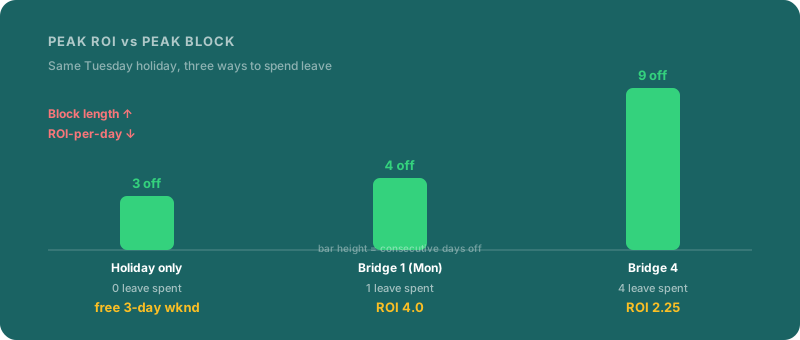
| Bridge Monday | 1 | 4 (Sat–Tue) | 4.0 |
| Bridge Mon + Wed–Fri | 4 | 9 (Sat–next Sun) | 2.25 |
Notice the ROI per leave day actually drops from 4.0 to 2.25 as you extend — but the absolute break grows from 4 days to 9. This is the core trade-off: peak ROI (bridge one day, stop) versus peak block length (spend more, get a real trip). Neither is "right"; it depends on whether you're collecting cheap long weekends or building one big holiday. The optimizer lets you sort by either.
Worked example: 2028 US Independence Day
Let's make it concrete with real, verified dates. In 2028, Independence Day falls on Tuesday, July 4 (per Calendarpedia and OPM). That is the textbook Tuesday case.
Step 1 — the free block. Sat Jul 1, Sun Jul 2 are the weekend. Tue Jul 4 is the holiday. Mon Jul 3 is the only workday in between.
Step 2 — the one-day bridge. Spend 1 leave day on Monday Jul 3. You now have Sat Jul 1 → Tue Jul 4 = 4 consecutive days off for 1 spent. ROI 4.0.
Step 3 — extend for a real week. Add Wed Jul 5, Thu Jul 6, Fri Jul 7 (3 more leave days). Total spent: 4. Block: Sat Jul 1 → Sun Jul 9 = 9 days off. ROI 2.25.
So a single US worker — who, remember, has no federal statutory minimum leave at all (the US is the only OECD country in that position) — can turn 4 of their company-granted PTO days into a 9-day break around one Tuesday holiday. Contrast Thanksgiving 2028, Thursday Nov 23: bridge Friday Nov 24 and you get Thu–Sun = 4 off for 1, then Monday's already free of the following weekend — a clean, cheap 4-day ROI-4.0 play.
Exact dates and weekdays are for 2028 specifically. They rotate every year — a July-4-on-Saturday year has completely different math. Always re-run your target year in the optimizer.
How the formula plays out across countries
Your starting leave balance changes how much bridging you can afford. Statutory minimums vary enormously. The table below shows verified statutory floors — actual company grants are often higher, especially in the US where there is no legal minimum.
| Country | Statutory min. paid leave (working days) | Paid public holidays (approx.) | Bridging headroom |
|---|---|---|---|
| Austria | 25 | ~13 | Very high |
| France | 25 (5 weeks) | 11 | High |
| South Korea | 15 (→ up to 25 with seniority) | ~11–15 observed | Moderate |
| Germany | 20 | ~10 (varies by state) | High |
| Japan | 10 | 0 statutory pay (16 observed) | Low–moderate |
| United States | 0 (no federal minimum) | 11 federal (private-sector varies) | Depends entirely on employer |
Sources for these figures are listed at the end. A few notes:
- South Korea: the Labor Standards Act (근로기준법) grants 15 paid leave days after one qualifying year (80%+ attendance), rising one day every two years up to a 25-day cap. Korea's real superpower is its long holiday clusters — Seollal (Lunar New Year) and Chuseok each span three days plus substitute holidays (대체공휴일) when they collide with weekends. Those clusters produce the highest natural ROI in the world; a two-leave-day bridge onto a Chuseok block routinely yields 6–9 days off. See our deeper average PTO by country comparison.
- United States: with no statutory floor, ROI planning is everything — you're optimizing a scarce, employer-granted resource. Tuesday/Thursday federal holidays are where US workers get the most leverage.
- Europe: high statutory floors mean you can afford longer blocks, so European optimization leans toward block length over peak ROI.
Because substitute-holiday rules and per-year dates shift, don't hard-code any of the "days off" outcomes above for a specific future year — the optimizer applies the current-year rules for your country automatically.
A quick ranking heuristic
When you look at next year's calendar, rank your leave days by this quick score before spending any:
- Is there a Tue or Thu holiday? → highest priority; 1 bridge day = ROI 4.0.
- Are there two holidays within one work-week? → double-bridge candidate; huge block for a few days.
- Is it a Wed holiday? → only worth it if you'll commit 2 days each side for a 5-day block.
- Mon/Fri holiday? → already a free long weekend; save your leave for the cases above.
Feed the whole year in and let the leave optimizer do the ranking — it computes the ROI of every possible bridge and sorts them for you.
FAQ
Is a higher ROI always better?
No. ROI measures efficiency per leave day, not total time off. Bridging one Monday next to a Tuesday holiday gives ROI 4.0 but only 4 days off. Spending four days for a nine-day trip gives ROI 2.25 — lower efficiency, but a real vacation. Decide whether you're farming cheap long weekends (maximize ROI) or building a big break (maximize block length).
Why do Tuesday and Thursday holidays beat Mondays for optimization?
A Monday or Friday holiday already touches the weekend, so it's a free three-day weekend with zero leverage left to extract. A Tuesday or Thursday holiday sits exactly one workday from the weekend, so a single bridge day connects the whole run at ROI 4.0. The marginal value of your leave day is highest precisely when the holiday is one step away from a weekend.
Does this work the same in every country?
The arithmetic is universal, but the inputs differ: how many public holidays you get, whether they're paid, and whether substitute-holiday rules (like Korea's 대체공휴일) shift a weekend holiday to a weekday. Countries with long holiday clusters (Korea's Seollal/Chuseok) or high statutory leave floors (Austria, France) give you more raw material to bridge.
How do I find the best bridge days for my year?
Don't do it by hand — weekday alignment changes every year and substitute-holiday rules add exceptions. Put your country and leave balance into the leave optimizer; it enumerates every bridge, computes each one's ROI and block length, and ranks them.
Sources
- List of minimum annual leave by country — Wikipedia — statutory paid-leave and public-holiday figures for Germany, France, Austria, Japan.
- Paid annual leave per country: global guide — Deel — cross-country statutory leave comparison; confirms the US has no federal statutory minimum.
- Federal Holidays — U.S. Office of Personnel Management (OPM) — official US federal holiday list and weekend-observance rules.
- US Federal Holidays 2028 — Calendarpedia — 2028 dates and weekdays (Independence Day Tue Jul 4; Thanksgiving Thu Nov 23).
- Holidays and Days-Off — InvestKOREA — South Korea Labor Standards Act annual-leave entitlement (15 days, up to 25 with seniority) and substitute-holiday rules.
- OECD Family Database — leave entitlements — OECD-wide context on statutory leave across member countries.
Next Step
See your own best PTO windows
The article gives you the strategy. The optimizer gives you the exact dates for your year and your PTO balance.
Find my windowsGet the calendar and return when you are ready
Related topics
Useful tools
Related Articles
The Holiday Leverage Ratio: How Much Time Off Each Weekday Buys You
A data-driven look at the holiday leverage ratio -- how many days off each paid leave day buys you, ranked by the weekday a public holiday lands on. Includes a Korea vs. US comparison, a worked 15-day PTO example, and the exact bridge math.
How Many Days Off Per PTO Day? The Leave Leverage Ratio, Explained
Every vacation day you spend buys somewhere between 1 and 4+ days off, depending on the calendar. This data explainer defines the leave leverage ratio, ranks the scenarios, and shows how the US, Korea, and Europe differ — with a worked example and a country comparison table.
Double-Holiday Weeks: How to Turn Two Nearby Public Holidays Into One Long Break
When two public holidays land in adjacent weeks, a handful of leave days can fuse them into one 9-to-14 day break. Here's the leverage math, worked examples for the US, Korea, and Japan, and a rule for when to bridge versus split.