The Holiday Deserts: Which Months Have the Fewest Public Holidays — and How to Spend PTO There
Fact-checked July 10, 2026 · 6 sourcesHow we verify
Everyone plans PTO around the holidays. Almost nobody plans it around the gaps. Yet the empty stretches of the calendar — the months with no public holiday to lean on — are where a strategic leave day is worth the most and costs the least. This is a data piece about those "holiday deserts": where they are, why they exist, and how to spend leave in them.
This is a research post written with sources. The structural facts (which months are empty, how many holidays each system has, the leverage math) are stable. The exact dates and weekdays of each year's holidays shift annually — and in Korea the substitute-holiday (대체공휴일) rules move things by a day or two — so we hedge those and hand the per-year calculation to the leave optimizer. Confirm current-year dates in the Sources below before you book.
The map of empty months
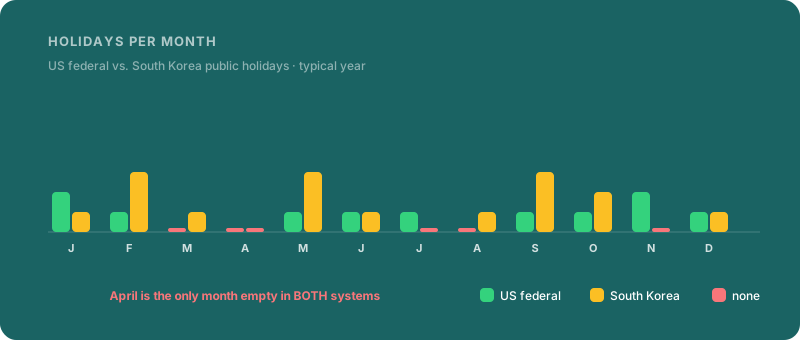
Public holidays are not spread evenly across the year. They cluster around the start of the year, spring, and late autumn, leaving long droughts in between. Here is the shape of it for two very different systems — the US (11 federal holidays, no statutory paid leave) and South Korea (a holiday-dense calendar with a legal leave floor).
The United States: three empty months
The US federal calendar has exactly 11 holidays, and three months contain none of them:
| Month | Federal holidays | Notes |
|---|---|---|
| January | 2 | New Year's Day, MLK Day |
| February | 1 | Washington's Birthday (Presidents' Day) |
| March | 0 | Empty |
| April | 0 | Empty |
| May | 1 | Memorial Day (last Monday) |
| June | 1 | Juneteenth |
| July | 1 | Independence Day |
| August | 0 | Empty |
| September | 1 | Labor Day |
| October | 1 | Columbus / Indigenous Peoples' Day |
| November | 2 | Veterans Day, Thanksgiving |
| December | 1 | Christmas |
The single longest gap in the US year runs from Washington's Birthday in mid-February to Memorial Day at the end of May — just over three months with no federal holiday at all, swallowing the whole of March and April. August is the second desert: it sits alone with no anchor between Independence Day and Labor Day.
South Korea: dense, but with its own droughts
Korea has roughly 13–15 public holidays in a typical year once substitute holidays are counted, and they cluster hard: Seollal (Lunar New Year) in Jan/Feb, a triple-header in May (Children's Day and Buddha's Birthday), Chuseok in Sep/Oct, plus National Foundation Day and Hangeul Day in October. The droughts are April, July, and November — and in some years December has only Christmas.
The striking overlap: April is the only month that is thin-to-empty in both systems. If you work across a US–Korea axis, April is the one month where neither calendar hands you a day.
Why the deserts exist
The empty months are not random. Public holidays are anchored to three things: the turn of the year (New Year, Lunar New Year), religious and seasonal festivals (Easter-adjacent dates, Buddha's Birthday, harvest festivals like Chuseok and Thanksgiving), and civic commemorations (independence, labor, veterans). Those anchors bunch in winter, spring, and autumn. Mid-summer and early spring have no comparable civic or seasonal anchor in most calendars — which is precisely why August in the US and July in Korea sit empty.
For the leave planner, the empty months have one enormous advantage: nobody else is fighting you for the same days. Around a national holiday, everyone requests the same bridge, flights spike, and blackout rules kick in. In a holiday desert, a manufactured long weekend is quieter, cheaper, and easier to get approved.
The leverage ratio: why weekday beats month
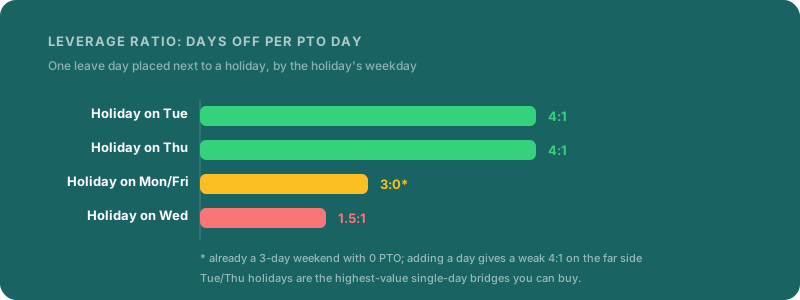
Before choosing when, understand the arithmetic of how much a leave day is worth. The core metric is the leverage ratio — total days off divided by PTO days spent. It depends almost entirely on which weekday a holiday lands on.
| Holiday weekday | Bridge move | PTO spent | Total days off | Leverage |
|---|---|---|---|---|
| Tuesday | Take Monday | 1 | 4 (Sat–Tue) | 4.0× |
| Thursday | Take Friday | 1 | 4 (Thu–Sun) | 4.0× |
| Monday or Friday | (already long weekend) | 0 | 3 | ∞ baseline |
| Wednesday | Take Tue+Thu | 2 | 5 (Sat–Sun) | 2.5× |
| Wednesday | Take one side | 1 | 3.5 effective | ~1.5× |
The lesson: a Tuesday or Thursday holiday is the highest-value single leave day you can buy — one day becomes four. A Wednesday holiday is the worst; it "wastes" a holiday in the middle of the week. This is why the weekday a holiday falls on matters more than the month it's in — and why exact per-year weekdays should be pulled from the optimizer rather than memorized.
The desert strategy: manufacture your own long weekends
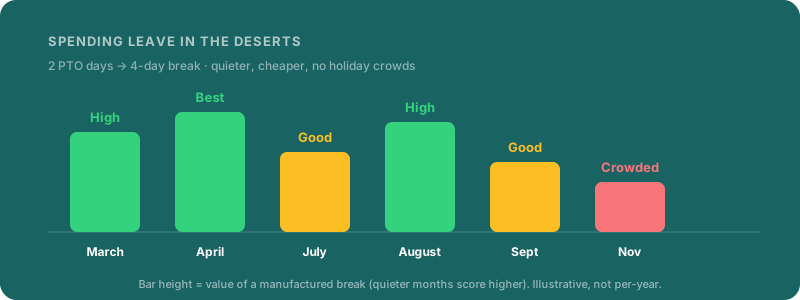
In a holiday desert there is no holiday to bridge — so you build a break from scratch. The move is simple: spend 2 PTO days to bracket a weekend and make a 4-day break, or spend 4 to make a 9-day stretch. Because there's no competing holiday, you get the quiet-and-cheap dividend.
Where the desert breaks pay off best:
- April (both systems): The prime target. Shoulder-season travel pricing, mild weather, no holiday crowds, and it interrupts the long Feb→May US drought. A Thu–Fri PTO pair gives a 4-day break with maximum "recovery from the grind" value.
- August (US): The one summer month with no federal anchor. Two PTO days around a weekend beat a peak-July-4th week on both price and crowd.
- July (Korea): Between the May cluster and September's Chuseok. A quiet window for a domestic or short-haul break.
- March (US): Late-winter reset before the spring rush.
- November (Korea): Empty except at the edges; a good pre-year-end decompression window.
A worked example: 5 leave days, US worker
You have 5 PTO days left and want maximum time off with minimum crowding. Compare two strategies.
Strategy A — chase the holidays. You spend all 5 around Thanksgiving week (the most-contested week of the US year). You get a 9-day break, but flights are at their annual peak, the request competes with your whole team, and you're traveling with the entire country.
- 5 PTO days → 9 days off. Leverage 1.8×. Cost and stress: high.
Strategy B — split into deserts. You place the days where nothing competes:
| Placement | PTO days | Weekend attached | Days off | Leverage |
|---|---|---|---|---|
| April: Thu + Fri | 2 | Sat–Sun | 4 | 2.0× |
| August: Thu + Fri | 2 | Sat–Sun | 4 | 2.0× |
| One Tue/Thu holiday bridge* | 1 | via a real holiday | 4 | 4.0× |
| Total | 5 | — | 12 | 2.4× |
*The single bridge day uses a real Tuesday/Thursday holiday elsewhere in the year — pulled from the optimizer.
Strategy B yields 12 days off from the same 5 PTO days (versus 9), spread across the calendar, all in low-crowd windows. Same leave budget, ~33% more days off, and far cheaper travel. The desert strategy wins on nearly every axis except "one single long block."
How this scales with your leave entitlement
The deserts matter more the fewer days you have — and entitlements vary wildly by country. A rough floor:
| Country | Statutory paid leave (baseline) | Public holidays | Practical implication |
|---|---|---|---|
| South Korea | 15 days (Labor Standards Act Art. 60, up to 25) | ~13–15 | Dense holidays; spend own leave in Apr/Jul/Nov droughts |
| Germany | 20 days (24 by federal law*) | ~9–13 (varies by state) | Generous both ways; Brückentage in deserts are king |
| France | 25 days | ~11 | Le pont culture already targets the gaps |
| United Kingdom | 28 days (incl. bank holidays) | 8 bank holidays | Long summer desert (Aug bank holiday aside) |
| United States | No legal minimum | 11 federal | Deserts are pure PTO; every day counts double |
*Germany's statutory minimum is often cited as 20 working days; the federal Vacation Act baseline is 24 working days on a 6-day week. Figures are baselines and shift with tenure, region, and employer policy — treat as orders of magnitude.
The pattern holds everywhere: the more your calendar clusters holidays, the more your own leave belongs in the deserts. In the US, where there is no statutory leave at all, this is not a nicety — every desert day you place well is a day the calendar was never going to give you.
FAQ
Which single month is the best to take leave in?
For most US and Korea workers, April — it's thin-to-empty in both systems, sits in shoulder-season travel pricing, and breaks the long spring drought. August is the runner-up for US workers. The exact best week depends on which weekday the nearest holiday lands on that year; check the optimizer.
Isn't it better to save PTO for one big holiday-week trip?
It depends on your goal. One big block maximizes a single trip; splitting into desert weekends maximizes total days off and minimizes cost and crowding. As the worked example shows, the split can yield ~33% more days off from the same budget. If you value frequent resets over one epic trip, the deserts win.
Why is a Wednesday holiday so bad for leverage?
Because it sits in the middle of the week with no weekend to anchor to. Bridging it costs 2 PTO days (Tue and Thu) to build a 5-day break — a 2.5× ratio — versus a Tuesday or Thursday holiday where a single day buys a 4-day weekend (4.0×). When a big holiday falls on a Wednesday, that's often the year to spend leave in a desert instead.
Do these empty months change every year?
The months are stable — March/April/August are structurally empty in the US, and Korea's April/July/November droughts recur. What moves is the weekday each holiday lands on and, in Korea, the substitute-holiday rules that can shift a date by a day or two. Those year-specific details are exactly what the optimizer computes, so we don't hard-code them here.
Related reading
- The April PTO Trap: why Q2 eats more vacation than you plan for
- The most efficient public holidays of the year
- Which day of the week do holidays fall on most?
Sources
- US Office of Personnel Management — Federal Holidays (official list of the 11 US federal holidays and observance rules).
- Wikipedia — Federal holidays in the United States (month distribution; March, April and August have none).
- timeanddate — Holidays in South Korea, 2027 (Korean public-holiday dates, substitute holidays, and monthly clustering).
- Korea Legislation Research Institute — Labor Standards Act (English) (Article 60 annual-leave entitlement, 15 days baseline, up to 25).
- Wikipedia — List of minimum annual leave by country (statutory leave and public-holiday counts by country).
- Statista — Statutory minimum paid leave and public holidays (OECD cross-country comparison).
Next Step
See your own best PTO windows
The article gives you the strategy. The optimizer gives you the exact dates for your year and your PTO balance.
Find my windowsGet the calendar and return when you are ready
Related topics
Useful tools
Related Articles
How Many Days Off Per PTO Day? The Leave Leverage Ratio, Explained
Every vacation day you spend buys somewhere between 1 and 4+ days off, depending on the calendar. This data explainer defines the leave leverage ratio, ranks the scenarios, and shows how the US, Korea, and Europe differ — with a worked example and a country comparison table.
The Holiday Leverage Ratio: How Much Time Off Each Weekday Buys You
A data-driven look at the holiday leverage ratio -- how many days off each paid leave day buys you, ranked by the weekday a public holiday lands on. Includes a Korea vs. US comparison, a worked 15-day PTO example, and the exact bridge math.
How to Request Time Off: 5 Email Templates That Actually Get Approved
Stop guessing what to write in your leave request. These 5 proven email templates cover standard PTO, bridge days, extended leave, last-minute requests, and denied leave follow-ups -- with timing advice by company size.