The Holiday Leverage Ratio: How Much Time Off Each Weekday Buys You
Fact-checked July 10, 2026 · 6 sourcesHow we verify
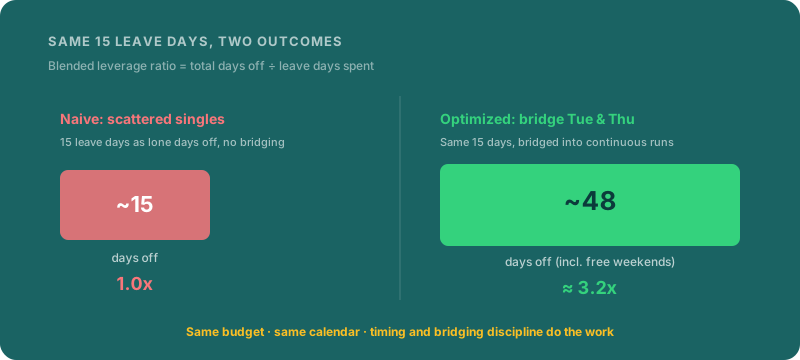
Two people at the same company each get 15 paid leave days a year. One finishes the year with 22 days of continuous vacation. The other stretches the exact same 15 days into 48. Neither cheated. The difference is entirely which weekday their public holidays fell on -- and whether they spent their leave to exploit it.
That multiplier has a name: the holiday leverage ratio -- days off produced per paid leave day spent. This is a data piece, so we will keep it concrete: the math, a ranked table by weekday, a Korea vs. US comparison, and one fully worked 15-day example.
This is a research post with sources. The leverage math is fixed arithmetic and does not change year to year. But exact holiday dates and the weekday each one lands on shift every year, so we never assert a specific future date -- plug your actual calendar into the leave optimizer to get your real numbers. Where a rule depends on your employer or country (Saturday-holiday observance, Korea's substitute-holiday trigger), we say so.
What the holiday leverage ratio actually measures
The leverage ratio is one division:
Leverage ratio = total consecutive days off ÷ paid leave days spent
If a Thursday holiday plus one bridged Friday plus the weekend gives you four days off for one leave day, that is a 4.0x ratio. If you take a random Wednesday off in a week with no holiday, you get one day off for one leave day -- a 1.0x floor. Everything interesting happens between those two poles, and the lever that moves it is the weekday the holiday falls on.
Three inputs decide the outcome:
- The holiday's weekday. A fixed-date holiday (US Independence Day is always July 4; Korea's Liberation Day is always August 15) walks through all seven weekdays over a roughly 5-6 year cycle. Same holiday, wildly different value depending on the year.
- The bridge cost. How many working days sit between the holiday and the nearest weekend. Zero means a free long weekend; one or two means a cheap bridge; three-plus rarely pays.
- Weekend-overlap rules. When a holiday lands on a Saturday or Sunday, some systems hand you a replacement weekday and some let it evaporate. This is the single biggest hidden variable, and it differs by country (details below).
Leverage by weekday: the core table
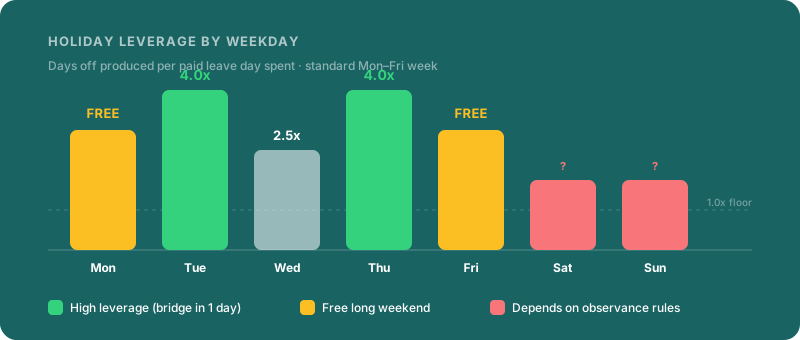
Assume a standard Monday-to-Friday workweek and a single public holiday with no other holidays nearby. Here is what each landing weekday is worth. "Free" days off cost zero leave; the bridge column is the cheapest leave spend that maximizes the continuous run.
| Holiday lands on | Bridge leave to spend | Continuous days off | Leverage ratio | Verdict |
|---|---|---|---|---|
| Tuesday | 1 (Mon) | 4 | 4.0x | Elite -- cheap bridge into the weekend |
| Thursday | 1 (Fri) | 4 | 4.0x | Elite -- cheap bridge into the weekend |
| Wednesday | 2 (Mon+Tue or Thu+Fri) | 5 | 2.5x | Good -- or spend 4 for a full 9-day run |
| Monday | 0 | 3 | Free (∞) | Automatic long weekend, no leave needed |
| Friday | 0 | 3 | Free (∞) | Automatic long weekend, no leave needed |
| Saturday | 0 (if Fri observed) | 3 | Observance-dependent | You get it or you lose it -- rules below |
| Sunday | 0 (if Mon observed) | 3 | Observance-dependent | You get it or you lose it -- rules below |
The pattern is counterintuitive on first read: Monday and Friday holidays look best (free three-day weekend) but are actually low-leverage because you cannot invest leave to grow them cheaply. Tuesday and Thursday holidays are where your leave day works hardest -- one day spent, four days out, a clean 4.0x. Wednesday is the "commitment" holiday: mediocre at a 2-day bridge, but if you are willing to spend four leave days you unlock a nine-day run (Sat-Sun-Mon-Tue-Wed-Thu-Fri-Sat-Sun), which is the longest single-holiday break the calendar offers.
For a deeper single-holiday walkthrough, see how holiday bridges work and the tier ranking in ranking every US federal holiday by bridge potential.
The weekend-overlap rule is where countries split
This is the part most weekday tables ignore, and it is decisive.
- United States (federal). If a federal holiday falls on a Saturday, it is observed the preceding Friday; if on a Sunday, the following Monday (OPM "in lieu of" rule, codified in 5 U.S.C. 6103(b) and Executive Order 11582). Caveat: this is guaranteed only for federal employees. Private employers often follow it, but many do not -- so a Saturday holiday may simply vanish for you.
- South Korea. Under the substitute-holiday system (대체공휴일), when an eligible holiday overlaps a weekend (or another holiday), the next available weekday becomes a paid day off. This has covered private firms with five or more employees as paid leave since 2022 (Lockton). Caveat: the list excludes New Year's Day and Memorial Day, and for the multi-day Seollal (Lunar New Year) and Chuseok clusters the substitute triggers based on which of the three days lands on a Sunday.
Net effect: weekend holidays are far less punishing in Korea than for a US private-sector worker without generous observance. In the US, a Saturday holiday at a non-observing employer is a pure loss. In Korea, that same overlap is usually clawed back as a Monday.
Korea vs. US: the raw leave-and-holiday endowment
Leverage math sits on top of two very different starting endowments. This is where the "no vacation nation" gap shows up.
| Country | Statutory minimum paid leave | Paid public holidays (approx.) | Weekend-overlap protection |
|---|---|---|---|
| South Korea | 15 days (Article 60, LSA; 80% attendance; rises toward a 25-day cap) | ~15 | Yes -- substitute holiday for eligible days |
| United States | 0 (no federal statutory minimum) | ~11 federal (private employers not required to give any) | Federal only; private-sector varies |
| Germany | 20 working days | ~10 | Regional variation |
| France | 25 working days | ~11 | Limited |
Sources: Korea Labor Standards Act Article 60; US has no federal statutory minimum leave, and its ~11 federal holidays bind only federal employers; European figures via the Wikipedia minimum-annual-leave table and Statista.
The practical reading: a Korean worker has both a legal floor of leave and weekend-overlap protection, so leverage is about stacking the guaranteed holidays. A US private-sector worker often has neither guarantee, so leverage is about defensively harvesting the few holidays that happen to land Tuesday/Thursday in a given year -- and confirming with HR whether Saturday holidays are observed at all.
A worked example: turning 15 leave days into 48 days off
Let us make the multiplier concrete. Take a worker with 15 paid leave days and a hypothetical year in which the holidays happen to fall on high-leverage weekdays. (The weekdays below are illustrative -- in a real year they shift, which is exactly why you run the optimizer against your actual calendar.)
| Holiday lands on | Leave spent | Continuous days off | Running leverage |
|---|---|---|---|
| Thursday holiday | 1 (Fri) | 4 (Thu-Sun) | 4.0x |
| Tuesday holiday | 1 (Mon) | 4 (Sat-Tue) | 4.0x |
| Wednesday holiday | 4 (Mon-Tue + Thu-Fri) | 9 (Sat-next Sun) | 2.25x |
| Two-holiday cluster (e.g. Thu + following Tue) | 3 (Fri + Mon + Mon) | 11 (Thu-next Sun) | 3.67x |
| One free Monday holiday | 0 | 3 (Sat-Mon) | free |
| Remaining flexible leave | 6 | ~17 (a proper two-and-a-half-week block bridged to weekends) | ~2.83x |
| Totals | 15 | 48 | ≈ 3.2x blended |
Fifteen invested leave days, plus the free weekends and free Monday, roll up to roughly 48 days of not-at-work time in the good scenario. The blended leverage ratio is about 3.2x. Contrast that with the naive worker who takes all 15 days as isolated singles in holiday-free weeks: they get 15 days off, a 1.0x ratio, plus whatever free long weekends the calendar handed them anyway.
That is the entire thesis in one number: the same 15 days is worth 1.0x or 3.2x depending on weekday timing and bridging discipline. The calendar is fixed; your allocation is not.
How to raise your own blended ratio
- Front-load Tuesday and Thursday holidays. These are your 4.0x machines. Spend the single adjacent bridge day first, before committing leave anywhere else.
- Only "commit" to Wednesday holidays if you want length. A 2-day bridge is mediocre; a 4-day bridge for a 9-day run is excellent. Decide which you want -- do not spend two days for a lukewarm five-day break by accident.
- Never spend leave on a Monday or Friday holiday's weekend. It is already free. Redirect that leave to a mid-week holiday.
- Cluster adjacent holidays. Two holidays a week apart can be bridged into an 11-day-plus run with fewer leave days than doing each separately. Korea's Chuseok and Seollal clusters are the classic case.
- Confirm Saturday/Sunday observance in writing. In the US private sector this is the difference between a free day and a lost one.
For budget-based allocation strategies, see optimal leave allocation by budget, and to stretch further, half-day PTO strategy.
The leverage cycle: why a holiday's value rotates every year
Because most fixed-date holidays advance about one weekday each year (two after a leap year), any given holiday cycles through a "golden" high-leverage phase (Tue/Thu), a free phase (Mon/Fri), and a "dead" phase (Sat/Sun) over roughly five to six years. That is why the same holiday can headline your plan one year and be worthless the next.
The strategic takeaways:
- Some years are structurally better than others. When several major holidays cluster on Tuesdays and Thursdays, the whole year is high-leverage -- worth front-loading leave and even carrying leave forward into it if your policy allows.
- In "dead" years, pivot to self-made bridges. If the holidays mostly fall on weekends, stop chasing them and build your own long weekends off the free Monday/Friday holidays that remain.
- Plan across the year boundary. The best single break often straddles late December into early January, combining year-end holidays from two leave allowances.
You do not need to compute the rotation by hand. Enter your country and year in the leave optimizer and it flags every high-leverage window for you.
FAQ
Is a Monday holiday really worse than a Thursday holiday?
For leverage, yes. A Monday holiday hands you a free three-day weekend but gives you no cheap way to invest leave to grow it -- you would have to spend leave on the Tuesday, which is a plain 1.0x day. A Thursday holiday lets you spend one leave day (Friday) to reach four continuous days off, a 4.0x return. The Monday holiday is more free value; the Thursday holiday is more leverage per leave day. If your leave budget is tight, chase the Thursday.
Does the leverage ratio change if my country observes weekend holidays?
Yes, and this is the biggest cross-country difference. In South Korea, an eligible holiday that lands on a weekend usually rolls to the next weekday under the substitute-holiday system, so a Saturday/Sunday holiday is rarely a total loss. For US federal employees the "in lieu of" rule does the same, but private US employers are not required to, so a Saturday holiday can simply disappear. Always confirm your employer's observance policy -- it can swing a year's plan by several days.
Can I really hit 3x leverage, or is that a best-case number?
Roughly 3x blended leverage is achievable in a good year with disciplined bridging, but it is not guaranteed. It depends on how many holidays fall on Tuesdays and Thursdays that year, whether you can cluster adjacent holidays, and whether your employer observes weekend holidays. In a "dead" year where holidays cluster on weekends, a realistic ceiling is closer to 2x. The honest framing: your leverage is bounded by the calendar you are handed, but almost everyone leaves some leverage on the table -- the optimizer's job is to find the maximum for your specific year.
Should I save leave for a high-leverage year?
If your employer permits carryover, sometimes yes -- carrying a few days into a year where major holidays cluster on high-leverage weekdays can meaningfully raise your blended ratio. But weigh it against use-it-or-lose-it forfeiture risk and the opportunity cost of a break you skip now. This is a personal trade-off, not a universal rule; model both scenarios in the optimizer before deciding.
Sources
- U.S. Office of Personnel Management -- Federal Holidays and the Federal Holidays "In Lieu Of" Determination fact sheet (Saturday → preceding Friday, Sunday → following Monday; 5 U.S.C. 6103(b), EO 11582).
- Korea Ministry of Government Legislation -- Labor Standards Act (English translation), Article 60 Annual Paid Leave (15 days at 80% attendance, 25-day cap).
- Lockton Global Benefits -- Korea expands substitute public holiday system (대체공휴일 scope, paid-leave status for 5+ employee firms).
- Wikipedia -- List of minimum annual leave by country (statutory minimums; Germany 20, France 25 working days; US has none).
- Statista -- Statutory minimum paid leave and public holidays (leave-plus-holiday comparison across OECD countries).
Next Step
See your own best PTO windows
The article gives you the strategy. The optimizer gives you the exact dates for your year and your PTO balance.
Find my windowsGet the calendar and return when you are ready
Related topics
Useful tools
Related Articles
The Bridge-Day ROI Formula, Explained: How to Measure Days-Off-Per-Leave-Day
A data-driven breakdown of bridge-day ROI: the days-off-per-leave-day formula, why Tuesday and Thursday holidays outperform Mondays, and how to rank every leave day you own. Worked examples for the US, Korea, and Europe.
The Sandwich Day Strategy, Explained: Turn 1 Leave Day Into 4 Off
A sandwich day is the lone workday wedged between a public holiday and the weekend. Spend one leave day on it and a 4-day break appears. Here is the leverage math, a weekday-by-weekday ratio table, a worked example, and the one payroll trap that can quietly cost you extra days.
The Holiday Deserts: Which Months Have the Fewest Public Holidays — and How to Spend PTO There
A data look at which calendar months have the fewest public holidays in the US and South Korea, why April, July and August are 'holiday deserts,' and the PTO strategy that turns those empty months into your cheapest long weekends.