The Sandwich Day Strategy, Explained: Turn 1 Leave Day Into 4 Off
Fact-checked July 10, 2026 · 5 sourcesHow we verify
Most vacation guides tell you to "take a long weekend." A sandwich day is the specific, high-leverage move underneath that advice — and once you can spot one, you stop spending leave days at random.
A sandwich day is the lone workday trapped between a public holiday and the weekend. A holiday lands on Thursday; suddenly Friday is stranded — sandwiched between the holiday and Saturday. Take that one Friday off and you get Thursday through Sunday: four days off for one leave day.
Germans call the move a Brückentag (bridge day). The French faire le pont (make the bridge); Spanish hacer puente; Italian fare il ponte. Every language has a word for it because everyone has noticed the same free lunch.
This is a research post: the reusable math (leverage ratios, allocation logic) is stable, but exact holiday dates and weekdays shift every year. We hedge those and hand the per-year calculation to the Leavewise optimizer. Country leave and holiday counts reflect the sources cited at the bottom and can change with legislation.
Why sandwich days exist at all
Time off is scarce almost everywhere, but especially where you'd least expect it. The United States mandates zero statutory paid leave — it is the only OECD economy that guarantees none — while most European systems guarantee 20–25 days. Public-holiday counts are similarly uneven.
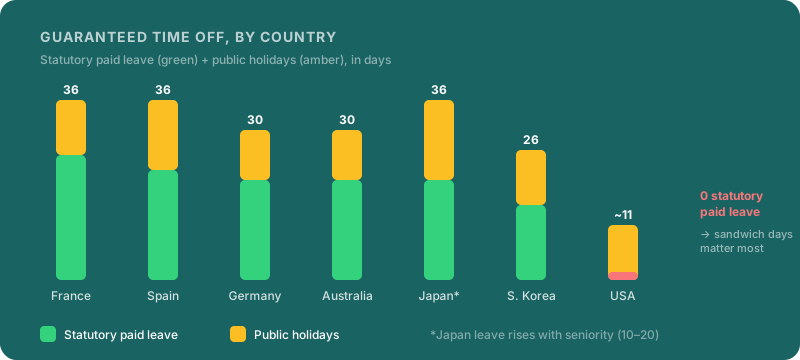
| Country | Statutory paid leave | Public holidays | Combined floor |
|---|---|---|---|
| France | 25 | ~11 | ~36 |
| Spain | 22 | ~14 | ~36 |
| Germany | 20 | ~10 | ~30 |
| Australia | 20 | 10 | 30 |
| United Kingdom | 28* | included above | 28 |
| South Korea | 15 (base) | 11 | ~26 |
| Japan | 10–20 | 16 | ~26–36 |
| Canada | 10–20 | 7–13 | varies |
| United States | 0 (no statutory min) | ~11 federal | ~11 |
*The UK's 28 days already bundle its 8 bank holidays into a single statutory figure. Public-holiday counts are approximate because several holidays float or vary by region/province. Sources: Statista, Wikipedia "minimum annual leave by country."
The takeaway: wherever your paid leave is scarcest, sandwich days matter most. A US worker with 10–15 negotiated PTO days can't afford to burn them one at a time on random Tuesdays. Aligning each day against a holiday is the difference between ~15 days off and ~30.
The leverage ratio: what one leave day actually buys
The whole strategy reduces to a single number — the leverage ratio, or days off per leave day spent. Take a day off in a vacuum and the ratio is 1.0x. Bridge a holiday and it climbs.
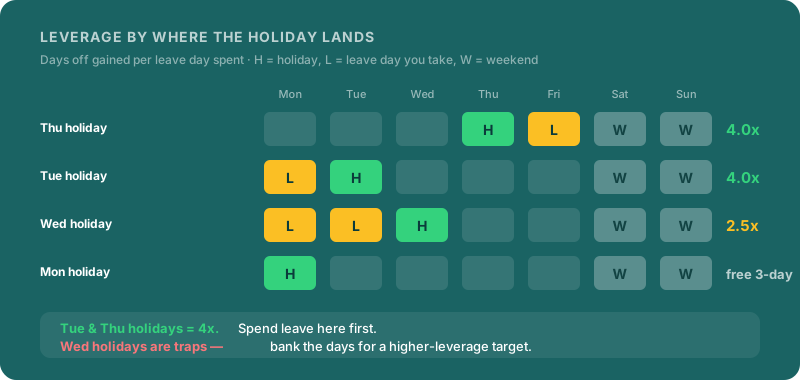
Which weekday the holiday falls on determines everything. A Wednesday holiday is a weak target (bridging it costs two leave days to link back to a weekend); a Tuesday or Thursday holiday is the sweet spot.
| Holiday lands on | Sandwich day you take | Leave days spent | Consecutive days off | Leverage |
|---|---|---|---|---|
| Thursday | Friday | 1 | 4 (Thu–Sun) | 4.0x |
| Tuesday | Monday | 1 | 4 (Sat–Tue) | 4.0x |
| Friday | (none needed) | 0 | 3 (Fri–Sun) | free 3-day |
| Monday | (none needed) | 0 | 3 (Sat–Mon) | free 3-day |
| Wednesday | Mon+Tue or Thu+Fri | 2 | 5 (Sat–Wed / Wed–Sun) | 2.5x |
| Wednesday (full week) | Mon,Tue,Thu,Fri | 4 | 9 (Sat–Sun) | 2.25x |
| Saturday/Sunday | — | — | 0 (or substitute day*) | 0–varies |
*In South Korea, a holiday that falls on a weekend is pushed to the next weekday under the 대체공휴일 (substitute holiday) rule — which quietly creates a fresh sandwich-day opportunity. New Year's Day and Memorial Day are excluded from that rule.
Two rules fall straight out of the table:
- Tuesday and Thursday holidays are gold — one leave day, 4x return.
- Wednesday holidays are traps. The tempting "take the whole week" move is only ~2.25x. Often you're better off spending nothing and enjoying a mid-week breather, then saving those four days for a Tue/Thu holiday elsewhere in the year.
A worked example: 5 leave days, one calendar year
Say you have 5 discretionary leave days and your year happens to serve up this (hedged, illustrative) set of holidays — the actual weekdays shift year to year, so treat the pattern, not the dates, as the lesson:
- Holiday A — falls on a Thursday
- Holiday B — falls on a Tuesday
- Holiday C — falls on a Wednesday
- Holiday D — falls on a Monday (already a free 3-day weekend)
Naive plan — spread 5 days across random Fridays through the year, no holiday alignment:
- Days off gained: 5 leave days → 5 long-ish weekends of 3 days each? No — a random Friday only extends the weekend you already had. Net new consecutive days: 5. Leverage: 1.0x.
Sandwich plan:
| Move | Leave days | Days off |
|---|---|---|
| Bridge Holiday A (Thu) with Friday | 1 | 4 |
| Bridge Holiday B (Tue) with Monday | 1 | 4 |
| Bank Holiday C (Wed) — spend nothing, save days | 0 | 1 (the holiday itself) |
| Holiday D (Mon) — already free, add Friday before | 1 | 4 |
| Stack remaining 2 days onto A's window (Wed+extra) | 2 | +2 → A becomes a 6-day trip |
Total leave spent: 5 days. Consecutive days off delivered: roughly 4 + 4 + 4 + (2 stacked) = up to ~14 days across three real breaks, versus 5 disconnected days from the naive plan. Same budget, ~2.7x the time off.
The exact optimal split depends on which weekday each holiday lands on in your country, in your year — which is precisely the combinatorial problem the Leavewise optimizer solves for you. (For a deeper look at why naive gap-filling loses to real optimization, see how bridge day calculators actually work.)
The trap that reverses the whole strategy: "sandwich leave" policies
Here is where the same word means the opposite thing. A sandwich leave policy is a payroll rule — most common at employers in South Asia (India, Pakistan, Bangladesh) but occasionally seen elsewhere — where taking leave on both sides of a weekend or holiday causes the intervening days off to also be deducted from your balance.
Under a sandwich leave policy, taking Friday and the following Monday can cost you four days (Fri + Sat + Sun + Mon), not two. The bridge move that normally saves days instead burns them.
Before you build a bridge across a holiday, confirm two things in your handbook:
- Does leave taken adjacent to a holiday/weekend get "sandwiched" (intervening off-days deducted)?
- Are half-days permitted? If so, the half-day PTO strategy stacks neatly on top of sandwich days.
If your employer runs a sandwich leave policy, the counter-move is simple: take leave on one side of the holiday only, never both, and never let a single leave day dangle between two off-blocks.
Ranking your year's holidays before you spend a day
You don't have to eyeball this. Score every holiday in your calendar on one axis — the weekday it lands on — and spend leave in priority order:
- Tier S — Tue / Thu holidays. 4x leverage. Spend here first.
- Tier A — weekend holidays with a substitute day (Korea's 대체공휴일; some UK/Canada "day in lieu" rules). The substitute usually lands Monday, giving you a Tier-A-ish target.
- Tier B — Wednesday holidays. Only bridge if you have surplus days late in the year; otherwise bank them.
- Tier F — Fri / Mon holidays. Already free 3-day weekends. Spend zero leave — just show up on the other side.
Run out of Tier-S targets before you run out of leave days? Roll the surplus into stacking (lengthening one existing bridge into a full week) rather than scattering singles. Consecutive days compound in value; isolated days off don't.
FAQ
Is a sandwich day the same as a bridge day?
Effectively yes — "sandwich day" describes the stranded workday itself (the meat between two slices of time off), while "bridge day" describes the act of taking it off to connect the holiday to the weekend. German Brückentag, French le pont, and Spanish hacer puente all refer to the same maneuver.
How many days off can I realistically add per year with this?
It depends entirely on how your country's holidays fall. In a good year, a worker who aligns every leave day against Tuesday/Thursday holidays can roughly double the consecutive time off a fixed leave balance buys — turning, say, 15 leave days into a run of long breaks totaling 25–30 days off. In a year where most holidays land on Wednesdays or weekends (without substitution), the upside shrinks. Let the optimizer compute the real number for your year.
Should I ever take a Wednesday holiday's full week off?
Rarely as your first move. Bridging a Wednesday costs 2 leave days for a 5-day break (2.5x) or 4 leave days for a 9-day break (2.25x) — both weaker than the 4x you get from a Tuesday or Thursday holiday. Prioritize Tue/Thu holidays; only spend on a Wednesday once your higher-leverage targets are used up and you specifically want one long trip.
Does the US have sandwich days if it has no statutory leave?
Yes — the leverage math is identical, it's just that your leave supply is scarcer (often 10–15 negotiated PTO days versus 20–25 statutory in Europe). That scarcity makes alignment more valuable in the US, not less: every one of your few days should be bridging a federal holiday, never spent in isolation.
Sources
- U.S. Travel Association / Statista — Americans forfeited a record 768 million vacation days in 2018 (a widely-cited figure from the association's State of American Vacation study; illustrates the cost of unplanned, unused leave — not a live annual update).
- Statista — Statutory minimum paid leave and public holidays by country.
- Wikipedia — List of minimum annual leave by country (cross-check of statutory leave and public-holiday counts).
- 국가법령정보센터 — 근로기준법 제60조 (연차 유급휴가) / Labor Standards Act Article 60 — Korea's 15-day base leave, +1 day per 2 years of service, 25-day cap.
- timeanddate — Public holidays in South Korea 2026 — 11 official holidays and the 대체공휴일 substitute-holiday rule.
Next Step
See your own best PTO windows
The article gives you the strategy. The optimizer gives you the exact dates for your year and your PTO balance.
Find my windowsGet the calendar and return when you are ready
Related topics
Useful tools
Related Articles
The Holiday Leverage Ratio: How Much Time Off Each Weekday Buys You
A data-driven look at the holiday leverage ratio -- how many days off each paid leave day buys you, ranked by the weekday a public holiday lands on. Includes a Korea vs. US comparison, a worked 15-day PTO example, and the exact bridge math.
How to Request Time Off: 5 Email Templates That Actually Get Approved
Stop guessing what to write in your leave request. These 5 proven email templates cover standard PTO, bridge days, extended leave, last-minute requests, and denied leave follow-ups -- with timing advice by company size.
Weekend Holidays: How Many Days Off Your Country Quietly Loses Each Year
When a public holiday lands on a Saturday or Sunday, some countries hand you a substitute day off — and some just let it vanish. This data piece compares the weekend-holiday rules of Korea, the US, the UK, Japan, and Germany, and estimates how many days off each system loses in an average year.