Double-Holiday Weeks: How to Turn Two Nearby Public Holidays Into One Long Break
Fact-checked July 10, 2026 · 6 sourcesHow we verify
Some vacation days are worth far more than others. Spend one on a random Wednesday in March and you get exactly one day off. Spend three in the gap between two public holidays that happen to land in back-to-back weeks, and you can walk away with a twelve-day unbroken break. That is the difference between a leave day and a leveraged leave day.
This post is about a specific, recurring structure in the calendar: the double-holiday week — two public holidays close enough together that a small number of leave days fuses them into one long stretch. It happens more often than people notice (the US Christmas–New Year window is the obvious one, but Korea's Chuseok clusters and Japan's Golden Week are richer), and it is the single highest-ROI leave pattern most workers never plan for.
We'll define the leverage math, rank real double-holiday windows across the US, Korea, and Japan, walk a worked example, and give you a rule for when bridging two holidays beats splitting them. This is a companion to The Bridge-Day ROI Formula, Explained and The Half-Day PTO Strategy — read those for single-holiday tactics; this one is about the two-holiday case.
This is a research post written with sources. The formula is deterministic arithmetic. The specific dates and ratios depend on which weekday each holiday lands on in a given year, and those shift annually — especially for lunar-calendar holidays like Chuseok and Seollal. Treat every number here as illustrative and confirm your own year in the leave optimizer.
What counts as a "double-holiday week"
A double-holiday week is any pair of public holidays separated by a small number of working days — typically one to four — so that the weekends on either side plus a few leave days chain them into a single continuous break.
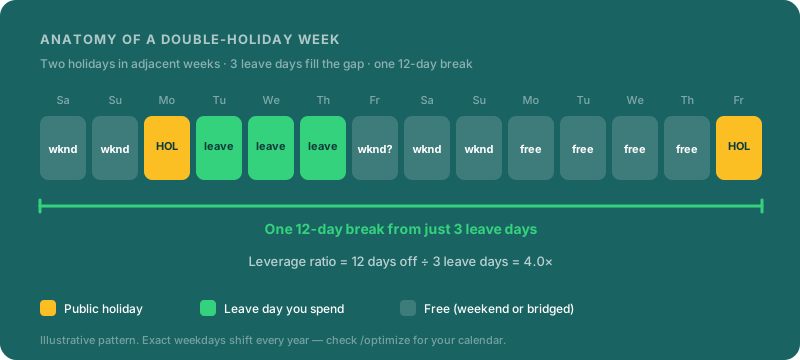
The reason this pattern is so powerful is that you are paying for the gap only. The two holidays are free. The weekends bracketing them are free. So the leave you spend buys the bridge between two anchors that are already fixed — and the total break you get back includes both anchors and all the free days around them.
There are three flavors, and they behave differently:
| Structure | Example | Gap you pay for | Typical result |
|---|---|---|---|
| Fixed-date pair | US Christmas (Dec 25) + New Year (Jan 1) | 1-3 working days | 9-11 days off for 3-4 leave days |
| Holiday cluster | Korea Chuseok / Seollal (3-day block) | 0-2 working days to the nearest weekend | 5-10 days off for 1-3 leave days |
| Stacked holidays | Japan Golden Week (4 holidays in ~7 days) | 1-3 working days inside the run | 7-10 days off for 2-3 leave days |
The gap size is the whole game. A two-working-day gap is a near-free layup. A five-working-day gap means you are essentially just taking a normal week off that happens to be bookended by holidays — the leverage collapses.
The leverage math (and why span matters as much as ratio)
The core metric is the same leverage ratio used for single bridge days:
Leverage ratio = (total consecutive days off) ÷ (leave days you spend)
A normal vacation day scores 1.0×. A single well-placed bridge day around one long weekend can hit 4.0× (spend 1, get a 4-day weekend). Double-holiday weeks are special because they let you sustain a high ratio across a much longer span.
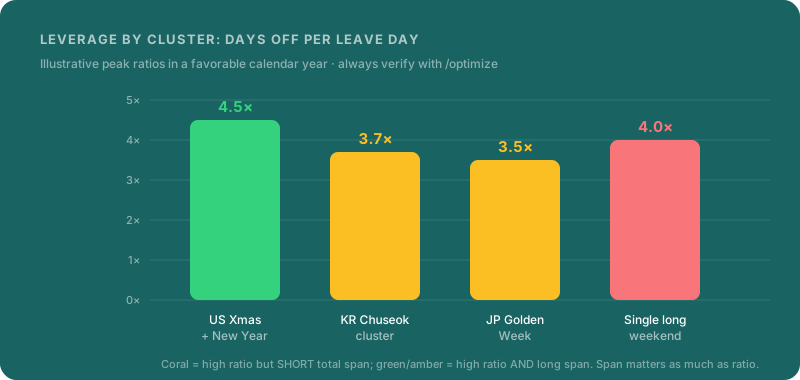
Notice the trap in that chart. A single long weekend can tie a double-holiday week on ratio (4.0×) — but it only ever returns a 4-day break. The double-holiday week returns the same ratio over a 9-to-14-day span. When you are choosing where to spend scarce leave, you want high ratio AND long span, and double-holiday weeks are one of the few structures that give you both.
A useful second metric is the marginal ratio — how much extra you get for each additional leave day once you've committed. In a double-holiday week the first bridge day is almost always the highest-value day you'll spend all year; each subsequent one is worth less. That declining curve is exactly why the "should I bridge or split?" question below has a clean answer.
Ranking real double-holiday windows
Here are the recurring windows worth building a plan around. Weekday placement shifts every year, so these are structural rankings, not date claims — the optimizer resolves the exact days for whatever year you're planning.
| Window | Region | Why it's a double-holiday week | Structural leverage |
|---|---|---|---|
| Christmas + New Year | US / global | Two fixed holidays ~7 days apart; the gap is 3-4 working days | Very high — the flagship |
| Chuseok | Korea | 3-day block; when it abuts a weekend, a substitute holiday extends it | Very high in favorable years |
| Seollal (Lunar New Year) | Korea | Same 3-day structure as Chuseok | Very high in favorable years |
| Golden Week | Japan | Four holidays (Apr 29, May 3-4-5) in ~7 days | High and reliable |
| Silver Week | Japan | Respect-for-the-Aged + Autumnal Equinox with a sandwiched day | High but rare (~every 5-7 years) |
| Good Friday / Easter Monday | UK, much of Europe | Two holidays bracketing a weekend | Moderate — the gap is only the weekend |
Two things drive whether any of these actually pays off in your year:
- Which weekday the anchors fall on. A Tuesday and a Thursday holiday in adjacent weeks is a jackpot; two Wednesdays is merely good. This is the same weekday-placement effect covered in the bridge-day ROI formula.
- Substitute-holiday rules. Korea's system is the most generous: when Seollal, Chuseok, Children's Day, and several others (Buddha's Birthday and Christmas were added in 2023) overlap a weekend, the next non-holiday weekday becomes a paid substitute — which can lengthen a cluster and shrink the gap you have to pay for. (The precise trigger differs by holiday — for Seollal and Chuseok it hinges on a Sunday overlap — so let the optimizer resolve it for your year.) Japan applies a similar Sunday-substitute rule to Golden Week. The US uses only an "in-lieu-of" shift (a Saturday holiday is observed Friday, a Sunday holiday Monday) — it never adds a day.
Worked example: three leave days, one twelve-day break
Take a generic double-holiday week in the shape of the diagram above:
- Holiday A lands on a Monday (Week 1).
- Holiday B lands on a Friday (Week 2, the following week).
- Between them sit the Tuesday–Thursday of Week 1, the weekend, and Monday–Thursday of Week 2.
Now count what's already free before you spend anything: the weekend before Holiday A (Sat–Sun), Holiday A itself (Mon), the weekend between the two weeks (Sat–Sun), and Holiday B (Fri) plus the weekend after it (Sat–Sun). The only working days standing between you and one continuous break are:
- Week 1: Tue, Wed, Thu (3 days)
- Week 2: Mon, Tue, Wed, Thu (4 days)
If you bridge the whole span you'd spend 7 leave days. But you don't have to. The highest-ROI move is often to bridge just one side:
- Spend 3 leave days on Week 1's Tue–Thu.
- Result: Sat, Sun, Mon (HOL), Tue, Wed, Thu + the weekend = one continuous run from the Saturday before Holiday A through the following weekend.
That gives you Saturday through the next Sunday — up to a 9-to-12 day block depending on how the second weekend and Holiday B line up. Three leave days, roughly twelve days off, a 4.0× leverage ratio — and you still have leave in the bank.
Compare that to the naive move: taking the same three days on random weeks across the year. Same three days spent, three days off, 1.0×. The calendar structure did all the work; you just had to place the leave in the right gap.
The exact number of days you net depends entirely on the weekdays in your year and your country's substitute rules. Don't hand-count it — drop your leave balance into the optimizer and let it find the highest-ratio placement.
When to bridge versus split
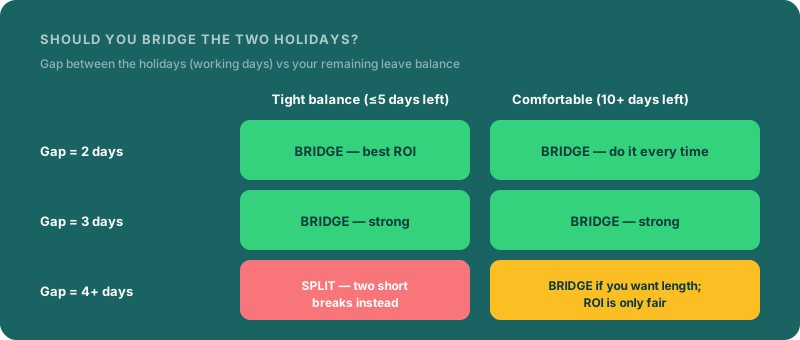
Bridging isn't always right. If the gap between the two holidays is wide, you're spending a full week of leave just to connect them — and you might get more life out of two separate short breaks. Here's the rule:
The logic:
- Gap of 2 working days: always bridge. You're paying almost nothing to connect two anchors — this is the highest-ROI leave you'll spend all year.
- Gap of 3 working days: still bridge in almost every case. A 3-day spend for a 9-to-12 day break is elite leverage.
- Gap of 4+ working days on a tight balance: split. Bridging now costs you nearly a full week of leave, dropping your ratio toward 2×. You'll usually get more total joy from taking each holiday's long weekend separately and banking the difference.
- Gap of 4+ days but you want a long trip and have leave to burn: bridge deliberately, eyes open — you're buying length, not efficiency, and that's a legitimate choice.
One more nuance: stacked-holiday runs like Golden Week change the math because the holidays are inside the run, not just bracketing it. There, even a wide-looking span can be cheap to bridge because you're only paying for the one or two working days the holidays didn't already cover. Always let the tool count the real gap rather than eyeballing the calendar.
Why the payoff differs so much by country
The same structural pattern returns wildly different value depending on where you work, because the raw materials differ: how many public holidays exist, whether substitute days are added, and how much annual leave you start with.
| Country | Statutory paid annual leave | Paid public holidays (approx.) | Substitute-holiday rule |
|---|---|---|---|
| United States | 0 (no federal minimum) | ~11 federal | In-lieu-of only (no day added) |
| South Korea | 15 (after 1 yr; up to 25) | ~15 incl. substitutes | Yes — adds a paid day |
| Japan | 10-20 | ~16 national | Yes — Sunday substitute + sandwiched-day rule |
| Germany | 20 | ~10 (varies by state) | No |
| United Kingdom | 28 (incl. bank holidays) | 8 bank holidays | In-lieu-of only |
Statutory minimums; figures per the sources below. Company policy frequently exceeds these, and public-holiday counts vary by region and year.
Two takeaways. First, substitute-holiday countries (Korea, Japan) are structurally the best at double-holiday weeks because their rules actively lengthen clusters and shrink the gaps you pay for. Second, the US gets extraordinary value from its one flagship window (Christmas–New Year) precisely because it's leave-poor — with 0 statutory days, every leveraged leave day matters more. The worker with the least leave has the most to gain from placing it well.
Frequently asked questions
How is a "double-holiday week" different from a normal bridge day?
A bridge day connects one holiday to the nearest weekend. A double-holiday week connects two holidays to each other, so the free anchors on both ends — plus both bracketing weekends — are baked into the break before you spend a single leave day. That's why the span is so much longer for a similar leverage ratio. The single-holiday version is covered in How Holiday Bridges Work.
Which countries have the best double-holiday weeks?
Structurally, Korea and Japan, because both add paid substitute holidays that lengthen holiday clusters. Korea's Chuseok and Seollal are each 3-day blocks that a substitute day can push against a weekend; Japan's Golden Week stacks four holidays in about a week with a sandwiched-day rule. The US Christmas–New Year window is the standout single case in a country with otherwise minimal statutory leave. Exact value depends on the year's weekday alignment — the optimizer ranks them for your specific calendar.
Should I always bridge two nearby holidays?
No. Bridge when the gap is 2-3 working days — that's elite leverage. When the gap is 4 or more working days and your balance is tight, you're spending nearly a full week just to connect them, and two separate long weekends often deliver more total time off across the year. Use the decision matrix above, and let the tool compute the real gap after substitute holidays are applied.
Do lunar-calendar holidays change this every year?
Yes — significantly. Korea's Chuseok and Seollal follow the lunar calendar, so they shift by roughly two to three weeks year over year and can land on very different weekdays. That means a Chuseok that yields a 10-day break one year might yield only 5 the next. This volatility is exactly why you should never hard-code these dates from memory; check the current year in the leave optimizer.
Sources
- List of minimum annual leave by country — Wikipedia — statutory paid leave and public-holiday counts by country (Germany 20+10, France 25+11, Austria 25+13, US 0).
- Labor Standards Act (official English) — Korea Legislation Research Institute — Article 60 annual paid leave: 15 days after one qualifying year, +1 day per 2 years up to 25; 1 day per completed month in the first year.
- Federal Holidays — U.S. Office of Personnel Management — the 11 US federal holidays and the "in-lieu-of" weekend-observance rule.
- Public Holidays in Korea — Nowak & Partner — Seollal and Chuseok 3-day structure and the substitute-holiday (대체공휴일) rule.
- Golden Week (Japan) — Wikipedia — the four Golden Week holidays, the sandwiched-weekday rule, Sunday-substitute rule, and Silver Week alignment.
- Statutory minimum paid leave and public holidays — Statista — cross-country comparison confirming the US at 0 statutory paid leave.
Next Step
See your own best PTO windows
The article gives you the strategy. The optimizer gives you the exact dates for your year and your PTO balance.
Find my windowsGet the calendar and return when you are ready
Related topics
Useful tools
Related Articles
The Bridge-Day ROI Formula, Explained: How to Measure Days-Off-Per-Leave-Day
A data-driven breakdown of bridge-day ROI: the days-off-per-leave-day formula, why Tuesday and Thursday holidays outperform Mondays, and how to rank every leave day you own. Worked examples for the US, Korea, and Europe.
The Holiday Leverage Ratio: How Much Time Off Each Weekday Buys You
A data-driven look at the holiday leverage ratio -- how many days off each paid leave day buys you, ranked by the weekday a public holiday lands on. Includes a Korea vs. US comparison, a worked 15-day PTO example, and the exact bridge math.
The Best Bridge Years, Ranked: 2027–2030 for Squeezing Days Off (US + Korea)
A data-driven ranking of 2027, 2028, 2029, and 2030 by how much time off you can build from a fixed pool of paid leave. We score each year on weekday alignment, weekend-loss, and bridge-day leverage for the US federal calendar and South Korea's holiday system.